

Alternatives to Drata: How ResponseHub Compares for Questionnaire Automation
Buy Drata if you need full compliance automation with questionnaire answering bundled in. Buy ResponseHub if questionnaire and RFP automation is the actual problem you're solving — it starts at $124/month with unlimited usage, cited AI answers, and a self-serve free trial with no sales call.
Drata is a serious compliance automation platform, and after its $250M acquisition of SafeBase in 2025 it also entered the questionnaire answering space. So the question isn't whether Drata is a good product — it's whether you need an enterprise GRC suite just to answer security questionnaires. This page compares the two head-to-head on pricing, AI quality, format support, and team fit so you can make a clear call.
By Neil Cameron

Buy Drata if you need full compliance automation (SOC 2, ISO 27001, continuous monitoring) and want questionnaire answering bundled in. Buy ResponseHub if questionnaire and RFP automation is the actual problem you're solving: it starts at $124/month with unlimited usage, cited AI answers, and a self-serve free trial with no sales call required.
It's a scalpel versus a Swiss Army knife: one tool engineered entirely around one problem, the other a platform that absorbed it through acquisition. The right instrument depends on what you're trying to cut.
See also: The 5 Best Drata Alternatives in 2026
Which one is right for you?
Choose ResponseHub if…
- Questionnaire and RFP volume is your actual bottleneck — you need a tool built around that workflow, not a feature inside a suite.
- You want transparent pricing ($124/month, unlimited usage) and a 7-day self-serve free trial — no sales call, no quote process.
- You need every AI answer cited to the exact policy, page, section, and sentence, with per-answer confidence scores.
Choose Drata if…
- You need full compliance automation: continuous monitoring, evidence collection, and control mapping across SOC 2, ISO 27001, HIPAA, and PCI DSS.
- You already run Drata and want the SafeBase-powered questionnaire features bundled into the platform you pay for.
- You want a trust center that shares your compliance posture with buyers before they send a questionnaire.
ResponseHub
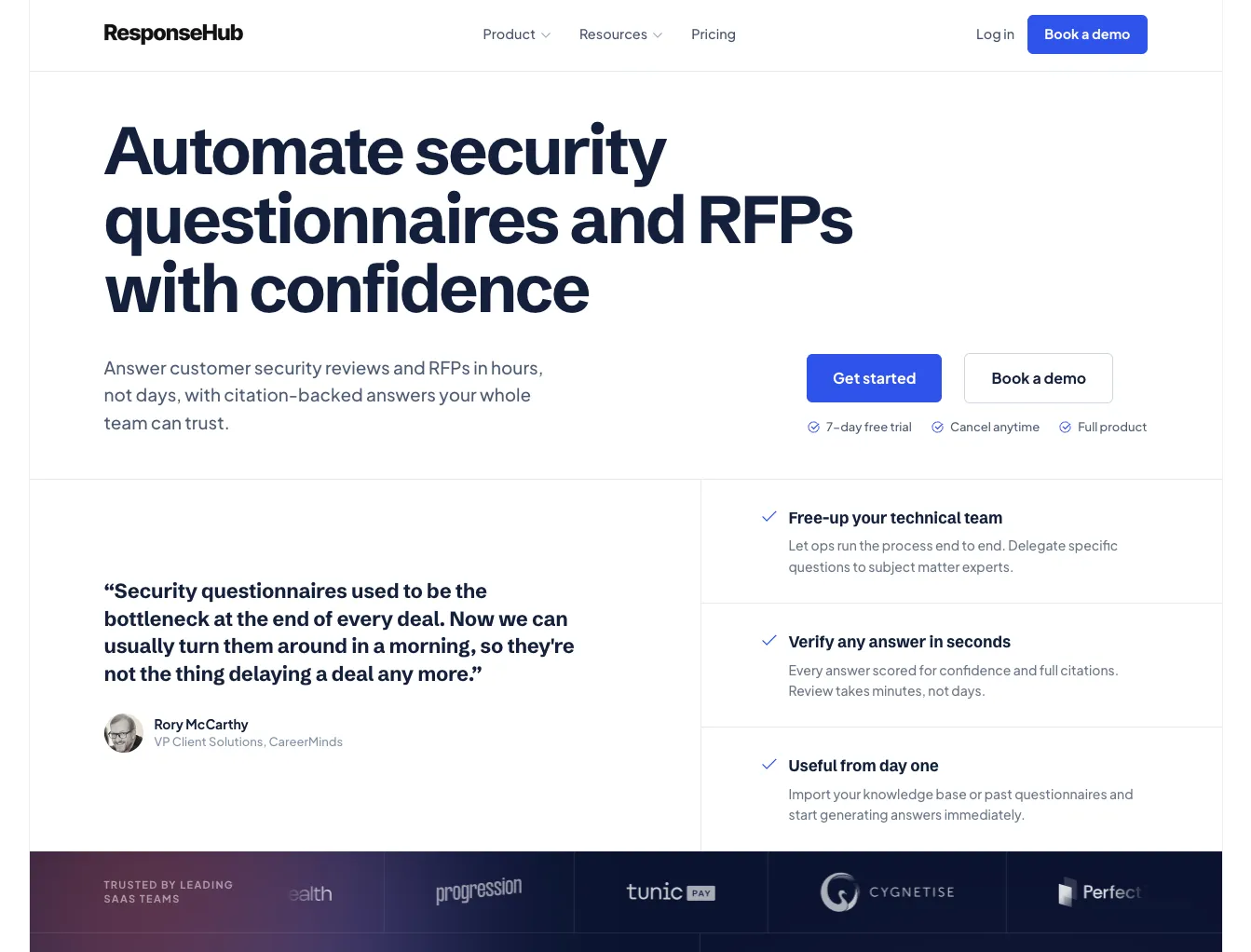
Questionnaire automationResponseHub is a dedicated questionnaire automation tool. It handles security questionnaires, RFPs, and DDQs (due diligence questionnaires). You upload your policies as PDFs, import your existing answer library and past questionnaires, and the AI drafts answers grounded in your actual documentation, with citations to the exact policy, page, section, and sentence. Every answer comes with a confidence score so your team knows exactly where to focus human review.
Drata
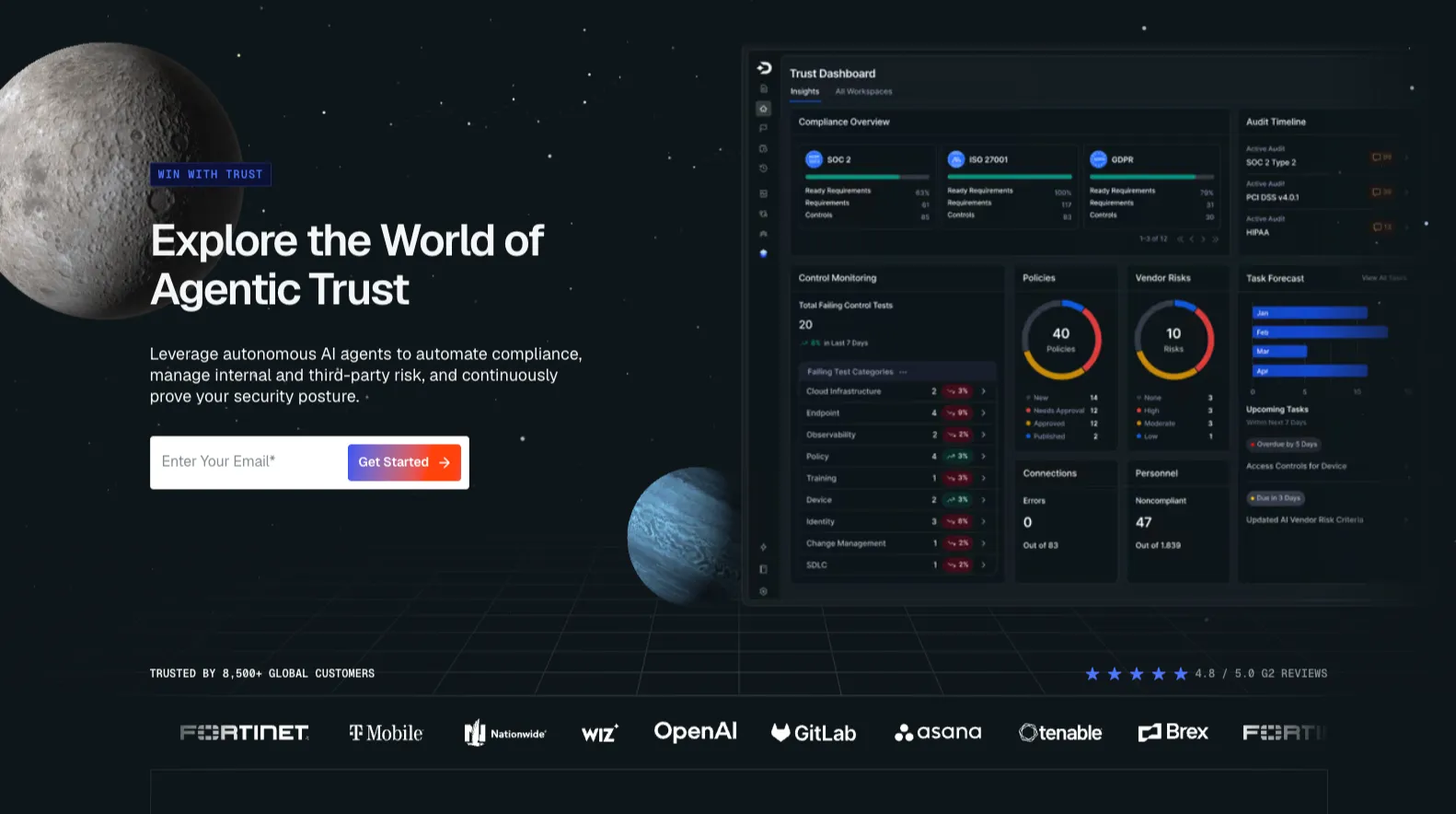
Compliance / GRCDrata is a compliance automation platform built for continuous monitoring against frameworks like SOC 2, ISO 27001, HIPAA, and PCI DSS. It automates evidence collection, maps controls, and tracks compliance posture across your stack. With the 2025 SafeBase acquisition, Drata added trust centers and AI-powered questionnaire answering to its platform. Questionnaire automation is not a standalone product; it's part of the broader GRC suite.
At a glance
| Comparison point | ResponseHub | Drata |
|---|---|---|
| Published pricing | Starter $124/mo, Business $332/mo | Quote-only (sales-led) |
| Usage limits | Unlimited — no credits or fees | Not publicly documented |
| Ideal team size | Any size, startups to large enterprises | Mid-market to enterprise |
| AI citations | Policy, page, section, sentence + confidence scores | Via SafeBase; citation detail not documented |
| Questionnaire formats | xlsx, docx, online portals (Chrome extension) | Not publicly documented |
| Round-trip export | Yes — back to original xlsx/docx | Not publicly documented |
| Free trial | 7-day, fully self-serve | Not publicly available |
| Data residency / AI training | EU-hosted, zero AI data retention, never trained on | Not publicly documented |
| Best fit | Questionnaire and RFP automation as the primary tool | Full compliance automation, questionnaires bundled |
Competitor pricing and limits as reported publicly, last verified August 2026.
How they compare, dimension by dimension
Pricing and transparency
ResponseHub publishes pricing on its website. Starter is $124/month with 2 Editor seats. Business is $332/month. Every plan includes unlimited usage: no credits, no per-questionnaire fees. Viewer seats are free and unlimited. You can start a 7-day free trial without talking to anyone.
Drata does not publish pricing. You have to book a sales call to get a quote, and third-party estimates put median annual contracts around $25,000. G2 reviews from the past year frequently mention steep renewal price increases as a pain point, with some users reporting significant jumps after the first contract term. That $25,000 figure also buys the full compliance automation platform; there is no publicly available option to purchase just the questionnaire features at a lower price point.
AI answer quality and citations
Both tools use AI to generate questionnaire answers, but the approach and transparency differ.
ResponseHub uses a RAG pipeline (retrieval-augmented generation, meaning the AI retrieves information from your actual documents before answering, rather than relying on generic training data). Every answer cites the exact policy name, page, section, and sentence it drew from. Each answer also gets a confidence score, so your team can skip high-confidence answers during review and spend time where it matters. The knowledge base is self-improving: every completed questionnaire feeds future answers, and built-in deduplication flags duplicate or stale entries.
Drata's questionnaire AI came through the SafeBase acquisition. SafeBase's trust center AI can auto-fill answers, though the specifics of its citation model (whether it cites exact pages and sentences versus general source documents) are not publicly documented in detail.
Product focus and scope
ResponseHub does one thing: questionnaire automation. Security questionnaires, RFPs, DDQs. That focus means the product is designed around the specific workflow of receiving a questionnaire, generating AI answers from your policies, reviewing and approving those answers, and exporting them back in the buyer's format. If questionnaire volume is your actual bottleneck, a purpose-built tool will generally outperform a feature inside a suite.
Drata is a full GRC platform. If you need continuous compliance monitoring, automated evidence collection, control mapping across SOC 2, ISO 27001, HIPAA, PCI DSS, and similar frameworks, Drata covers all of that. Questionnaire automation was added through acquisition, which means it benefits from the broader compliance data Drata already holds, but it's still one feature inside a much larger product.
Format handling and export
Security questionnaires arrive in every format imaginable. Messy spreadsheets with missing headers. Word documents with inconsistent formatting. Portal-based questionnaires that can't be downloaded.
ResponseHub accepts Excel (xlsx), Word (docx), and extracts questions directly from online security portals using its Chrome extension. Its extraction engine handles real-world mess: multiple choice options, not-applicable questions, missing column headers, and unfamiliar layouts. Finished answers export back into the original file format, preserving the buyer's formatting. No copy-pasting between tools.
Drata's SafeBase integration supports trust center workflows, but specific details on questionnaire import formats and round-trip export capabilities are not publicly documented.
Setup and onboarding
ResponseHub is self-serve from start to finish. Sign up, drag and drop your policy PDFs, import your existing answer library or old completed questionnaires, and start answering. The whole setup takes under 5 minutes. No sales call, no implementation project, no waiting for an onboarding specialist.
Drata is a sales-led product. The buying process involves a demo, scoping, and contract negotiation. Implementation for the full compliance platform typically includes integration setup with your cloud providers, HR systems, and other tools, which is valuable if you need that, but a significant time investment if all you want is to answer questionnaires faster.
What teams say about ResponseHub
We weren't sure it would actually save time, or if we'd still have to check each response individually. But reviewing is fast. The citations point to the exact supporting text every time, we're not searching a whole policy.

Pros and cons
ResponseHub
- Purpose-built for questionnaires. The entire product exists to solve one problem, which means no wasted features and a workflow built around how teams actually handle questionnaires.
- Transparent, affordable pricing. Starts at $124/month with unlimited usage. No credits, no per-questionnaire fees.
- Cited AI answers. Every answer references the exact policy, page, section, and sentence, with confidence scores that reduce review time.
- Self-improving knowledge base. Each completed questionnaire trains the next one, and deduplication keeps the knowledge base clean.
- Self-serve onboarding. 7-day free trial, set up in under 5 minutes, no sales call.
- MSSP support. Dedicated multi-client accounts for MSSPs and vCISOs.
- Not a compliance automation platform. No continuous monitoring, no evidence collection, no control mapping. If you need those, you still need a GRC tool.
- Smaller brand footprint. Less established than Drata in the broader compliance market.
- No named integrations. Does not plug into your cloud or HR stack the way a full GRC platform does.
Drata
- Comprehensive compliance automation. Covers SOC 2, ISO 27001, HIPAA, PCI DSS, and more with continuous monitoring, evidence collection, and control mapping in a single platform.
- Trust center via SafeBase. The SafeBase acquisition added proactive security trust centers that let you share your compliance posture with buyers before they even send a questionnaire.
- Deep integration ecosystem. Connects to cloud providers, HR systems, identity providers, and development tools to automate evidence gathering.
- Established market presence. Large customer base and strong brand recognition in the GRC space.
- No public pricing. Requires a sales conversation to get a quote, and third-party estimates suggest median contracts around $25,000/year.
- Renewal price increases. G2 reviewers frequently cite significant price jumps at renewal as a frustration.
- Questionnaire automation is not the core product. It was added through acquisition; teams that only need questionnaire answering are paying for a lot of platform they won't use.
- No self-serve trial. You can't test the product before committing to a contract.
- MSSP limitation. Each client needs their own Drata subscription, making it impractical for MSSPs or vCISOs who manage questionnaires on behalf of multiple clients.
What it costs
ResponseHub publishes its pricing: $124/month for Starter (2 Editor seats) or $332/month for Business, with unlimited usage on every plan and a 7-day self-serve free trial. Drata is quote-only, with third-party estimates putting median annual contracts around $25,000 — and there is no publicly available option to buy just the questionnaire features at a lower price point.
See full pricingSwitching from Drata?
- Keep Drata for compliance monitoring if you need it — you can run ResponseHub alongside it for questionnaires.
- Import your existing answer library and old completed questionnaires to seed the knowledge base.
- Drag and drop your policy documents as PDFs.
- Most teams are up and running within 5 minutes — fully self-serve, no sales call.
- 7-day free trial, so you can test it on a real questionnaire before you commit.
Which should you pick?
Our honest recommendation by situation.
If your organization already runs on Drata for SOC 2, ISO 27001, or other framework compliance, adding the SafeBase-powered questionnaire features keeps everything in one platform. You're already paying for the suite, so using its questionnaire capabilities avoids adding another vendor.
If your primary problem is getting audit-ready (continuous monitoring, evidence collection, control mapping) and questionnaires are a secondary concern, Drata covers both needs. The questionnaire features may not be as specialized, but you get them bundled with the compliance infrastructure you actually need.
If your team handles a growing volume of security questionnaires and RFPs, and your main goal is to stop losing days to manual answers, ResponseHub gives you automated, cited answers starting at $124/month. No sales call, no six-figure contract, no compliance platform you won't use. Start a free trial and see results the same day.
Drata's questionnaire tooling is tied to each client's own platform subscription, which means an MSSP can't simply buy Drata and operate it across client accounts. ResponseHub has a dedicated MSSP version with multiple separate client accounts under one relationship. Each client's data stays isolated, and your team manages everything from a single relationship. The economics work in your favor: same team, more clients, without requiring each client to buy their own subscription.
When a $50k deal is stuck because the buyer sent a 200-question security questionnaire and nobody has time to fill it out, you don't need a $25,000/year compliance platform. You need answers fast. ResponseHub's self-serve trial means you can be answering that questionnaire within 5 minutes of signing up, with AI answers grounded in your actual policies.
For most teams whose core problem is questionnaire volume, ResponseHub is the better fit. It's purpose-built for the job, priced transparently at $124/month, and gives you cited AI answers with confidence scores so you know exactly where to trust the AI and where to review.
Drata is a strong choice if you need full compliance automation and want questionnaire capabilities inside that ecosystem, but paying enterprise GRC prices just to answer questionnaires is a hard trade-off to justify. If questionnaires are the bottleneck, start a ResponseHub free trial: no sales call needed, completely self-serve, and you'll be set up in under 5 minutes.
Frequently asked questions
Does Drata have a free trial for questionnaire automation?
Drata does not offer a publicly available free trial. The platform is sales-led, so you need to book a demo and go through a quoting process before you can access the product. ResponseHub offers a 7-day free trial that is fully self-serve with no sales call required.
Can I use Drata just for questionnaire automation without buying the full platform?
As of August 2026, Drata does not offer a standalone questionnaire-only product at a lower price point. The questionnaire AI (from the SafeBase acquisition) is part of the broader GRC platform, which means you're buying the full suite. If questionnaires are your only need, a dedicated tool like ResponseHub will be significantly more cost-effective.
Can I migrate from Drata to ResponseHub for questionnaire answering?
Yes. ResponseHub lets you import your existing answer library and old completed questionnaires to seed the knowledge base. You can also drag and drop your policy documents as PDFs. Most teams are up and running within 5 minutes. If you keep Drata for compliance monitoring, you can run ResponseHub alongside it for questionnaires.
Is Drata worth it for a 20-person startup?
If you need SOC 2 or ISO 27001 readiness and are willing to invest in a full compliance platform, Drata can be valuable even for smaller companies, though the cost may be significant relative to your budget. If your main pain is answering security questionnaires that are blocking deals, ResponseHub solves that specific problem starting at $124/month without the overhead of a full GRC deployment.
Get Started
Get started in under 5 minutes with our self-serve trial or contact us for a demo
- 7-day free trial
- Cancel anytime
- Full product