

Alternatives to Loopio: ResponseHub vs Loopio for Security Questionnaires
If your team's primary workload is security questionnaires and you want transparent pricing ($124/month) with self-serve setup, go with ResponseHub. If you run a large proposal team answering RFPs, RFIs, and security reviews at enterprise scale and need deep CRM integrations, Loopio is the stronger fit.
Here's the short reason why: Loopio is an established enterprise RFP response platform where security reviews are one use case among many. ResponseHub is purpose-built for security questionnaires, DDQs, and RFPs, with AI answers grounded in your actual policies and cited down to the page and sentence. The rest of this page breaks down how the two actually compare.
By Neil Cameron

Picture a magnifying glass over a security questionnaire: Loopio tries to see everything at once across every proposal type, while ResponseHub focuses its lens precisely on the security review in front of you.
This page covers pricing, AI quality, format handling, and setup so you can make a fast, informed call.
Which one is right for you?
Choose ResponseHub if…
- Security questionnaires and DDQs are most of your workload and you want a tool built for exactly that.
- You want transparent pricing — $124/month with unlimited usage — instead of a sales-led contract estimated around $20,000/year.
- You need per-answer citations and confidence scores so reviewers can verify AI answers at a glance.
- EU data residency and zero AI data retention matter to your compliance story.
Choose Loopio if…
- You run an enterprise proposal team answering a broad mix of RFPs, RFIs, and security reviews.
- You need a mature content library with approval workflows, tagging, and expiration reminders.
- Your workflow depends on native Salesforce, Slack, or Microsoft Teams integrations.
ResponseHub
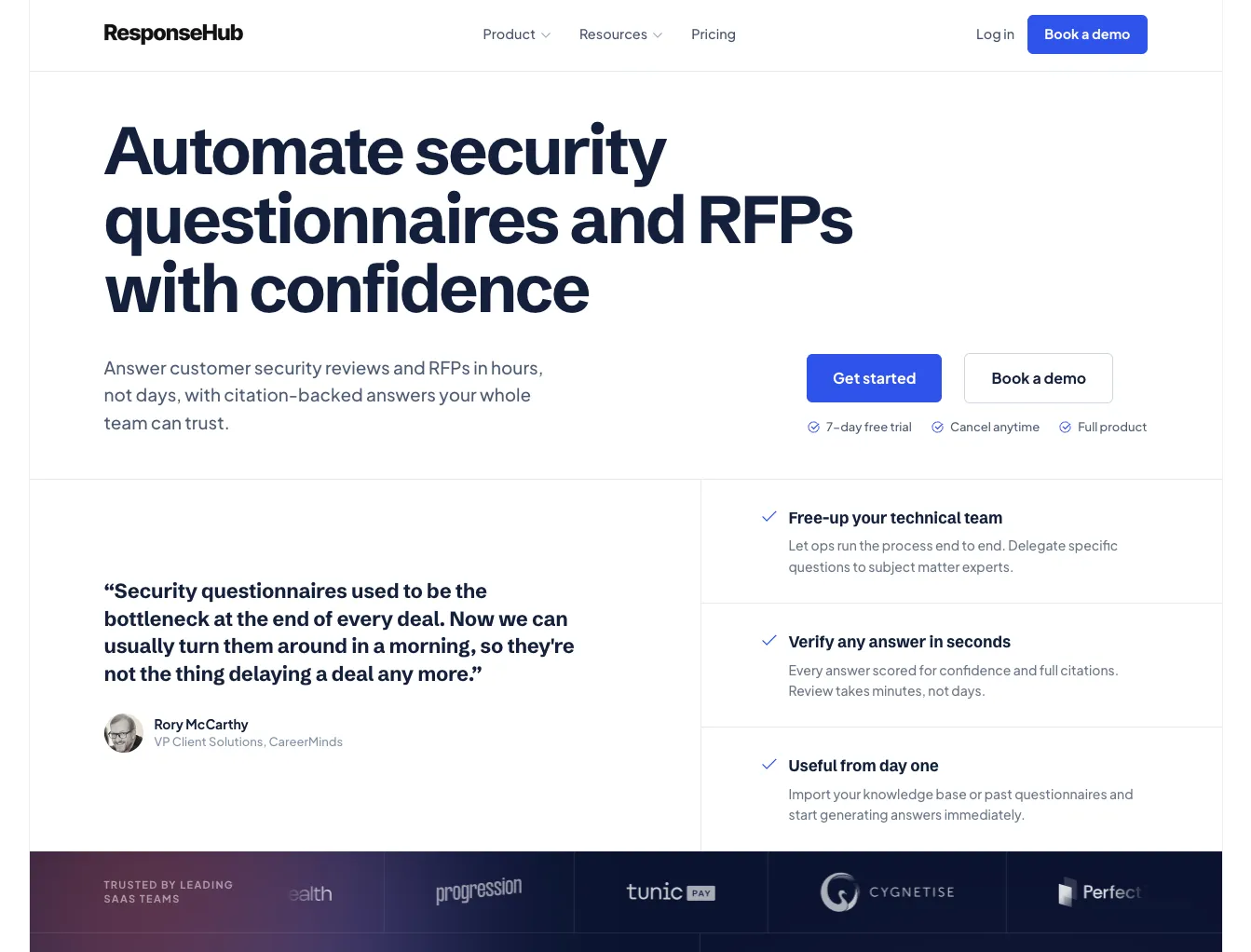
Questionnaire automationResponseHub is a focused security questionnaire automation tool. You upload your policies as PDFs, import your existing answer library and old completed questionnaires, and the AI drafts answers grounded in that material, with citations to the exact policy, page, section, and sentence. Per-answer confidence scores tell your reviewers where to spend their time. It handles Excel, Word, and online security portals (via Chrome extension), and exports answers back into the buyer's original format.
Loopio
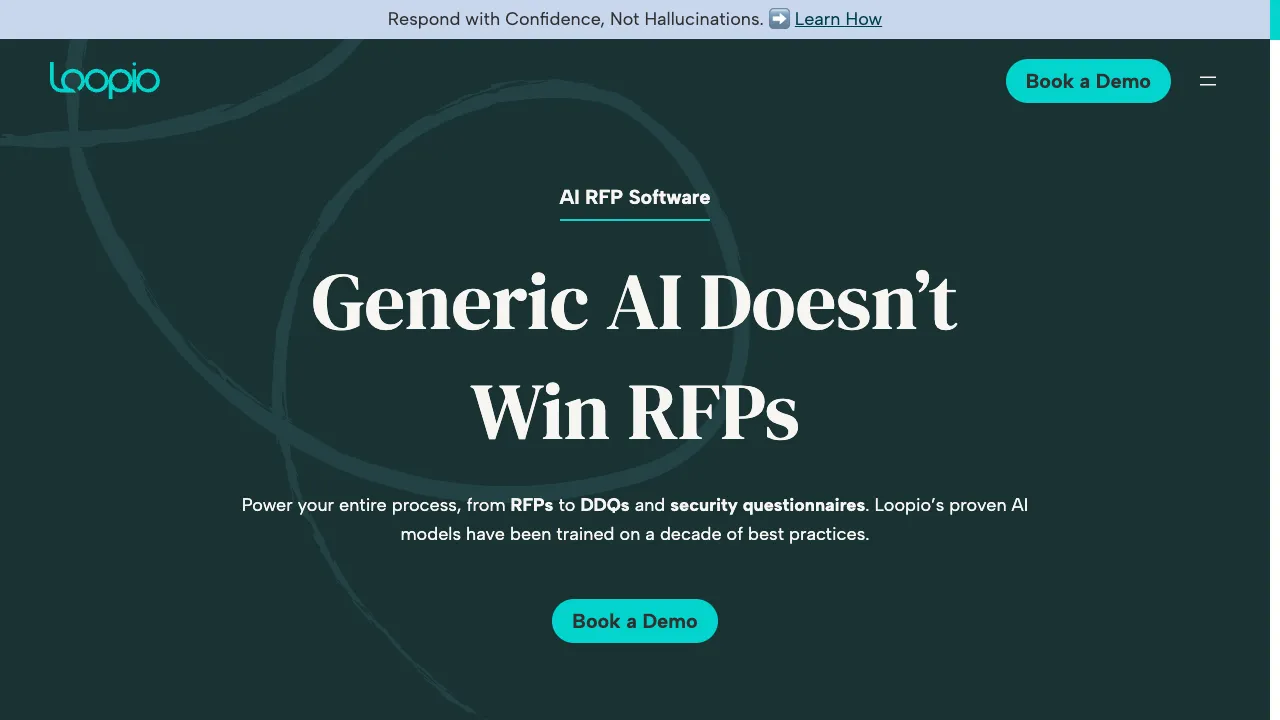
RFP response managementLoopio is an enterprise RFP response management platform built for proposal teams. It covers RFPs, RFIs, DDQs, and security questionnaires under one roof, with a central content library, project management workflows, and integrations with tools like Salesforce, Slack, and Microsoft Teams. Its "Magic" AI autofill feature pulls answers from your library to populate responses.
At a glance
| Comparison point | ResponseHub | Loopio |
|---|---|---|
| Published pricing | Starter $124/mo, Business $332/mo | Not published — demo required |
| Usage limits | Unlimited — no credits or fees | Seat-based; limits not documented |
| Ideal team size | 1 to 20+ (scales via Editor seats) | 10+ (enterprise proposal teams) |
| AI citations | Exact source + confidence score | Library autofill; no per-answer citations |
| Supported formats | xlsx, docx, portals via Chrome extension | Excel, Word, PDF; portal integrations |
| Round-trip export | Yes — preserves buyer formatting | Yes — exports to original format |
| Free trial | 7-day, fully self-serve | Not publicly available |
| Data residency / AI training | EU-hosted, zero AI data retention | SOC 2 Type II; details on request |
Competitor pricing and limits as published or estimated by third-party sources, August 2026.
How they compare, dimension by dimension
Pricing and transparency
ResponseHub publishes its pricing on its website. $124/month for Starter (2 Editor seats), $332/month for Business. Every plan includes unlimited usage: no credits, no per-questionnaire fees. You pay for Editor seats; Viewer seats are free and unlimited.
Loopio does not publish pricing. You have to book a demo, talk to sales, and negotiate. Third-party sources estimate entry-level contracts start around $20,000 per year, though exact figures are hard to pin down because they depend on seat count, onboarding packages, and add-ons. If you're a smaller team or you simply want to try the product before committing budget, that gated process is a real barrier.
ResponseHub offers a 7-day free trial with no sales call required: set up in under 5 minutes, start answering questionnaires immediately.
AI answer quality and citations
ResponseHub's AI is grounded in your uploaded policies and completed questionnaires. Every generated answer cites the exact source: policy name, page, section, and sentence. Each answer also carries a confidence score, so your reviewers know exactly which answers need human attention and which are solid. The knowledge base is self-improving: every completed questionnaire feeds future responses, with built-in deduplication catching duplicate and stale answers.
Loopio's "Magic" autofill pulls from your content library to pre-populate answers. When the library is well-maintained, it works. But G2 and Capterra reviews consistently note that Magic's accuracy degrades when the library isn't actively curated. There are no per-answer citations to a source document, and no published confidence scoring mechanism. For security questionnaires, where an inaccurate answer can derail a deal or misrepresent your security posture, that gap matters.
Knowledge base and library management
Both tools rely on a central knowledge base, but they approach it differently.
ResponseHub lets you seed your knowledge base by importing your existing answer library, old completed questionnaires, and PDF policy documents via drag and drop. From there, the system auto-improves: each questionnaire you complete adds to the knowledge base. Deduplication flags stale or conflicting entries. The knowledge base exports to CSV.
Loopio has a mature content library with approval workflows, tagging, and expiration reminders. For large teams with dozens of subject-matter experts contributing content across hundreds of RFP categories, Loopio's library management features are genuinely deeper. The tradeoff is effort: multiple reviewers report that keeping the library current takes significant ongoing work, and the AI's usefulness is directly tied to that maintenance.
Format handling and export
Security questionnaires show up in messy Excel spreadsheets, Word docs with inconsistent tables, and increasingly in online security portals.
ResponseHub handles all three: xlsx, docx, and portal-based questionnaires via its Chrome extension. Its extraction engine deals with the real-world mess of multiple-choice options, not-applicable questions, and missing column headers. Answers export back into the buyer's original file format, preserving their formatting.
Loopio supports Excel, Word, and PDF import, and integrates with several portals. If you're responding to RFPs that arrive in diverse formats beyond security questionnaires, Loopio's broader format support is an advantage.
Data residency and security posture
ResponseHub is hosted on DigitalOcean (EU region), with AI processing via AWS Bedrock in EU regions under zero data retention. Customer data is never used for model training. GDPR compliant with a DPA available on request. MFA, role-based permissions, audit logging, and an annual penetration test (report available) round out the security story.
Loopio holds SOC 2 Type II certification and provides security documentation on request. Specific hosting regions and AI data handling policies are not prominently published on their website.
For compliance and security managers who need to justify a vendor's data practices to their own customers, ResponseHub's upfront transparency makes that conversation simpler.
What teams say about ResponseHub
We worried setup would create more work before it saved any. Then we imported our previous questionnaires and were generating answers almost immediately.
Pros and cons
ResponseHub
- Transparent, affordable pricing. $124/month to start, unlimited usage, no surprise invoices.
- Cited AI answers. Every answer references the exact policy, page, section, and sentence, so reviewers can verify fast.
- Self-improving knowledge base. Each completed questionnaire automatically strengthens future responses, with deduplication catching stale entries.
- Self-serve setup. 7-day free trial, no sales call, productive in under 5 minutes.
- EU data residency with zero AI data retention. Strong story for privacy-conscious teams.
- Narrower scope. ResponseHub focuses on security questionnaires, DDQs, and RFPs. It's not a full proposal management suite with CRM integrations or project workflows.
- Smaller ecosystem. No native Salesforce or Slack integrations. Teams that rely on tight CRM connectivity will feel that gap.
- Younger product. Loopio has years of enterprise feature development behind it. ResponseHub's feature set is focused but less extensive.
Loopio
- Broad RFP coverage. Handles RFPs, RFIs, DDQs, security questionnaires, and more under one platform.
- Mature content library. Approval workflows, tagging, expiration reminders, and multi-contributor support are well-developed.
- Enterprise integrations. Native connections to Salesforce, Slack, Microsoft Teams, and other tools proposal teams rely on.
- Established track record. Large customer base and years of iteration on enterprise needs.
- No published pricing. You have to go through a demo and sales process to learn what it costs. Third-party estimates suggest a much higher entry point than ResponseHub.
- Library maintenance burden. Multiple reviewers note that Magic autofill quality drops sharply if the library isn't constantly curated.
- No per-answer citations or confidence scores. Harder to verify AI-generated answers at a glance, which is a real concern for security-sensitive responses.
- No self-serve trial. You can't try Loopio before committing time and budget to a sales conversation.
What it costs
ResponseHub is transparently priced at $124/month (Starter, 2 Editor seats) or $332/month (Business), both with unlimited usage and unlimited Viewer seats. Loopio does not publish pricing — third-party estimates place entry-level contracts around $20,000/year, with onboarding add-ons and additional seats increasing the cost, and access gated behind a demo and sales conversation.
See full pricingSwitching from Loopio?
- Export your Loopio content library and use it to populate ResponseHub — import your existing answer library to seed the knowledge base.
- Import old completed questionnaires so your historical answers carry over.
- Drag and drop your policy documents as PDFs and the AI drafts cited answers from them.
- Self-serve setup in under 5 minutes — no sales call, no procurement cycle.
- 7-day free trial, so you can test it on a real questionnaire before committing.
Which should you pick?
Our honest recommendation by situation.
If security questionnaires and DDQs are most of your workload, ResponseHub's focused tooling, cited AI answers, and self-improving knowledge base will get you moving fast. You don't need a full proposal management suite, and you'll save thousands of dollars per year compared to Loopio's entry-level pricing.
If your team responds to a wide variety of proposal types, not just security questionnaires, and you need project management, approval workflows, and Salesforce integration, Loopio's broader platform is a better fit. The higher price and sales-led buying process are standard for this segment.
If your existing workflow is tightly integrated with Salesforce or Microsoft Teams and you need those native connections, Loopio supports them today. Ripping out a working integration stack to save on licensing rarely pays off.
ResponseHub has a dedicated MSSP version with multiple separate client accounts under one relationship. You manage everything from one place while keeping client data isolated. Loopio is designed for single-organization use; it doesn't offer a comparable multi-tenant MSSP model. Compliance platforms like Vanta and Drata tie their questionnaire features to the client's own subscription, so an MSSP can't operate them independently. ResponseHub solves this directly.
At $124/month with a 7-day free trial, you can start answering questionnaires today without a procurement process. Upload your SOC 2 report and existing policies, and the AI drafts grounded answers immediately. For a team this size, Loopio's sales cycle and estimated price point are overkill.
For teams whose core problem is security questionnaires, ResponseHub is the better tool. It's focused, transparently priced, and built so you can be productive in minutes, not months. Cited AI answers, per-answer confidence scores, and a self-improving knowledge base mean your team spends less time reviewing and more time closing deals or shipping product.
Loopio is a strong platform for enterprise proposal teams with broad RFP needs and deep CRM requirements, and we've recommended it clearly for those scenarios. But if security questionnaires are the drain on your week, ResponseHub is purpose-built for that work. Start a 7-day free trial: no sales call needed, completely self-serve, set up in under 5 minutes.
Frequently asked questions
Does Loopio have a free trial?
Loopio does not offer a publicly available free trial. You need to request a demo and go through a sales conversation to access the platform. ResponseHub offers a 7-day free trial that's fully self-serve with no sales call required.
Can I migrate from Loopio to ResponseHub?
Yes. ResponseHub lets you import your existing answer library and old completed questionnaires to seed your knowledge base. If you export your Loopio content library, you can use that material to populate ResponseHub and be up and running quickly.
Is Loopio worth it for a small team focused on security questionnaires?
For most small teams, Loopio's pricing (estimated around $20,000/year based on third-party sources) and sales-led process are a significant commitment. If security questionnaires are your primary workload, ResponseHub starts at $124/month with unlimited usage and is designed for exactly that use case.
How does ResponseHub's AI compare to Loopio's Magic autofill?
ResponseHub's AI generates answers grounded in your uploaded policies and cites the exact source: policy name, page, section, and sentence. Each answer has a confidence score. Loopio's Magic pulls from your content library without per-answer source citations, and reviewers frequently report that accuracy depends heavily on how well-maintained the library is.
Get Started
Get started in under 5 minutes with our self-serve trial or contact us for a demo
- 7-day free trial
- Cancel anytime
- Full product