· Jane Iamias · sample proposals projects · 17 min read
7 Actionable Sample Proposals Projects to Win Deals in 2025
Discover 7 expert-backed sample proposals projects with templates for B2B SaaS, security, and RFPs. Get actionable tips to win your next big project.
Crafting a compelling project proposal is the critical first step towards transforming a great idea into a funded, approved, and successful initiative. Yet, starting with a blank page can be daunting, often leading to missed opportunities and stalled progress. This guide eliminates that uncertainty by providing a curated collection of high-quality sample proposals projects designed for a variety of industries and objectives. We move beyond generic templates to offer a detailed breakdown of what makes each example effective, from B2B SaaS pitches to complex RFP responses.
Each sample is accompanied by a strategic analysis, highlighting the specific tactics used to persuade stakeholders, define scope, and secure buy-in. You will learn not just what to include, but why specific elements work and how to adapt them for your unique needs. We’ll also cover key editable sections and offer practical tips for incorporating robust security and compliance details, which are often the deciding factor in enterprise deals. To effectively win these deals, proposals must also address potential challenges and outline mitigation strategies; understanding and Mastering Software Project Risk Management is a critical part of this blueprint for success. This resource is your blueprint for building proposals that don’t just get read-they get signed.
1. Software Development Project Proposal
A Software Development Project Proposal is the foundational document for any custom software initiative, from mobile apps to complex enterprise systems. It serves as a comprehensive blueprint that aligns technical teams and business stakeholders, detailing the project’s scope, objectives, methodology, and resource allocation. This proposal is critical for securing budget approval and ensuring everyone shares a unified vision from the outset.
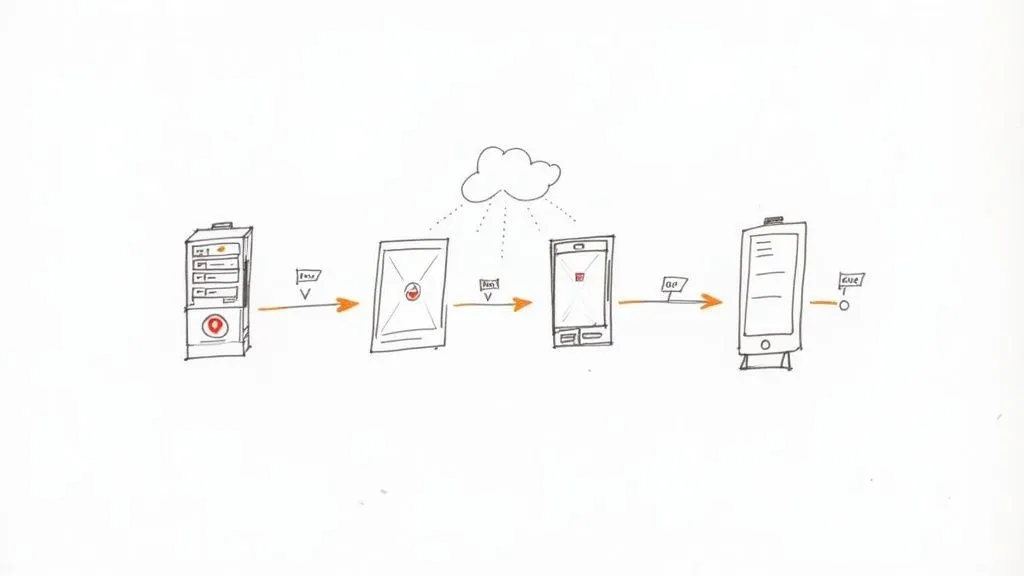
This type of proposal translates a business need into a tangible development plan. It forces teams to think critically about architecture, potential challenges, and success metrics before a single line of code is written. For a deeper dive into specifying project needs, explore our guide on mastering the business requirements document.
Strategic Breakdown and Application
This proposal is essential when pitching a significant tech investment that requires cross-departmental buy-in. It’s not just a technical document; it’s a strategic tool for persuasion and planning.
- When to Use: Ideal for new product development, major feature additions, or infrastructure overhauls. Use it to gain approval from leadership, secure funding, or align multiple engineering teams.
- Key Sections:
- Executive Summary: A concise overview of the problem, proposed solution, and expected business impact.
- Technical Architecture: Diagrams and descriptions of the system design, technology stack, and data flows.
- Development Roadmap: A phased timeline with key milestones, deliverables, and dependencies.
- Budget and Resources: A detailed cost breakdown. Accurate budgeting is a cornerstone; understanding how to present these figures is essential for a credible plan, which includes decoding the true cost of software development.
- Adaptation for Security Questionnaires: When responding to RFPs, you can repurpose the technical architecture and development methodology sections to answer questions about your Secure Software Development Life Cycle (SDLC) and data handling protocols.
This structured approach makes it one of the most effective sample proposals projects can be modelled on, providing clarity and minimising risk before development begins.
2. Infrastructure and Construction Project Proposal
An Infrastructure and Construction Project Proposal is a comprehensive document outlining the plan for large-scale physical projects like buildings, bridges, or utilities. It serves as the master plan that aligns engineers, architects, government agencies, and financiers, detailing everything from site analysis and engineering schematics to safety protocols and environmental impact. This proposal is fundamental for securing permits, attracting investment, and selecting qualified contractors.
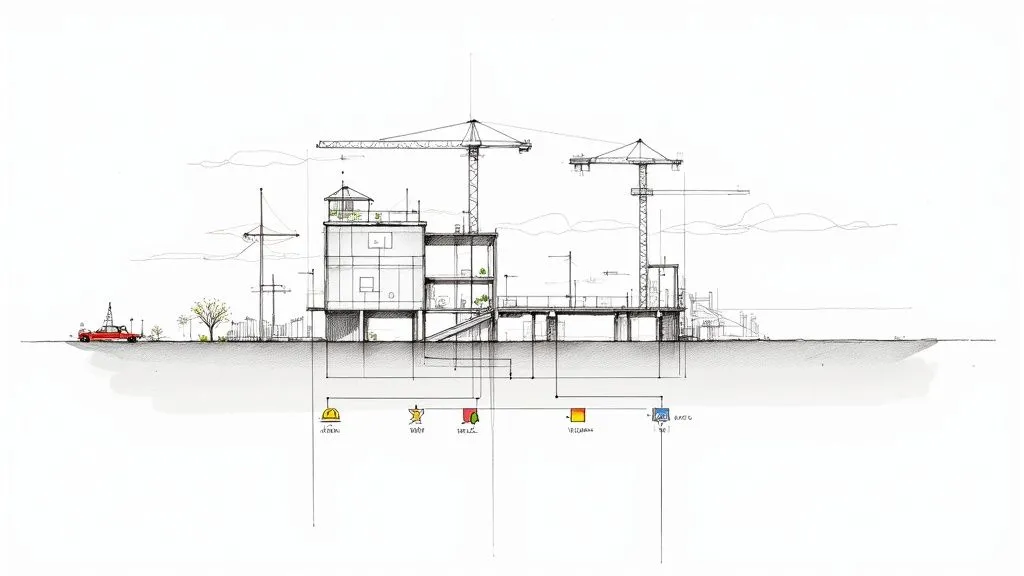
This type of proposal translates an ambitious vision into a feasible, sequenced construction plan. It necessitates meticulous upfront research, from geotechnical surveys to regulatory compliance checks, ensuring the project is viable before breaking ground. The process often involves complex tendering, which you can navigate by mastering the process of procurement.
Strategic Breakdown and Application
This proposal is indispensable when embarking on projects with significant capital expenditure, long timelines, and major public or environmental impact. It is a tool for risk management as much as it is for planning.
- When to Use: Essential for new commercial buildings, public works like transport systems, energy facilities, or major urban regeneration schemes. Use it to win government tenders, secure institutional funding, and coordinate multi-disciplinary teams.
- Key Sections:
- Project Feasibility Study: An analysis of the project’s viability, including site analysis, geotechnical data, and initial environmental screening.
- Engineering and Design Plans: Detailed blueprints, 3D models, and technical specifications for all structural and systemic components.
- Construction Schedule and Phasing: A Gantt chart or similar timeline detailing phases, critical path milestones, and dependencies.
- Health, Safety, and Environmental (HSE) Plan: Protocols for site safety, risk mitigation, and compliance with environmental regulations.
- Adaptation for Security Questionnaires: The HSE Plan and risk management sections can be repurposed to address questions about physical security protocols, site access control, and operational resilience in due diligence questionnaires.
This rigorous framework makes it a critical example of sample proposals projects can learn from, ensuring large-scale ventures are built on a solid foundation of planning and due diligence.
3. Marketing and Brand Campaign Project Proposal
A Marketing and Brand Campaign Project Proposal is the strategic document that transforms a creative concept into a measurable business outcome. It is essential for launching new products, repositioning a brand, or expanding into new markets. This proposal aligns marketing, sales, and creative teams by clearly defining campaign objectives, target audience, messaging, channel strategy, and key performance indicators (KPIs).
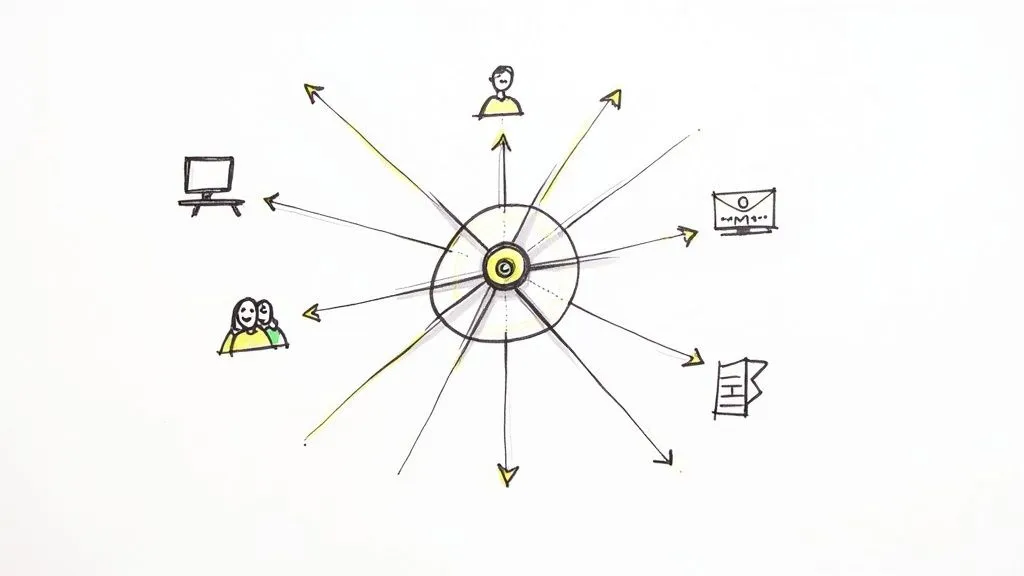
This document serves as the business case for a significant marketing investment. It moves beyond just creative ideas to provide a data-driven plan for execution and analysis, ensuring every pound spent is tied to a specific, trackable goal. For teams needing to create compelling visuals for their digital channels, tools that help you craft attention-grabbing visuals with a powerful banner generator can be invaluable.
Strategic Breakdown and Application
This proposal is critical for securing budget and executive buy-in for major marketing initiatives. It demonstrates strategic foresight and a clear understanding of the market landscape, reassuring stakeholders that the campaign is built on solid research and analysis.
- When to Use: Essential for product launches, seasonal campaigns, brand awareness drives, or major repositioning efforts. Use it to gain approval from leadership, coordinate with agencies, and align cross-functional teams.
- Key Sections:
- Market and Audience Analysis: Detailed research on market trends, competitor activity, and target audience demographics and psychographics.
- Campaign Strategy and Messaging: The core creative concept, key messages, and the overarching story the campaign will tell.
- Channel and Media Plan: A breakdown of which platforms (e.g., social media, email, PPC, PR) will be used, with justifications for each.
- Budget and Performance Metrics: A detailed budget allocation across all channels and activities, along with the KPIs (e.g., conversion rate, cost per acquisition, brand lift) that will be used to measure success.
- Adaptation for Security Questionnaires: When a campaign involves collecting customer data (e.g., through a contest or sign-up form), you can repurpose the audience analysis and channel plan sections to address questions about data privacy, consent mechanisms, and how user information will be handled and secured, demonstrating GDPR or other regional compliance.
By formalising the plan, this document stands as one of the most vital sample proposals projects for any marketing department aiming to deliver impactful and ROI-driven campaigns.
4. Research and Development (R&D) Project Proposal
A Research and Development (R&D) Project Proposal is a formal document designed to secure funding, institutional backing, or corporate approval for pioneering scientific or technological initiatives. It outlines a clear hypothesis, a rigorous methodology for investigation, and the anticipated outcomes, bridging the gap between an innovative idea and a tangible research plan. This proposal is foundational for projects aiming to create new knowledge, from vaccine development to next-generation battery technology.
This document serves as the scientific and financial justification for an R&D endeavour. It forces researchers and engineers to structure their investigative process, anticipate challenges, and articulate the potential impact of their work, whether it is filling a gap in academic literature or creating a disruptive commercial product.
Strategic Breakdown and Application
This proposal is indispensable when venturing into uncharted territory where the outcomes are not guaranteed but the potential rewards are significant. It is a tool for persuasion, demonstrating rigour, feasibility, and a clear vision to grant committees, investors, or internal leadership.
- When to Use: Essential for seeking grants from bodies like the National Science Foundation (NSF), securing internal budget for corporate innovation labs, or attracting venture capital for deep-tech start-ups.
- Key Sections:
- Hypothesis and Objectives: A clear, testable statement of the research question and specific, measurable goals.
- Literature Review: A summary of existing research that establishes the scientific gap the project aims to fill.
- Methodology: A detailed description of the experimental design, procedures, data collection, and analysis techniques.
- Budget and Justification: A granular breakdown of costs for personnel, equipment, and materials, with a strong rationale for each expense.
- Adaptation for Security Questionnaires: For R&D involving sensitive data (e.g., medical research), the methodology section can be repurposed to detail data anonymisation techniques, secure storage protocols, and compliance with regulations like GDPR or HIPAA, directly addressing data governance concerns in security assessments.
Its structured approach to exploring the unknown makes it one of the most vital sample proposals projects can be modelled on, especially when seeking support for high-risk, high-reward innovation.
5. Business Process Improvement Project Proposal
A Business Process Improvement (BPI) Project Proposal is a strategic document designed to justify and outline changes to an organisation’s core operations. It focuses on enhancing efficiency, reducing waste, and improving quality by analysing and redesigning existing workflows. This proposal is crucial for securing senior leadership buy-in and resources for operational transformation projects.
This type of proposal makes a compelling case for change by contrasting the current state with a proposed, optimised future state. It moves beyond simple suggestions to provide a data-backed plan for implementation, measurement, and continuous improvement. For businesses aiming to scale, understanding how to articulate these operational needs is fundamental.
Strategic Breakdown and Application
This proposal is indispensable when an organisation needs to address operational bottlenecks, high costs, or declining quality that impacts profitability and customer satisfaction. It serves as a roadmap for structured change, ensuring all stakeholders understand the ‘why’ and ‘how’ behind the initiative.
- When to Use: Essential for justifying investments in new technology like automation, restructuring departmental workflows, or implementing methodologies like Lean or Six Sigma. Use it to gain budget approval for projects that promise significant ROI through efficiency gains.
- Key Sections:
- Current State Analysis: A detailed audit of the existing process, including process maps, performance metrics, and identified pain points.
- Proposed Improvements: A clear description of the redesigned process, highlighting specific changes and the methodologies used.
- Implementation Plan: A phased rollout schedule with key milestones, resource requirements, and a robust change management strategy.
- Benefits and ROI Analysis: A quantitative forecast of expected outcomes, such as cost savings, time reduction, and quality improvement, to build a strong business case.
- Adaptation for Security Questionnaires: The process analysis and redesign sections are highly valuable for RFPs. You can leverage them to demonstrate a commitment to operational excellence and risk management, explaining how your improved processes enhance data integrity, security, and service reliability.
By methodically outlining the path from problem to solution, a BPI proposal makes a powerful argument and is a cornerstone for any list of sample proposals projects.
6. Community Development and Social Impact Project Proposal
A Community Development and Social Impact Project Proposal outlines an initiative designed to address specific social challenges and improve community welfare. It is a persuasive document used to secure funding from foundations, government bodies, or impact investors by clearly articulating a community’s needs, the proposed interventions, and the expected positive outcomes. This proposal bridges the gap between a compelling social mission and the practical, fundable steps required to achieve it.
This type of proposal translates altruistic goals into a structured, measurable plan. It forces organisations to conduct thorough needs assessments, engage with stakeholders, and define success not just in activities completed, but in tangible, positive changes to people’s lives. For example, proposals for initiatives like Girls Who Code or Water.org rely on this format to demonstrate their potential for scalable impact.
Strategic Breakdown and Application
This proposal is indispensable when seeking support for projects where the primary return is social, not financial. It’s a strategic tool for building trust with funders and demonstrating a deep understanding of the community you aim to serve.
- When to Use: Ideal for launching new non-profit programmes, expanding social services, or piloting innovative solutions to systemic issues like poverty, lack of education, or inadequate healthcare. Use it to apply for grants, attract philanthropic investment, or build partnerships with local government agencies.
- Key Sections:
- Problem Statement and Needs Assessment: A data-driven analysis of the specific social problem and the target community’s needs.
- Proposed Interventions and Activities: A detailed description of the project’s activities, grounded in evidence-based practices or a clear Theory of Change.
- Impact Measurement and Evaluation: A plan outlining key metrics (e.g., IRIS+ Metrics), data collection methods, and how social return on investment will be measured and reported.
- Sustainability Plan: A forward-looking strategy detailing how the project’s positive impact will be maintained beyond the initial funding period.
- Adaptation for Security Questionnaires: While not directly focused on IT security, the stakeholder engagement and impact measurement sections can be adapted. Use them to answer questions about community data privacy, ethical data collection practices, and how you protect the sensitive information of vulnerable populations you serve.
This framework makes it one of the most vital sample proposals projects for the third sector, ensuring that good intentions are backed by a rigorous and accountable plan.
7. Product Development and Innovation Project Proposal
A Product Development and Innovation Project Proposal is the strategic document that transforms a market opportunity into a tangible product. It lays out the business case for a new product or a significant enhancement, covering everything from customer needs analysis and go-to-market strategy to financial projections. This proposal is fundamental for securing board approval, investment capital, and organisational resources for major product initiatives.
This proposal bridges the gap between a visionary idea and a viable, market-ready solution. It forces teams to validate assumptions with market data, define what success looks like, and anticipate risks before committing significant resources. Think of Tesla’s Model 3 proposal, which would have outlined not just the car’s design but the entire plan for production scaling and market disruption.
Strategic Breakdown and Application
This proposal is indispensable when you are not just building a feature, but creating a new revenue stream or entering a new market. It’s a persuasive tool that aligns stakeholders around a shared product vision and a clear path to profitability.
- When to Use: Essential for launching a new product line, expanding into an adjacent market, or undertaking a major product overhaul that requires significant investment. Use it to pitch to investors, company leadership, or a new product steering committee.
- Key Sections:
- Market Opportunity Analysis: A detailed assessment of the target market, customer pain points, and competitive landscape.
- Product Vision and Specification: A clear description of the product, its core features, and its unique value proposition. Prototypes or mock-ups are highly effective here.
- Go-to-Market (GTM) Strategy: A comprehensive plan for marketing, sales, and distribution to capture the target audience.
- Financial Projections: An in-depth financial model including revenue forecasts, development costs, and profitability analysis. Understanding how to articulate financial viability is critical, and a well-structured plan can make or break a pitch.
- Adaptation for Security Questionnaires: The product specification section can be repurposed to answer security-related questions about data handling, privacy by design, and the features that protect user information within the product architecture.
This holistic approach makes it one of the most powerful sample proposals projects can be based on, ensuring that innovation is directly tied to a sound business strategy and execution plan.
7-Project Proposal Comparison
| Proposal Type | Implementation Complexity 🔄 | Resource Requirements ⚡ | Expected Outcomes 📊 | Ideal Use Cases 💡 | Key Advantages ⭐ |
|---|---|---|---|---|---|
| Software Development Project Proposal | High — complex architecture, integrations 🔄🔄 | High — engineering teams, QA, cloud infra ⚡⚡ | Scalable software, roadmap, measurable KPIs 📊 | Custom apps, digital transformation, startups 💡 | Clear technical specs; reduces scope creep; stakeholder alignment ⭐ |
| Infrastructure and Construction Project Proposal | Very high — engineering, permitting, environmental 🔄🔄🔄 | Very high — heavy equipment, materials, specialists ⚡⚡⚡ | Completed built assets, regulatory approvals, long-term ROI 📊 | Large-scale construction, public works, developers 💡 | Comprehensive compliance; accurate cost/time estimates; attracts contractors ⭐ |
| Marketing and Brand Campaign Project Proposal | Moderate — research + creative coordination 🔄🔄 | Moderate — research, creative teams, media budget ⚡⚡ | Brand awareness, campaign metrics, demonstrable ROI 📊 | Product launches, brand repositioning, market expansion 💡 | Data-driven strategy; measurable ROI; cross-team alignment ⭐ |
| Research and Development (R&D) Project Proposal | High — experimental design, ethical/regulatory controls 🔄🔄 | High — specialized equipment, skilled personnel, funding ⚡⚡ | New knowledge/tech, prototypes, publications, IP potential 📊 | Scientific research, tech innovation, grant-funded projects 💡 | Scientific rigor; attracts funding; enables commercialization ⭐ |
| Business Process Improvement Project Proposal | Moderate — process analysis and change management 🔄🔄 | Moderate — analysts, training, tooling ⚡ | Cost/time savings, efficiency gains, improved KPIs 📊 | Operational optimization, Lean/Six Sigma, service orgs 💡 | Reduces costs; improves productivity; builds continuous improvement capability ⭐ |
| Community Development & Social Impact Proposal | Moderate — stakeholder engagement, context sensitivity 🔄🔄 | Variable — community partners, grant funding, monitoring ⚡ | Measurable social outcomes, community buy-in, sustainability metrics 📊 | NGOs, nonprofits, CSR programs, impact investors 💡 | Demonstrates social value; attracts funders; builds community trust ⭐ |
| Product Development & Innovation Project Proposal | High — market validation, prototyping, cross-functional work 🔄🔄 | High — R&D, design, supply chain, marketing ⚡⚡ | Validated product/MVP, go-to-market plan, revenue potential 📊 | New product launches, startups, corporate innovation labs 💡 | Validates demand; aligns stakeholders; supports investment/funding ⭐ |
Transforming Your Proposals into a Competitive Advantage
Throughout this guide, we have dissected a diverse collection of sample proposals projects, moving far beyond generic templates to uncover the strategic architecture that underpins successful bids. We have explored everything from highly technical SaaS implementations and robust infrastructure plans to creative marketing campaigns and critical R&D initiatives. The goal has been to equip you not just with examples, but with a replicable framework for analysis and adaptation.
The common thread woven through each successful proposal is its ability to transition from a mere document into a compelling narrative of value. It achieves this by demonstrating a profound understanding of the client’s problem, presenting a meticulously planned solution, and transparently outlining the expected outcomes. The strongest proposals, as we’ve seen, are never one-size-fits-all; they are bespoke, client-centric, and strategically aligned.
Your Blueprint for Proposal Excellence
As you move forward, distil the insights from these examples into a repeatable process. Focus on these core pillars to elevate your own proposal development:
- Empathise Before You Strategise: The most persuasive proposals are built on a foundation of genuine client understanding. Before writing a single word, ensure you have a granular grasp of their pain points, objectives, and internal success metrics.
- Structure for Clarity, Write for Impact: Use the structures we’ve analysed, such as the clear problem-solution-outcome flow, to guide your reader logically. Employ concise language, strategic formatting, and powerful executive summaries to capture attention immediately.
- Quantify Everything Possible: Vague promises fall flat. Tangible metrics, data-driven projections, and clear KPIs transform your proposal from a hopeful pitch into a credible business case. This is crucial for demonstrating ROI and securing stakeholder buy-in.
- Integrate Security and Compliance Proactively: In today’s digital landscape, security is not an afterthought. As demonstrated in our adaptation tips, weaving in security considerations, referencing compliance standards, and being prepared for security questionnaires builds immediate trust and signals professional maturity.
Ultimately, the sample proposals projects we’ve examined are more than just documents; they are powerful business development tools. Mastering the art of the proposal is a direct investment in your organisation’s growth, reputation, and competitive positioning. It’s the critical juncture where your expertise is formally presented and your potential partnership is defined.
Take these frameworks, adapt the specific tactics, and begin crafting proposals that don’t just win projects but build lasting, high-trust client relationships. The effort you invest in creating a truly exceptional proposal is the first, and most important, promise you make to a future partner. Make it count.