· Jane Iamias · business requirements document · 21 min read
Mastering the Business Requirements Document
Learn how to write a business requirements document that sets your project up for success. Get templates, real-world examples, and step-by-step guidance.
A Business Requirements Document (BRD) is essentially the master plan for a project. It’s a formal document, sure, but think of it as the story of what a project needs to achieve and why it matters to the business. It’s created right at the start, getting everyone on the same page before a single line of code is written or a technical solution is chosen. This way, you avoid costly U-turns and misunderstandings later on.
What a Business Requirements Document Actually Does
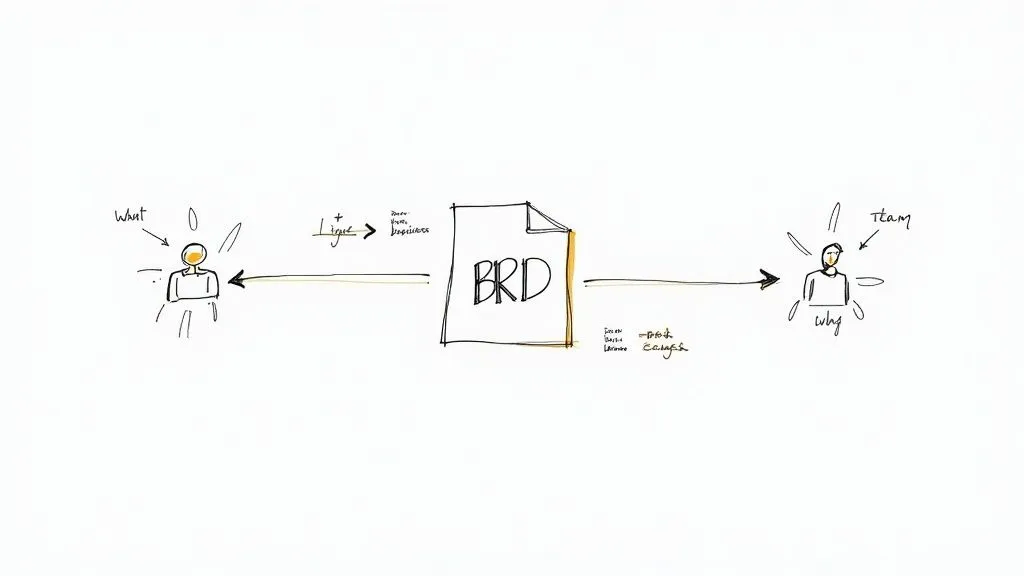
Imagine you’re building a custom house. You wouldn’t just tell the builders to “start building.” Instead, you’d sit down with an architect and create a detailed blueprint. That plan wouldn’t specify the brand of nails or the type of saw to use; it would define the number of bedrooms, the kitchen layout, and where the windows go.
The business requirements document is that blueprint for your project.
It’s all about the high-level business needs. It deliberately steers clear of technical jargon and implementation specifics, focusing entirely on the problem that needs solving and the value the solution is expected to bring. This clarity is precisely what makes it so powerful.
By sticking to the “what” and “why,” a BRD acts as the perfect translator. It takes the vision from business stakeholders—like executives or department heads—and turns it into a clear set of instructions for the technical teams tasked with making it happen.
Bridging the Communication Gap
Without a solid BRD, projects can easily go off the rails. It’s the classic case of miscommunication: stakeholders might be dreaming of a sophisticated e-commerce platform, but without clear guidance, the development team might deliver a basic shopping cart. The outcome? A blown budget, wasted time, and a final product that doesn’t actually solve the business problem.
The BRD is your safeguard against this. It becomes the single source of truth that everyone can refer back to. Its main jobs are to:
- Establish a Shared Vision: It makes sure everyone, from the project sponsor down to the end-users, is working towards the same goal.
- Define Success: It clearly spells out what a successful outcome looks like, with specific criteria for measuring it.
- Guide Decision-Making: When questions or changes come up mid-project, the BRD is the touchstone to ensure every decision still aligns with the original business goals.
- Set Clear Boundaries: It defines exactly what is included in the project (in-scope) and, just as crucially, what isn’t (out-of-scope). This is your best defence against scope creep.
A well-crafted Business Requirements Document is more than just a formality; it is a strategic tool that aligns teams, secures buy-in, and paves the way for project success.
A Foundation for Compliance and Security
In a world driven by data, the BRD’s role has expanded to cover governance and compliance. For UK businesses, especially those in highly regulated sectors or running complex IT projects, using structured BRDs has become standard practice. It makes sense, given that 73% of UK companies collecting digitised personal data now have a dedicated data protection lead—a role that relies on the kind of detailed requirements management a BRD offers. The UK Business Data Survey 2021 has some interesting findings on these trends.
By defining data handling, security, and privacy needs from the very beginning, the BRD lays the groundwork for systems like ResponseHub. These platforms depend on clear, policy-driven information to automate critical security and compliance workflows, and it all starts with the requirements laid out in the BRD.
The Anatomy of an Effective BRD
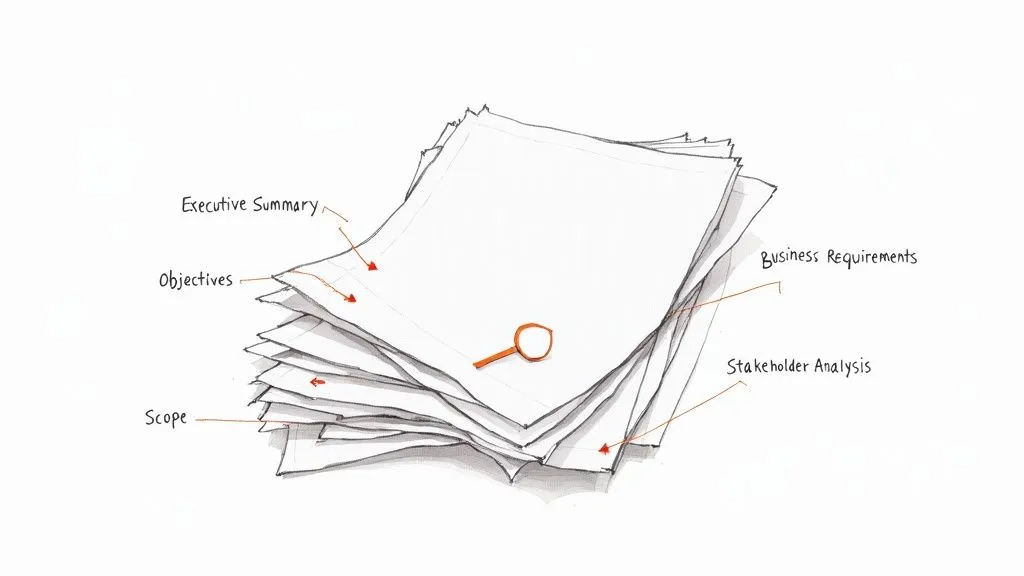
A really solid business requirements document is much more than a simple wish list; it’s a carefully constructed narrative that tells a project’s complete story. Each part flows logically from the one before it, creating a clear path from the big-picture vision right down to the nitty-gritty details.
Think of it like building a piece of flat-pack furniture. If you skip a step or guess what the instructions mean, you’ll end up with something wobbly and unreliable. A well-structured BRD prevents that from happening to your project.
Core Foundational Components
Every great BRD starts by setting the scene. These first few sections are absolutely vital for getting leaders on board and making sure everyone shares the same understanding of why the project exists in the first place. You have to nail the “why” before you get to the “what.”
- Executive Summary: This is your project’s elevator pitch. It’s a short, punchy overview of the entire document, written for busy executives who might not read the whole thing. It needs to quickly cover the business problem, the solution you’re proposing, and the results you expect.
- Project Objectives and Goals: This is where you turn that high-level vision into concrete, measurable targets. The SMART framework (Specific, Measurable, Achievable, Relevant, Time-bound) is your best friend here. It helps you define exactly what success looks like. For example, a goal might be “to reduce customer support ticket resolution time by 25% within six months of launch.”
Without this strategic context, all the detailed requirements that come later would be floating without a clear purpose.
Defining the Project Boundaries
Once the objectives are clear, the next job is to draw sharp lines around the project. This is all about managing expectations and, crucially, preventing scope creep—that dreaded, uncontrolled expansion of requirements that can completely derail timelines and budgets.
A business requirements document acts as the definitive guide for a project. Its most critical function is to clearly define what is included and, just as importantly, what is not. This clarity is the single best defence against future misunderstandings.
Being explicit is the name of the game here. This part of the BRD needs to spell out precisely what the project will deliver and what it will not deliver.
- Scope of the Project: This section outlines the project’s boundaries. You’ll list all the major features, functions, and deliverables that are in-scope. Just as important is a list of what’s out-of-scope, which stops assumptions from turning into arguments later on.
- Stakeholder Analysis: Projects are made by people, for people. This section identifies everyone involved—from the project sponsor and end-users to the development team—and clarifies their roles, responsibilities, and level of influence.
By setting these boundaries early, you create a stable foundation that keeps everyone aligned and guides decision-making for the rest of the project.
The Detailed Requirements and Logistics
Now we get to the heart of the business requirements document. This is where abstract goals are translated into concrete needs, breaking down exactly what the solution has to do to meet the business objectives. This section has to be incredibly detailed to leave no room for guesswork for the technical teams who will build it.
These detailed requirements are often split into categories to keep things clear. For instance, functional requirements describe what the system must do (e.g., “The system must allow users to reset their own passwords”), while non-functional requirements describe how well it must perform (e.g., “The system must support 100 concurrent users without a drop in performance”).
Finally, the BRD wraps up with the practicalities that will govern how the project gets done.
- Project Timeline and Milestones: This lays out a high-level schedule, highlighting key dates and major project phases.
- Cost-Benefit Analysis: This section makes the business case for the investment, weighing the expected costs against the anticipated benefits, like increased revenue or operational savings.
- Assumptions and Constraints: Here, you list all the assumptions made during planning (e.g., “key personnel will be available when needed”) and identify any known limitations, such as budget caps or technical restrictions.
Getting these sections right is fundamental to good project management. For a deeper look at organising all this information, exploring different approaches can be a huge help. You can learn more about these strategies in our guides on knowledge management best practices.
A Step-by-Step Guide to Writing a BRD
Creating a business requirements document can seem like a monumental task. The trick is to break it down into manageable stages. A truly effective BRD isn’t just written; it’s the product of thorough investigation, sharp analysis, clear communication, and collaborative agreement.
Getting this process right ensures the final document is accurate, comprehensive, and genuinely reflects what the business needs. It’s your best defence against costly rework down the line. We can map out this journey in four distinct phases.
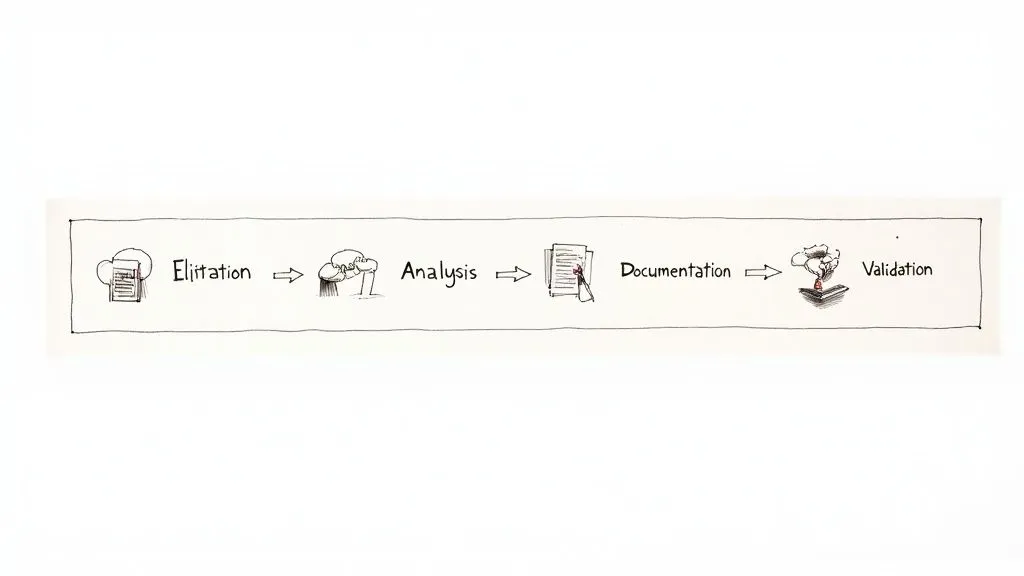
Phase 1: Elicitation and Information Gathering
Before a single word hits the page, you have to understand the landscape. This first phase, known as elicitation, is all about detective work – gathering information from all the right people to uncover the real business needs, not just the surface-level wants.
Your main job here is to engage with stakeholders. This means everyone, from the project sponsor and key executives right down to the end-users who will live with the solution day in and day out.
There are a few solid techniques you can use to draw out this information:
- Interviews: One-on-one chats are perfect for digging deep into individual roles and their specific pain points.
- Workshops: Getting people in a room together is brilliant for brainstorming ideas and ironing out conflicting requirements between different departments.
- Surveys: If you need to gather opinions or hard data from a large group, questionnaires are an efficient way to do it.
- Observation: Sometimes, the best insights come from simply watching a process in action. You’ll spot inefficiencies that people have become so used to they don’t even think to mention them.
Phase 2: Analysis and Prioritisation
Once you have a mountain of raw information, it’s time to make sense of it all. The analysis phase is where you sift through your notes, transcripts, and workshop outputs to pull out the core requirements. It’s about connecting the dots between individual requests and the bigger business goals, separating the genuine needs from the nice-to-haves.
A critical part of this stage is prioritisation. Let’s be honest, not all requirements are created equal. You’ll need to work with stakeholders to rank every item. A tried-and-tested method for this is the MoSCoW technique:
- Must-have: These are the non-negotiables. Without them, the project fails.
- Should-have: Important requirements that aren’t absolutely critical but add significant value.
- Could-have: Desirable features that can be included if time and resources allow.
- Won’t-have: Things that have been explicitly ruled out for this version of the project.
This framework is essential for managing everyone’s expectations and helps you make smart decisions when you inevitably have to make trade-offs later on.
Phase 3: Documentation and Articulation
With your requirements analysed and prioritised, you can finally start writing. The golden rule here is clarity. The business requirements document must be written in simple, unambiguous language that anyone – from the CEO to a junior developer – can understand.
Steer clear of jargon and acronyms if you can. If they’re unavoidable, make sure you include a glossary. It’s also a great idea to use visual aids like flowcharts and diagrams to bring complex processes to life. Structure the document logically, following the sections we’ve already outlined, to create a clear path for the reader.
This is also where you’ll carefully document any data protection or compliance needs. Defining these clearly is crucial for building secure systems. You can often find a solid starting point by reviewing a comprehensive template data protection policy to understand the necessary controls.
A well-written requirement is testable. It should be clear enough that someone can definitively say “yes, this has been met” or “no, it has not.” Ambiguity is the enemy of a successful project.
The UK’s dynamic business environment, with over 5.7 million private sector businesses, highlights just how vital this kind of clear documentation is. In such a competitive market, the project efficiency driven by a solid BRD can be the difference between success and failure.
Phase 4: Validation and Approval
The final hurdle is making sure everyone is on the same page. The validation phase involves sending the draft BRD around to all stakeholders for their review and formal sign-off. This isn’t just a box-ticking exercise; it’s a critical checkpoint to confirm that the document accurately captures their needs and the project’s goals.
Set up review meetings to walk stakeholders through the document, answer their questions, and sort out any lingering concerns. This collaborative approach ensures full alignment and gets you the buy-in needed to move forward with confidence.
Once all the feedback has been incorporated and every key stakeholder has given their approval, the BRD becomes the official project baseline. From this point on, it is the single source of truth that will guide the entire project team through to delivery.
BRD vs PRD vs SRS: Untangling the Acronyms
In the world of project management, the sheer number of acronyms can feel like trying to learn a new language. Three of the most common—and commonly confused—are the Business Requirements Document (BRD), the Product Requirements Document (PRD), and the Software Requirements Specification (SRS).
They all sound similar, but they each play a unique and critical role. Getting them wrong can lead to serious miscommunication and project drift. Understanding the difference is the key to keeping everyone on the same page.
Let’s use a simple analogy: building a new house.
The BRD is like the initial chat with the future homeowners. It captures their core vision: “We need a four-bedroom family home with a big garden because our family is growing.” It’s all about the why – the fundamental business or personal need.
Next, the PRD is the architect’s set of blueprints. It takes that high-level vision and turns it into a functional plan. It describes what the house will actually have—the layout of the rooms, where the windows go, how the kitchen connects to the living area. It defines the product that will solve the homeowners’ need.
Finally, the SRS is the detailed construction manual for the builders. This document explains how to build it: the specific type of concrete for the foundation, the exact dimensions for the timber framing, and the complete wiring diagram for the electricians. It’s the nitty-gritty technical guide for the team doing the work.
The Business Requirements Document (BRD)
The BRD is where it all begins. It’s owned by the business stakeholders and answers one simple but vital question: “Why are we doing this project?”
This document is always written in straightforward, non-technical language. Its audience—executives, project sponsors, and department heads—needs to understand the strategic value, not the technical details. A good BRD clearly defines the business problem, outlines measurable goals, and sets the project’s scope from a high-level perspective.
- Focus: The strategic “what” and the crucial “why” of the initiative.
- Author: Usually a Business Analyst working closely with business leaders.
- Audience: Senior management, project sponsors, and other non-technical stakeholders.
The Product Requirements Document (PRD)
Once the business case gets the green light, the focus shifts from the ‘why’ to the ‘what’. The PRD is where the high-level business needs from the BRD are translated into tangible product features. It answers the question: “What should this product do for the user?”
Here, you’ll find details like user personas, user stories, feature lists, and the core user experience (UX) principles. It describes how the product will look, feel, and behave from the end-user’s perspective. If you want to dive deeper, this Product Requirements Document (PRD) template is a great resource.
- Focus: The specific features and functionality of the end product.
- Author: Typically a Product Manager or Product Owner.
- Audience: The product team, including designers, developers, and QA testers.
The Software Requirements Specification (SRS)
The SRS is the most technical document of the three. It takes the functional requirements outlined in the PRD and breaks them down into a detailed technical blueprint for the engineering team. It definitively answers the question: “How are we going to build it?”
This document is dense with technical specifics. It covers everything from database schemas and system architecture to performance requirements and security protocols. For developers, the SRS is their single source of truth, ensuring they build the software precisely as intended.
While a BRD states the business goal and a PRD describes the user’s journey, the SRS provides the exact technical instructions needed to bring that journey to life. Think of them as three sequential layers of communication, each adding a new level of detail.
Comparing BRD vs PRD vs SRS
To make the distinction crystal clear, let’s break down their core differences in a simple table.
| Attribute | Business Requirements Document (BRD) | Product Requirements Document (PRD) | Software Requirements Specification (SRS) |
|---|---|---|---|
| Primary Question | ”Why are we doing this?" | "What should the product do?" | "How will we build it?” |
| Core Focus | Business goals, project scope, and ROI. | User needs, features, and functionality. | Technical specifications, system architecture. |
| Key Audience | Executives, sponsors, business leaders. | Product teams, designers, developers. | Engineers, developers, architects, testers. |
| Level of Detail | High-level and strategic. | Functional and user-centric. | Highly detailed and technical. |
| Typical Author | Business Analyst | Product Manager | Systems Analyst or Lead Engineer |
Each document flows logically from the one before it, creating a clear line of sight from the initial business idea all the way to the final code. Using the right document at the right time is absolutely essential for aligning everyone from the boardroom to the dev team on a single, shared path to success.
Common Pitfalls and How to Avoid Them
Putting together a business requirements document is a brilliant first move, but even the best-laid plans can hit a bit of turbulence. Knowing what to watch for can be the difference between a project that sails through challenges and one that gets completely knocked off course. Think of your BRD as a living document, but be aware of the common traps that can trip you up.
Getting ahead of these issues is the first step toward a more robust project plan. When you can spot potential weaknesses in your process early on, you can put strategies in place to keep everything on track, on time, and on budget.
Vague Requirements and Ambiguity
If a BRD is going to fail, ambiguity is almost always the culprit. Requirements like “improve the user interface” or “make the system faster” might sound good, but they’re practically useless. They’re completely subjective and leave far too much to interpretation, which creates a huge gap between what stakeholders expect and what gets delivered.
The only way to fight this is to write every single requirement with crystal clarity. A great rule of thumb is to apply the SMART framework not just to your main goals, but to each requirement.
- Specific: What exactly needs to be done?
- Measurable: How will you prove it’s been done? (e.g., “Page load times must be under two seconds”).
- Achievable: Is this actually realistic given the project’s limitations?
- Relevant: Does this requirement directly support a real business objective?
- Time-bound: Can you tie it to a specific deadline or project phase?
This kind of discipline turns vague wishes into concrete, testable instructions that leave no room for guesswork.
The Dangers of Scope Creep
Scope creep is the silent project killer. It usually starts with a few small, “harmless” requests that pile up over time, adding a mountain of extra work, pushing back deadlines, and blowing up the budget. Your BRD is your best line of defence, but only if you protect it with a proper process.
The moment a BRD is approved, it becomes the project’s baseline. Any deviation from this baseline must be managed through a formal change control process, ensuring the impact of every new request is fully understood and approved before any work begins.
Having a simple change control process isn’t optional; it’s essential. This process ensures every new request is documented, its impact on time and cost is properly assessed, and key stakeholders formally approve or reject it. Understanding its causes is crucial, and a solid BRD helps you outline strategies to avoid scope creep right from the start.
Inadequate Stakeholder Engagement
A BRD written in a vacuum is doomed from the start. If you don’t involve the right people from day one, you’re almost guaranteed to miss critical requirements or run into major objections when it’s far too late—and expensive—to make changes. This doesn’t just mean getting executive sign-off; it means talking to the end-users who will be in the system every day.
The solution is regular, structured communication. Schedule workshops, run interviews, and hold review sessions as you’re building the BRD. Visual aids like process maps and simple wireframes are also fantastic for building a shared understanding that words alone can’t achieve.
This collaborative approach makes sure the final document is a true reflection of what the business actually needs. For example, when choosing a new vendor, this depth of requirement gathering is vital. We cover this in more detail in our practical guide to vendor due diligence, where we explain how clear requirements make complex evaluations much simpler.
Got Questions About BRDs? We’ve Got Answers.
Even after you get the hang of what a business requirements document is and how to build one, questions always seem to surface once you’re in the thick of it. Let’s tackle some of the most common ones head-on.
Think of this as your go-to cheat sheet—a quick, straightforward guide to help you handle those tricky details and move forward with confidence.
Who Actually Writes the BRD?
Officially, the Business Analyst (BA) usually holds the pen. But thinking it’s a one-person show is a classic mistake. The BA is more like the conductor of an orchestra than a solo performer. They’re the one responsible for pulling everything together, structuring the document, and making it coherent, but the real substance comes from a whole cast of characters.
Putting together a solid BRD is a team effort. You absolutely need input from:
- Business Stakeholders: These are the leaders and executives who own the “why.” They set the high-level business goals and define what success looks like for the project.
- Subject Matter Experts (SMEs): Your people in the trenches. They know the current workflows, the daily frustrations, and the practical details that can make or break a solution.
- Project Managers: They’re the voice of reality, making sure the requirements actually fit within the project’s scope, budget, and timeline.
The BA’s real job is to get these different groups talking, translating their collective wisdom into a single, clear document that everyone can get behind.
How Detailed Does a BRD Need to Be?
Finding the right level of detail for a business requirements document is a delicate balancing act. Here’s the golden rule: be detailed enough that there’s zero confusion about the business goals, but not so detailed that you start designing the technical solution. You’re defining the destination, not giving the driver turn-by-turn directions.
The right depth often comes down to the project methodology you’re using.
A great BRD answers the ‘what’ and ‘why’ from a business perspective with total clarity. The second it starts dictating the ‘how’ of the technical build, you’ve gone too far.
In a traditional Waterfall project, for instance, the BRD needs to be incredibly detailed and buttoned-up because it acts as a fixed contract. Once it’s signed, changes are a big deal. For an Agile project, however, the BRD might be a higher-level guide that sets the overall vision, which is then fleshed out in more detail through user stories sprint by sprint.
Can a BRD Be Changed After It’s Approved?
Yes, but it’s not a free-for-all. The business world is always shifting, and sometimes a project’s needs have to shift with it. The trick isn’t to ban changes but to manage them with a proper process so things don’t descend into chaos.
Once a BRD is signed off, it becomes the project’s official baseline. From that point on, any proposed change has to go through a formal change control process.
This isn’t just red tape; it’s a safety net. The process usually looks something like this:
- Submit a Change Request: The person asking for the change has to formally write down what they want to alter and, crucially, why.
- Analyse the Impact: The project team digs in to see what effect this change would have on the scope, budget, timeline, and resources.
- Get Stakeholder Approval: The key decision-makers review the analysis and give the final thumbs-up or thumbs-down.
This structure is what saves projects from scope creep. It forces everyone to pause and understand the real cost of a change before committing to it.
What’s the Difference Between Functional and Non-Functional Requirements?
Getting your head around functional versus non-functional requirements is vital for a good BRD. It’s a point of confusion for many, but a simple analogy makes it click.
Think about buying a new car.
A functional requirement is what the car must do. For example:
- The car must accelerate when I press the pedal.
- The car must have brakes that stop it.
- The car must have a boot that opens and closes.
These are the fundamental actions the product has to perform. They’re non-negotiable.
A non-functional requirement, on the other hand, is how well the car does its job. For example:
- The car must go from 0 to 60 mph in under 5 seconds (this is a performance requirement).
- The cabin noise can’t be louder than 60 decibels on the motorway (this is a usability requirement).
- The car must have front and side airbags (this is a safety requirement).
You need both. Without functional requirements, you don’t even have a car. But without non-functional requirements, you might end up with a car that’s technically functional but painfully slow, noisy, and unsafe to drive. A great BRD captures both to ensure the final product isn’t just working, but working well.