· Jane Iamias · rfi vs rfp · 22 min read
RFI vs RFP: rfi vs rfp Essentials for Smarter Procurement
Understand the differences between rfi vs rfp and learn which document fits your procurement goals to secure better bids.
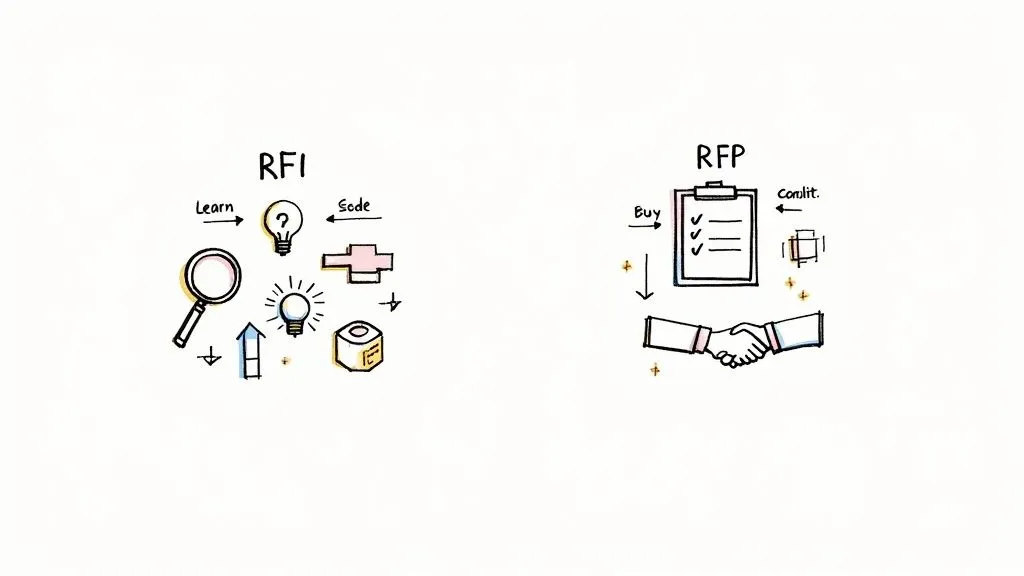
At its heart, the RFI vs RFP debate boils down to intent. A Request for Information (RFI) is your way of testing the waters and doing some market research. A Request for Proposal (RFP) is a formal invitation for vendors to pitch specific, competitive solutions to a problem you’ve already defined.
Think of it this way: an RFI asks, “What’s out there and what’s possible?” while an RFP asks, “Here’s our problem—how will you solve it, and what will it cost?”
Understanding The Core Difference Between RFI And RFP
In procurement, picking the right document for the job is the first step towards a successful outcome. The move from an RFI to an RFP isn’t just a change in paperwork; it’s a fundamental shift from informal exploration to a formal, structured evaluation.
An RFI is your first dip into a new market. It’s designed to educate your team, help you grasp the landscape of available solutions, and start shaping your understanding of what you actually need.
On the other hand, an RFP means you’ve done your homework. You have a clearly defined problem, a solid list of requirements, and you’re ready to compare potential partners on a level playing field to find the best fit.
Defining The Purpose And Scope
The RFI is all about being open-ended. You’re asking broad questions about a vendor’s general capabilities, the technology they use, or even what they see happening in the market. The aim isn’t to get a detailed quote, but to gather a wide net of information that helps you narrow down your project’s scope and build a list of potential suppliers.
An RFP, in contrast, is incredibly specific and structured. It lays out your project requirements, technical specs, how you’ll evaluate the submissions, and what you expect contractually. The responses need to be just as comprehensive, directly addressing every point so you can conduct a fair, apples-to-apples comparison.
This mirrors a wider trend in information gathering. In 2024, UK central government monitored bodies fielded a massive 83,041 Freedom of Information (FOI) requests, an 18% jump from 2023. This points to a growing need for preliminary data collection tools, much like an RFI serves procurement before a formal tender like an RFP. You can read more about these official statistics on GOV.UK.
The core principle is simple: An RFI is for learning, and an RFP is for buying. Confusing the two leads to inefficient processes, poor vendor responses, and mismatched solutions.
RFI vs RFP At a Glance
To quickly get a handle on the key differences, it helps to see how each document plays out in the real world. This table offers a straightforward, side-by-side comparison of their most important traits, helping you pick the right tool for where you are in the procurement journey.
| Characteristic | Request for Information (RFI) | Request for Proposal (RFP) |
|---|---|---|
| Primary Goal | Educate and gather market intelligence. | Evaluate and select a vendor for a specific project. |
| Timing | Early in the procurement cycle, when the solution is unclear. | Later in the cycle, when requirements are well-defined. |
| Document Format | Informal, with open-ended questions. | Formal and structured, with detailed requirements. |
| Vendor Commitment | Low; primarily for sharing information and expertise. | High; a detailed, binding offer to deliver a solution. |
| Outcome | A better understanding of the market and a longlist of vendors. | A shortlist of qualified vendors and a basis for a contract. |
Essentially, the table confirms that your choice between an RFI and an RFP depends entirely on how much you already know and what you need to find out next.
When to Use an RFI for Strategic Market Discovery
Think of a Request for Information (RFI) as your strategic compass in the procurement journey, not a shopping list. It’s the right tool when your organisation has spotted a problem or an opportunity but hasn’t yet figured out the solution. The RFI vs RFP decision really comes down to this: an RFI is for learning, not for buying.
It’s like casting a wide, intelligent net. You aren’t trying to catch a specific fish; you’re mapping the entire marine ecosystem. The main goal here is to gather broad market intelligence, get a feel for the vendor landscape, and uncover innovative approaches you might not have even known existed.
An RFI is most powerful when your project is just getting started. You might be facing a business challenge—like tightening up customer data security or automating a clunky manual workflow—but the path forward is still fuzzy. Sending out an RFI lets you tap into the market’s collective expertise without locking yourself into a specific direction or budget.
Structuring Your RFI for Maximum Insight
The secret to a great RFI is in its structure. Unlike the rigid, requirement-heavy format of an RFP, a powerful RFI is built around open-ended, exploratory questions. You want to encourage vendors to think outside the box and share what they know.
So, instead of asking, “Does your solution tick boxes X, Y, and Z?” try asking, “How would you tackle our challenge with data fragmentation?” This simple shift from closed questions to open prompts changes the whole dynamic. Vendors are no longer just bidders; they become potential strategic partners who can help you define what you actually need.
Consider structuring your RFI around these key areas:
- Vendor Landscape: Ask about their company history, where they sit in the market, and what they do best.
- Solution Philosophy: Get a sense of their general approach to solving problems like the one you’re facing.
- Technological Innovation: Prompt them to talk about new trends and how their technology is built for the future.
- Implementation Models: Ask about typical project timelines, their working methods, and any common roadblocks.
This approach gives you a rich, detailed picture, highlighting different philosophies and capabilities across the board. It provides crucial context that will help you build a much sharper, more focused RFP down the line.
An RFI is not a test with right or wrong answers. It’s a structured conversation designed to educate your team and de-risk your future procurement decisions by making sure you’re asking the right questions later on.
Identifying the Ideal Scenarios for an RFI
Knowing exactly when to use an RFI saves everyone time and avoids vendor fatigue. It’s a low-risk, high-reward move when used in the right situation. You should issue an RFI when you need to understand the market before you start committing serious resources.
For example, if you’re exploring whether a new AI-powered analytics platform is feasible, an RFI can help you gauge how mature the market is, identify the key players, and get a ballpark figure for potential costs. This initial data is gold for building a solid business case and getting the necessary buy-in from stakeholders.
The RFI is your first step in pre-qualifying potential partners. While you won’t be formally scoring responses, the quality, depth, and creativity you receive give you a pretty clear idea of which vendors are true experts and are genuinely interested in working with you. This initial filter makes the more intensive RFP process that follows far more efficient and targeted.
Making the Call: How to Use an RFP for a Final Vendor Decision
Once you’ve moved beyond simply gathering information and have a solid idea of what you need, it’s time for the Request for Proposal (RFP). This is where the serious decision-making begins. Unlike the wide-net approach of an RFI, an RFP signals a clear intention to buy. It’s a formal, structured document asking qualified vendors for competitive bids on a project you’ve already defined.
This formality is exactly what you need at this stage. An RFP takes the conversation from “what’s out there?” to “here’s what we need—how will you deliver it, and for how much?” It demands a significant investment of time and resources from everyone involved, which tells vendors that a final decision is on the horizon.
Crafting an RFP That Gets You Clear Answers
The success of your vendor selection rides on how clear and precise your RFP is. If your document is vague, you’ll get back a jumble of inconsistent proposals that are impossible to compare, defeating the whole purpose. A strong RFP leaves no room for guesswork.
To build a really effective RFP, you need to include a few key things:
- Detailed Project Specifications: Spell out the scope of work, technical requirements, project goals, and exactly what you expect to be delivered. The more specific you are, the more relevant and accurate the proposals will be.
- Transparent Evaluation Criteria: Let vendors know how you’ll be scoring their responses. Assigning a weight to different sections—like technical fit, project plan, cost, and vendor experience—keeps the comparison fair and objective for everyone.
- Specific Contractual Expectations: Don’t be shy about including key terms and conditions, service-level agreements (SLAs), and any legal or compliance must-haves. This heads off potential surprises when it’s time to negotiate the contract.
Giving vendors this level of detail helps them submit proposals that speak directly to your needs, which makes your evaluation process much smoother. For B2B RevOps, a process like selecting top marketing automation platforms is a critical move that is made much safer and more effective with a well-managed RFP.
An RFP isn’t just a price request; it’s a blueprint for a potential partnership. Its main job is to create a structured competition so you can objectively find the vendor who is truly best equipped to deliver on your goals.
From Proposal to Partnership
The ultimate goal is to receive high-quality, comparable proposals that make the final decision easier. A well-designed RFP pushes vendors to show not just what their solution does, but also how they’ll implement it, support it, and fit into your business strategy. This level of detail lets your team see past the marketing spin and evaluate the real substance behind each offer.
Putting these documents together can feel like a lot of work, but starting with a good structure is half the battle. You can find excellent starting points and ideas by looking at established templates for RFP responses to ensure you’ve covered all the important bases.
At the end of the day, the RFP process is about reducing risk and getting the best possible value. It creates a documented, auditable path for your decision, ensuring transparency and accountability for everyone involved. By using an RFP to make a final vendor selection, you turn a complicated procurement puzzle into a clear, methodical journey that leads straight to a successful partnership.
A Detailed Breakdown of the RFI vs RFP Process
When you get past the basic definitions, you start to see the real strategic split in the RFI vs RFP debate. Sure, one is for gathering information and the other is for getting a firm offer, but they’re built for completely different stages of the buying journey. Understanding how they actually work on the ground is what helps an organisation make smart, efficient purchasing decisions.
Think of an RFI process as a structured conversation. You’re starting with broad, open-ended questions because you want to tap into the market’s collective brainpower. The aim isn’t to pick a winner; it’s to learn from potential suppliers, using their insights to sharpen your project scope and build a longlist of credible partners.
The RFP process, on the other hand, is all business. It’s formal, highly structured, and designed to be competitive. It runs like a proper tender with strict deadlines, exhaustive requirements, and clear scoring criteria. Every response is a formal bid, and the whole exercise is set up for a direct, like-for-like comparison to choose a final partner and get a contract signed.
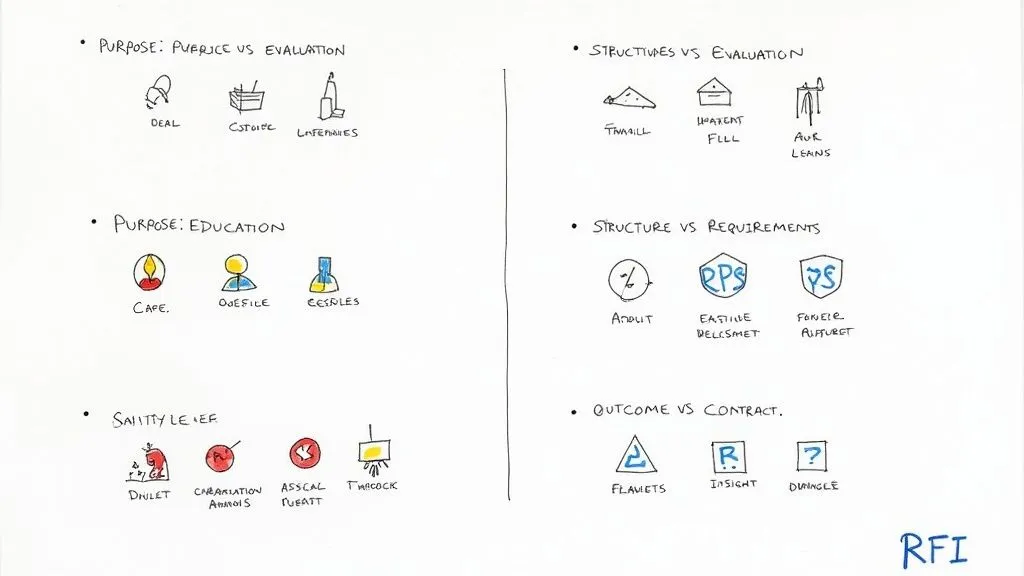
Strategic Purpose: Education vs Evaluation
The real heart of the difference is their strategic goal. An RFI is fundamentally an educational tool. You’re putting your hand up and admitting you don’t have all the answers, inviting vendors to help you understand the landscape. The prize at the end isn’t a signed deal; it’s genuine market insight.
In contrast, an RFP is purely about evaluation. It assumes you’ve already done your homework—often with the help of a previous RFI—and you’re now ready to measure vendors against a very specific set of benchmarks. The goal is to methodically score each proposal to find a winner. This is a crucial step in the cycle of procurement in the UK, where this formal approach ensures you get compliance and real value for money.
An RFI asks, “What should we be thinking about?” An RFP asks, “How will you meet our specific requirements?” This shift from inquiry to assessment is the most important distinction in the entire RFI vs RFP process.
Document Structure: Questions vs Requirements
This difference in purpose naturally shapes the documents themselves. An RFI is built around questions that encourage vendors to tell a story.
- Example RFI Question: “Describe your approach to implementing solutions for clients in the financial services sector.”
This kind of prompt gives vendors room to share their philosophy, show off with case studies, and demonstrate their expertise.
An RFP, however, is built on a rigid foundation of mandatory requirements. It often looks more like a checklist, where suppliers have to confirm compliance or explain exactly how their solution ticks each box.
- Example RFP Requirement: “The proposed system must be compliant with ISO 27001 standards and provide audit logs for all user access.”
There’s no ambiguity here. It’s designed for straightforward, objective scoring.
To truly appreciate these differences, let’s lay them out side-by-side. The following table breaks down the nuances across several key dimensions, moving from high-level strategy to the practical details of execution.
In-Depth Process Analysis RFI vs RFP
| Dimension | Request for Information (RFI) | Request for Proposal (RFP) |
|---|---|---|
| Primary Goal | Educate the buying team; understand the market and potential solutions. | Select a vendor for a specific project; secure a binding offer. |
| Timing | Early in the procurement cycle, before requirements are fully defined. | Late in the procurement cycle, when project scope is clear and a budget is allocated. |
| Document Focus | Open-ended questions to encourage detailed, educational responses. | Specific, mandatory requirements to facilitate direct comparison. |
| Vendor Selection | Creates a longlist of qualified vendors for a future RFP. | Results in a shortlist of finalists and the selection of a single partner. |
| Response Format | Flexible, often narrative-driven (e.g., white papers, case studies). | Highly structured, often requiring responses in a specific template or format. |
| Evaluation Criteria | Informal; focused on quality of information, expertise, and general capability. | Formal and weighted; proposals are scored against predefined criteria (e.g., technical, commercial). |
| Legal Status | Non-binding. An information exchange, not a commitment to purchase. | A formal offer. The response can form the basis of a legally binding contract. |
| Outcome | Market intelligence, a refined project scope, and a qualified vendor longlist. | A signed contract and the start of a project or partnership. |
This table highlights that choosing between an RFI and an RFP isn’t just a procedural step—it’s a strategic decision that shapes the entire procurement outcome.
Outcome: Market Insight vs Contract Award
Ultimately, the two processes take you to very different destinations. A successful RFI leaves your team with a much clearer picture of the market, a well-defined project scope, and a shortlist of suppliers who seem like a good fit. The logical next step is to use that new knowledge to write a watertight RFP.
The RFP process, however, is built to end in a decision. Its final outcome is the selection of a preferred vendor and the start of contract negotiations. The seriousness of the process is clear from the formal evaluation frameworks used. For example, a British Council RFP might use a weighting like Quality 30%, Methodology 30%, and Commercial 40%. In these scenarios, proposals are rigorously scored, and only the best submissions even pass the initial threshold.
This kind of structured evaluation is the defining feature that sets it apart from the flexible, information-gathering nature of an RFI. Knowing whether you’re in a learning phase or a buying phase is the key to choosing the right tool for the job.
Making the Right Choice: When to Issue an RFI
Deciding between an RFI and an RFP isn’t just a box-ticking exercise; it’s a strategic move that frames your entire procurement project. One of the most common and costly mistakes I see is jumping the gun with an RFP when requirements are still fuzzy. This almost always leads to confusing proposals, frustrated vendors, and a high risk of picking a solution that simply doesn’t fit.
The trick is knowing when to hit pause and gather intelligence with a Request for Information.
An RFI is your best friend when you’re navigating uncertainty. If you can’t clearly explain the problem you’re trying to solve, list specific technical needs, or even name the key players in the market, you are not ready for an RFP. Think of the RFI as a structured, low-risk discovery phase. It stops you from committing to a path before you’ve even had a chance to survey the terrain.
Exploring Emerging Technologies
Let’s say your organisation is looking at a new or fast-moving technology, like generative AI for customer support or IoT for monitoring your supply chain. Diving straight into an RFP here would be a mistake. You probably don’t know enough about the tech’s real capabilities, its limitations, or the headaches involved in implementation to write a decent set of requirements.
This is where an RFI becomes essential. It helps you:
- Understand the Technology’s Maturity: Ask vendors about the current state of play, common use cases, and what’s realistically on the horizon versus what’s just marketing hype.
- Identify Different Approaches: You’ll quickly learn how various suppliers are using the technology to solve business problems similar to yours. Their approaches might be wildly different, and that’s valuable information.
- Gauge Implementation Realities: Get the ground truth on typical integration challenges, what skills your internal team will need, and how long it actually takes to see a return on your investment.
This process arms you with the knowledge you need to build a solid business case and, down the line, write a much smarter and more effective RFP.
Rushing to an RFP for an unfamiliar technology is like drawing a map before you know the destination. An RFI is your compass, helping you find your bearings and chart the most effective course forward.
Defining an Ambiguous Project Scope
Sometimes, you know the problem but have no idea what the solution looks like. For instance, you might have a clear goal to “improve team collaboration,” but the path to get there is a total unknown. Should you buy new software? Overhaul a process? A bit of both? An RFP demanding a specific solution at this point would be pure guesswork.
Ambiguity is a flashing sign to issue an RFI. By asking open-ended questions, you invite vendors to step into a consultant role, suggesting different strategies based on their expertise. This helps you sharpen your project’s scope, clarify your objectives, and get everyone internally on the same page before you ask for competitive bids.
A Diagnostic Checklist for Your Decision
Before you commit to an RFP, run through these questions with your team. If the answer to any of them is “no” or “we’re not sure,” an RFI should be your immediate next step.
- Can we clearly define the evaluation criteria? If you can’t say exactly how you’ll score and compare proposals, you aren’t ready to evaluate them.
- Do we understand the full range of available solutions? If you only know the two biggest names in the market, an RFI will open your eyes to other, potentially better-fitting, options.
- Are our technical and business requirements specific and measurable? Vague requests like a “user-friendly interface” will get you proposals that are impossible to compare fairly.
- Have we validated our budget for this? An RFI can give you the high-level cost estimates needed to secure a realistic budget before you kick off a formal procurement cycle.
This disciplined approach is crucial everywhere, including public procurement. In the UK, for instance, a Freedom of Information (FOI) request can be used as a clever RFI equivalent, letting suppliers dig into historical buying patterns. With cost caps at £600 for central government bodies, it’s a cheap way to gather vital data before sinking resources into a formal tender. You can find more on this research tactic over at Thornton & Lowe.
Using an RFI at the right time isn’t about adding bureaucracy; it’s about preventing costly mistakes and setting your project up for success.
How to Respond and Win RFIs and RFPs
When you’re the one selling, not buying, RFIs and RFPs demand completely different playbooks. Winning isn’t about just filling in the blanks; it’s about reading the room, understanding what the buyer needs at that specific moment, and giving them exactly that. A cut-and-paste job is the quickest way to get your submission ignored.
Responding to an RFI is your chance to get in on the ground floor and become a trusted advisor before the formal competition heats up. The buyer is still figuring things out, so your response should be less of a sales pitch and more of an educational guide. Your aim is to show you understand their world and can help them define their problem more clearly.
This means you need to do more than just rattle off your product features. Frame your answers around industry trends, share relevant case studies, and adopt a consultative tone. By offering real value and insight, you establish your company as an expert. If you do it well, the requirements in the eventual RFP might just happen to line up perfectly with your strengths.
Nailing Your RFP Response with Precision
The moment an RFP arrives, the dynamic shifts. The buyer has finished exploring and is now in full-on evaluation mode. This is where precision and compliance are everything. Your response needs to be a detailed, point-by-point reply to their specific requirements, leaving absolutely no grey areas.
Every claim needs proof. Every feature needs to be mapped directly to their stated needs and evaluation criteria. The buyer has literally given you the blueprint for what they want to buy; your job is to prove you can build it. This is how you show not just what you’re capable of, but that you listen and can follow directions. For a deeper look at the scrutiny your proposal will face, check out our guide covering a practical guide to vendors due diligence.
In an RFI, you are the guide, helping the buyer explore the landscape. In an RFP, you are the architect, presenting a precise blueprint that proves you can build exactly what they need.
Before you even start writing, it’s vital to run the opportunity through a Go/No-Go framework. This is just a simple internal checklist to decide if a bid is actually worth your team’s time. You should be asking:
- Alignment: Does this project genuinely match what we do best?
- Relationship: Do we already know anyone at this company?
- Competition: Who else is likely bidding, and do we have a real shot at winning?
- Resources: Can we put together a top-quality response without derailing other important work?
Answering these questions honestly saves you from pouring countless hours into bids you were never going to win.
Streamlining Responses with Modern Tools
Building these detailed, high-stakes documents from scratch is a massive resource drain. This is where response management software like ResponseHub really comes into its own. Instead of your team digging through old proposals and SharePoint folders for approved answers, these platforms create a central library of your best, most up-to-date content.
By automating the routine parts of the process, ResponseHub helps make sure every submission is accurate, persuasive, and customised. It can help teams auto-answer up to 90% of questions with answers backed by official citations, which frees up your subject matter experts to focus on the strategic, high-value sections that will make your proposal stand out. It turns the frantic scramble of responding into a well-oiled machine built for winning.
Common Questions About the RFI and RFP Process
Even when you’ve got the definitions down, real-world questions always pop up during the procurement cycle. Getting these sticking points sorted helps everyone involved, whether you’re a buyer or a supplier, ensuring you’re using the right document at the right time.
Let’s dive into some of the questions we hear most often.
Can You Issue an RFP Without an RFI First?
Yes, you absolutely can. Think of an RFI as an optional, fact-finding mission. If your team already has a solid grip on your requirements and a good feel for the market, you can skip straight to the RFP.
An RFI is for learning. If you’ve already done your homework or you’re buying a standard, well-understood service, jumping to the RFP is the most direct and logical path.
What Is an RFQ and How Does It Compare?
This is a great question. An RFQ, or Request for Quotation, comes into play when the decision is almost purely about price. It’s the perfect tool for sourcing standardised products or services where the specs are crystal clear and there’s no room for negotiation on what you need. Essentially, you’re asking for the best possible price on a shopping list.
Here’s a simple way to separate them:
- RFI: You’re exploring what’s possible.
- RFP: You’re asking for a customised solution to a problem.
- RFQ: You’re asking for the lowest price on a specific thing.
While an RFI and RFP invite different approaches, an RFQ is all about a like-for-like cost comparison.
Is It Worthwhile for Vendors to Respond to an RFI?
Without a doubt. Responding to an RFI is a savvy move for any vendor. While it won’t land you a contract on its own, a well-thought-out response lets you start building a relationship with a potential buyer before things get truly competitive.
A strong RFI response showcases your expertise and positions you as a thought leader. It’s your first, best chance to influence the buyer’s perspective and help shape the future RFP—giving you a genuine competitive edge down the line.
How Long Should the RFI or RFP Process Take?
There’s no single answer here; it really depends on the complexity of what you’re buying. A simple RFI to get a feel for the market might be wrapped up in just two to four weeks.
On the other hand, a complex RFP for a new enterprise-wide system could stretch on for several months. The timeline is shaped by how many internal stakeholders need to weigh in, the depth of detail you’re asking for, and whether you plan to include rounds of vendor demos, presentations, or even a proof-of-concept phase.