· Jane Iamias · write a tender · 21 min read
How to Write a Tender That Wins Contracts
Learn how to write a tender that stands out and wins UK contracts. Our guide offers actionable steps for bid writing, strategy, and avoiding common pitfalls.
Before you even think about writing a single word of your tender response, you need to become a detective. The Invitation to Tender (ITT) document holds all the clues to what the buyer really wants, and taking the time to analyse it properly is the single most important thing you can do to boost your chances of winning.
It’s a step too many companies rush, but trust me, it saves a world of pain and wasted effort later.
Analysing the Tender Documents
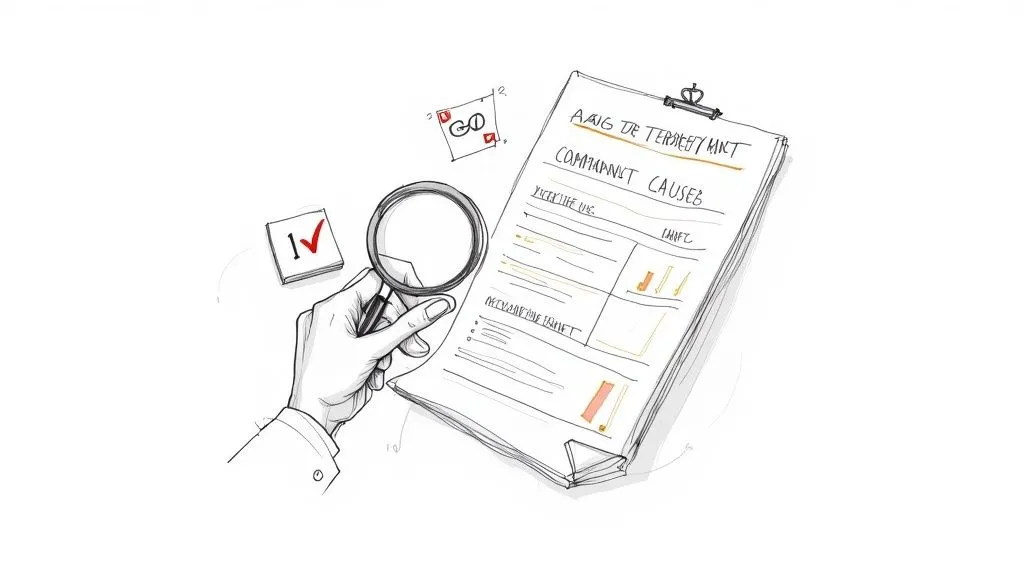
Cracking open a fresh tender file can feel a bit like starting a 1,000-piece puzzle without the picture on the box. Your first job is to lay out all the pieces, understand what you’re looking at, and figure out how the buyer will judge the finished picture.
For instance, almost every ITT will have scoring weights that clearly show how much each section is worth. Pay close attention here. Missing a mandatory requirement is an instant disqualification, no matter how brilliant the rest of your proposal is. You also need to get fluent in the buyer’s language, looking past the jargon to understand the underlying challenges they’re facing.
Is This Tender Right for You? The Go/No-Go Decision
Before you invest dozens or even hundreds of hours, you need to make a swift, honest call: should you even bid for this? This quick feasibility check, or Go/No-Go analysis, is your first filter.
Focus on the absolute deal-breakers:
- Are there any compliance must-haves you simply can’t meet?
- Do you meet the minimum capability thresholds (e.g., turnover, certifications)?
- Do you realistically have the people and resources to deliver?
If you spot any major red flags, it’s often smarter to walk away and save your resources for a better-fit opportunity. It stings, but it’s better than wasting weeks on a losing bid.
Decoding the Evaluation Criteria
The evaluation criteria section is your roadmap. It tells you exactly what the buyer values most and how they’ll score your response. To make this tangible, I always recommend creating a simple table to map out what’s required and why.
To help you get started, here is a quick reference guide to ensure you’ve thoroughly reviewed every critical component of the tender documents before you begin writing.
Tender Document Analysis Checklist
| Component to Check | What to Look For | Why It Matters |
|---|---|---|
| Mandatory Clauses | Non-negotiable terms, submission formats, and deadlines. | This is your ticket to the game. Fail here, and your bid won’t even be read. |
| Scoring Weights | The percentage points allocated to each section (e.g., Price 40%, Quality 60%). | Tells you where to focus your effort. A high-scoring section deserves more of your time. |
| Technical Standards | Specific data formats, security protocols, or regulatory requirements. | Missing a key technical spec is an easy way to get disqualified. |
| Social Value Model | Any requirements around social, economic, or environmental contributions (like PPN 06/20). | In public sector bids, this is often a mandatory, scored component. It’s not a ‘nice-to-have’. |
| Timeline & Milestones | Clarification deadlines, submission dates, and contract start dates. | Keeps your bid on track and ensures you don’t miss a critical window. |
This analysis is your foundation for building a compliance matrix.
A well-structured compliance matrix is your secret weapon. It instantly shows you where the gaps are, allowing you to fix them before it’s too late.
A simple traffic light system works wonders here: green for fully compliant, amber for needs work, and red for a serious problem.
Also, keep an eye on the bigger picture. In the UK, for example, the Procurement Act 2023 is changing the game, with a huge focus on transparency and social value. Understanding these shifts is vital.
Spotting Hidden Opportunities
Beyond the black-and-white requirements, read between the lines. The narrative sections often contain hints about what the buyer is really excited about. They might mention a desire for innovation, a push for digital transformation, or an interest in partnering with smaller, more agile suppliers. These are your opportunities to shine.
Mastering how to respond to RFP and win more deals can provide a solid framework that you can adapt for almost any tender submission. To ensure you’ve covered all your bases, our own due diligence checklist is a great tool for verifying everything before you commit.
A Few Practical Tips
Get your key people in a room (virtual or physical) to review the ITT together. A fresh pair of eyes from sales, product, and legal can spot things you might miss.
- Run a quick risk workshop. Score each requirement by its difficulty and its impact on your score.
- Don’t be afraid to ask for clarification. If a clause is ambiguous, submit a question before the deadline.
- Get all the key dates into a shared calendar with automated reminders. Obvious, but easily missed.
- Assign a clear owner for each section. This creates accountability and prevents things from falling through the cracks.
I’ve seen it time and again: early collaboration and clear ownership of the requirements dramatically improve the quality of the final submission—and the win rate.
For example, a SaaS client of mine once noticed a subtle, unstated preference for comprehensive user training in a tender. They decided to bundle an extra hands-on workshop into their offer. That small, proactive addition earned them 5 extra points and ultimately won them the contract.
Taking the time to dig deep into the tender documents is what separates the winners from the also-rans. Once you’re armed with these insights, you’re ready to start building a response that speaks directly to the buyer’s priorities.
Structuring Your Bid for an Easy Win
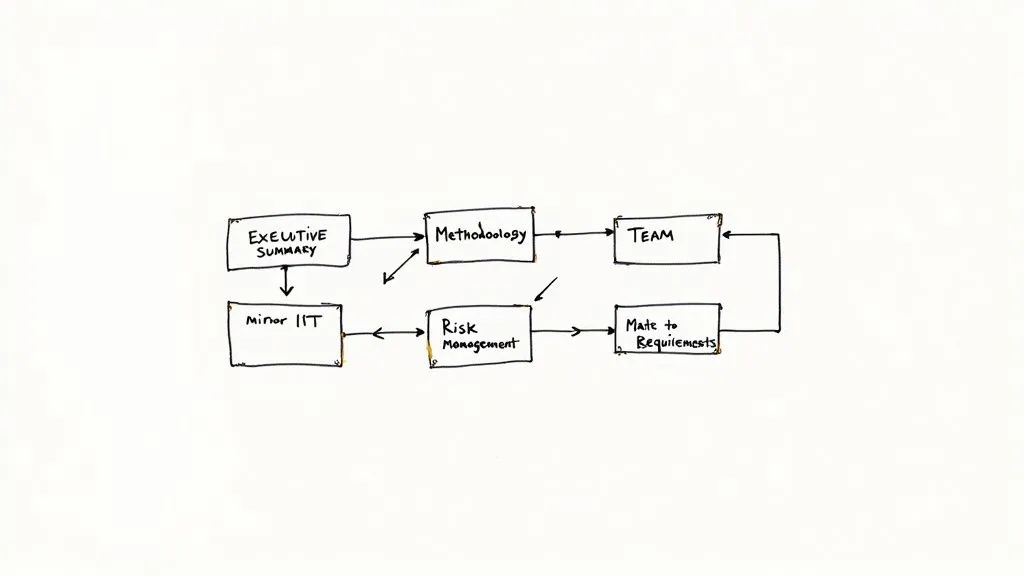
Let’s be honest: a disorganised tender is a failing tender. The people evaluating your bid are often overworked, sifting through dozens of dense documents. They simply don’t have the time or patience to hunt for answers. Your mission is to make their job easy.
Think of your bid’s structure as its user experience. A clean, logical layout immediately signals professionalism and respect for the evaluator’s time. On the other hand, a chaotic submission sends a worrying message that working with your company might be just as disorganised. A well-structured bid guides them effortlessly from one high-scoring answer to the next.
Start with a Compelling Executive Summary
The executive summary is your single chance to make a powerful first impression. It’s often the only section senior decision-makers will actually read, so it has to stand on its own as a powerful argument for choosing you. This isn’t just a fancy table of contents; it’s your entire pitch in a nutshell.
Your summary must get straight to the point, addressing the buyer’s core problem and spelling out precisely how your solution solves it better than anyone else. Zero in on two to three key differentiators that align perfectly with the most heavily weighted criteria in the evaluation matrix.
For instance, if the tender is all about data security and efficiency, your opening could be: “Our SaaS platform directly solves the data security challenges in section 4.2 with end-to-end encryption and UK-based data centres. Furthermore, our AI-driven workflow automation has proven to cut processing times by an average of 30% for clients like [Similar Company].”
Keep it concise, confident, and laser-focused on value. You want the evaluator thinking, “Finally, someone who gets it,” before they’ve even turned the page.
Mirror the Tender Document Precisely
If there’s one golden rule in this game, it’s this: structure your response to exactly match the numbering and headings of the ITT. If the buyer asks question 3.1.4, your answer must be under a heading that reads “3.1.4.” Don’t get creative and reorder, rename, or combine sections.
This isn’t just about being tidy; it’s a strategic move with huge benefits:
- It simplifies evaluation: You’re making it incredibly easy for the evaluator to tick off their boxes and assign scores. They will thank you for it.
- It ensures compliance: By following their map, you drastically reduce the risk of accidentally skipping a question or a mandatory requirement.
- It demonstrates attention to detail: It’s a subtle but powerful signal that you’re a diligent, professional, and easy-to-work-with partner.
Within each section, use formatting to your advantage. Break down complex answers with clear subheadings, use bullet points for features or benefits, and bold key phrases to draw their eyes right where you want them. Short, scannable paragraphs are your best friend.
Answering Common Tender Questions Effectively
You’ll quickly notice that certain questions pop up in almost every B2B SaaS tender. How you answer them can truly set you apart. Your responses need to be more than just factual—they need to tell a story of competence and reliability.
Methodology and Approach
When they ask about your implementation methodology, don’t just regurgitate generic project management jargon. Give them a clear, phased plan that feels real and achievable.
- Phase 1: Discovery & Onboarding: Detail the kick-off meetings, stakeholder interviews, and technical setup.
- Phase 2: Configuration & Training: Explain how you’ll tailor the platform and train their team for maximum adoption.
- Phase 3: Go-Live & Support: Describe the launch process and what your ongoing support model looks like.
This structured approach proves you have a tested, repeatable process for success.
Your Team and Their Expertise
Resist the urge to just list names and job titles. For the key people who will actually work on the contract, create mini-bios that highlight their relevant experience and qualifications.
For example, instead of “John Smith, Project Manager,” try something much more impactful: “John Smith, Senior Project Manager (PMP Certified): John has over 10 years of experience managing SaaS implementations for financial services clients, including a successful rollout for [Client Name] that resulted in a 98% user adoption rate within three months.” See the difference? You’ve connected his expertise directly to the buyer’s potential success.
Risk Management and Due Diligence
This is where you build crucial trust. Show them you’ve proactively considered what could go wrong. A simple risk register table is perfect for this. Identify potential risks (like data migration issues or low user adoption), assess their potential impact, and clearly outline your mitigation strategies for each one.
This demonstrates foresight and a mature, professional approach to partnership. Answering these questions thoroughly is a key part of vendor due diligence. For more insights, check out our practical guide to vendor due diligence to ensure you are fully prepared.
Crafting Compelling Content That Proves Your Value
When you’re writing a tender, persuasion is everything. But it’s not about flowery language; it’s about making every single claim unshakable. Generic, unsupported statements just don’t cut it with experienced evaluators. They’ve seen it all before.
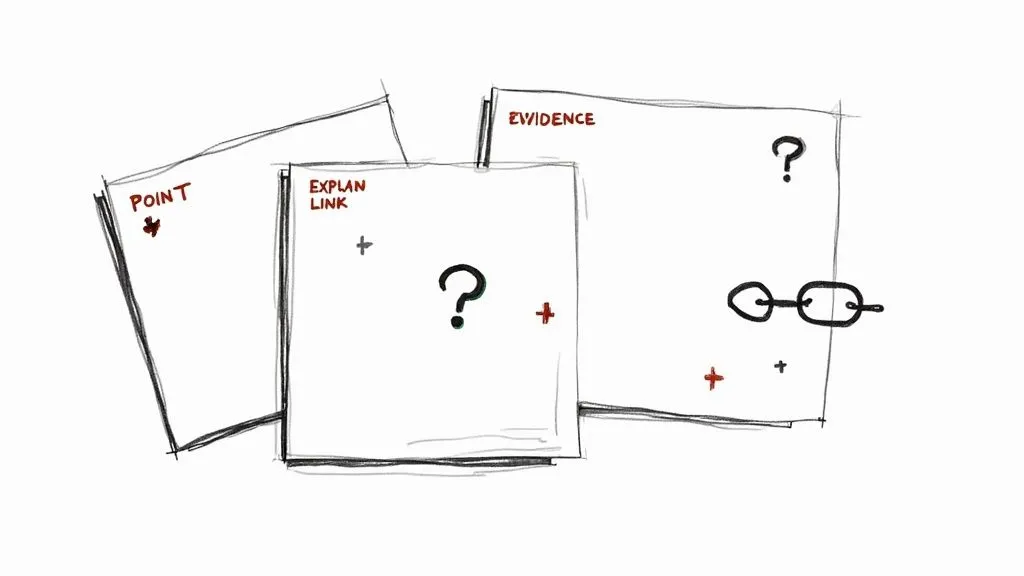
To make your arguments land with real impact, you need a clear structure. That’s where a simple but powerful technique like the PEEL method comes in. It forces you to back up every point you make.
Using PEEL to Anchor Your Arguments
The PEEL method is a brilliant way to keep your responses focused and credible. It breaks down like this:
- Point: Start with a direct, concise statement that answers the evaluator’s question.
- Evidence: Immediately back it up with hard proof. Think case studies, performance data, or client testimonials.
- Explain: Connect the dots for them. How does your evidence directly address their pain points or solve their specific problem?
- Link: Finally, tie it all back to the bigger picture – the overall value you’re offering and the core objectives of the tender.
Following this structure helps guide the evaluator through your logic, making your case stronger and more memorable. For example, instead of just saying your solution is efficient, you can show a 73% improvement in deployment time for a similar client and explain how that saves them money and resources.
Expert Tip: Don’t just present data. Weave it into a story. Pairing a powerful metric with a direct quote from a happy client makes your proof impossible to ignore.
Gathering Strong Evidence
The difference between a winning bid and a losing one often comes down to the quality of the evidence. In a competitive field like UK construction, for instance, most bids are competent, scoring around 7 out of 10. But the contracts go to those who can push their score to a 9. That last gap is closed with specific, tailored proof, not generic claims.
Think about how you can elevate your evidence from standard to standout.
| Evidence Type | Generic Claim | Tailored Proof |
|---|---|---|
| Case Study | ”We delivered great results." | "For a client in your sector, we achieved a 25% cost saving, directly addressing requirement 4.2 of the ITT.” |
| Testimonial | “They provide a great service.” | “Their team’s three-month training programme saved us £50k in the first year alone.” – Jane Doe, CFO |
| Certification | ”We are ISO certified." | "We hold an active ISO 27001 certification, with our last audit passed on [Date] with zero non-conformities.” |
Always align your examples with the specific sector and, where possible, the exact requirements laid out in the Invitation to Tender (ITT).
Demonstrating Real-World Impact
Data is powerful, but it’s even better when framed in a “before-and-after” context. For a SaaS vendor, this could mean showing how your platform reduced a client’s customer support calls by 45%.
Structure these mini-case studies clearly, often using subheadings that mirror the tender’s own language. This makes the evaluator’s job easy.
- Lead with the big, impressive number.
- Briefly describe the client’s challenge.
- Outline the key steps your solution involved.
- Summarise the final outcome with clear metrics.
This approach builds trust by demonstrating tangible, real-world value. If you’re looking for more ideas on organising this proof, our guides on https://responsehub.ai/category/best-practices-knowledge-management can be a great resource.
Aligning Social Value to Government Priorities
For UK public sector tenders, proving your social value is no longer a “nice-to-have” – it’s a critical scoring component. You need to show measurable contributions that align with government priorities.
Be specific and provide evidence for your claims:
- Net Zero Targets: Don’t just mention them; show your carbon reduction plan and progress to date.
- Skills and Employment: Detail your apprenticeship schemes, local hiring statistics, or engagement with SMEs in your supply chain.
- Community Benefits: Quantify your impact. How many training hours have you provided? What percentage of your staff are hired locally?
Embedding audited metrics and official certifications under each social value claim proves you’re not just paying lip service. It shows your entire operation is aligned with national targets. This strategic thinking is a key part of learning how to write a business proposal that wins deals.
By integrating concrete proof of your social contributions, your tender moves beyond a simple price comparison and becomes a true value proposition.
Developing a Smart Pricing Strategy
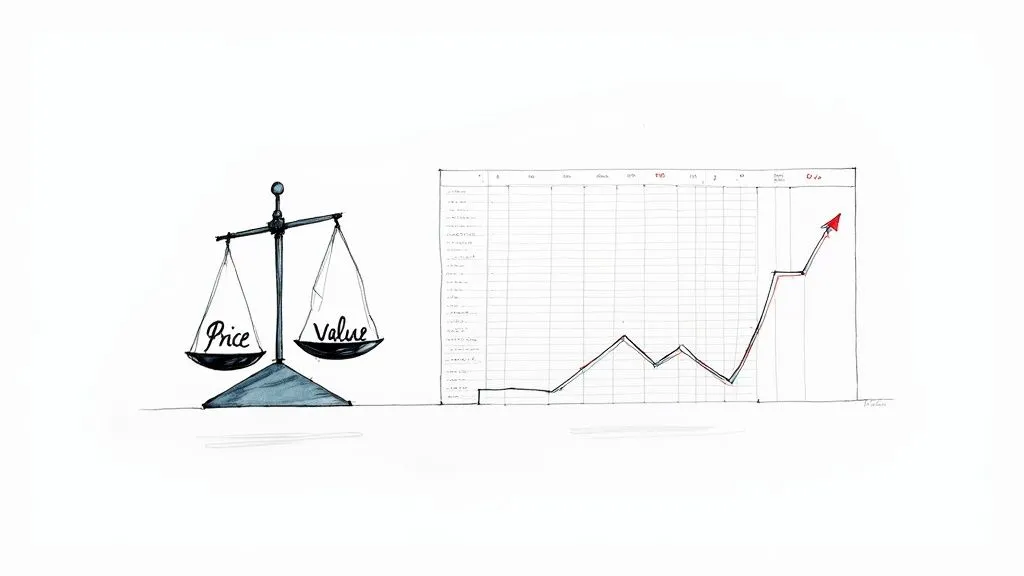
Drawing up a tender often prompts you to think the lowest bid wins—but any seasoned evaluator will tell you a bargain price can mask hidden fees, patchy support or an off-target solution. In reality, procurement teams hunt for value for money, not rock-bottom rates.
Every pound in your proposal must reflect a clear benefit. Shift the focus from “How much?” to “What will we gain?”
Choosing The Right Pricing Model
When you’re selling B2B SaaS, the structure of your fee schedule matters as much as the numbers themselves. Two models dominate:
Fixed Price
Ideal for well-scoped projects that rarely wander off track. Buyers love the budget certainty, and you demonstrate confidence by absorbing any overruns.Time & Materials (T&M)
Suits initiatives where scope can evolve or early discovery is essential. To ease nerves about spiralling costs, include a detailed rate card, real-time reporting and clear ceilings on expenditure.
In many cases, a hybrid approach strikes the perfect balance. For instance, lock in a fixed fee for the core licence and initial rollout, then apply T&M to customisation, training or ongoing consultancy. This combo offers predictability up front and flexibility where it counts.
Justifying Your Price And Demonstrating ROI
A bare list of fees won’t cut it—you need a narrative that links cost to long-term gain. Frame your figures around the outcomes your platform delivers.
Imagine showing how automation slashes manual data entry, freeing staff to tackle higher-value tasks and saving an organisation £40,000 a year in administrative overheads. Suddenly your price feels like a strategic investment, not an expense.
“Pricing sections that simply list costs are soon forgotten. The ones that weave a tale of efficiency gains, mitigated risks and future growth stick in the mind.”
Building A Transparent Pricing Schedule
Clarity is your ally. A pricing schedule riddled with hidden charges or calculation errors undermines trust at first glance. Break your commercial proposal into digestible pieces:
- One-off implementation and setup fees
- Annual or monthly subscription charges (per user or tiered)
- Optional modules and add-ons
- Professional services (training, support, consultancy)
This level of detail shows you’ve thought through every element. No surprises, no scope for dispute—just a solid foundation for a long-term partnership.
Finalising Your Submission to Avoid Costly Mistakes
You’ve spent weeks planning, writing, and pulling together your pricing. Now comes the final hurdle: getting it submitted. This is where simple, entirely preventable errors can undo all your hard work. A polished and compliant submission screams professionalism; a rushed one riddled with mistakes just plants a seed of doubt.
This final stretch isn’t just about uploading a few files. It’s your last chance to run a proper quality assurance process, making sure your bid is not only persuasive but also perfectly compliant and technically sound. I’ve seen too many otherwise strong bids fall at this last step because the team ran out of steam.
The Power of the Red Team Review
Before you even think about final checks, you need a fresh pair of eyes. This is where a Red Team Review is worth its weight in gold. The idea is simple but incredibly effective: grab a colleague who has had minimal involvement with the bid and ask them to play the role of the evaluator.
Their job isn’t to look for typos. It’s to hunt for weaknesses from the buyer’s perspective. Armed with the evaluation criteria, they need to ask the tough questions:
- Is our core value proposition crystal clear in the executive summary?
- Have we directly and convincingly answered every single question?
- Are our big claims backed up with solid, compelling evidence?
- Is the pricing easy to understand and does the value stack up?
This “fresh-eyes” review almost always uncovers gaps in logic, muddled arguments, or places where the persuasive thread gets a bit thin. It’s your last real chance to fix any strategic flaws before the bid goes out the door.
I once saw a Red Team Review catch that a bid had brilliantly answered the “what” but completely missed the “why.” A quick rewrite to better connect the solution to the client’s stated mission transformed the proposal from good to great.
Navigating the Submission Portal
Online procurement portals can be notoriously fiddly. Each one has its own quirks, and they always seem to throw a spanner in the works at the last minute. Don’t leave your first encounter with the portal until the final hour.
Get yourself familiar with the system at least 48 hours before the deadline. Seriously. Check for things like file size limits, required formats (they might demand PDF over Word), and any specific naming conventions. It’s always a good idea to upload a test document to see how the process works and get a feel for how long the final upload will take. Technical glitches happen all the time, and having that buffer is non-negotiable.
The Ultimate Pre-Submission Checklist
A final, methodical check is your safety net. This isn’t a quick skim-read; it’s a formal checklist to verify every last detail. Think of it as the final gate your tender must pass through before it’s released into the wild.
- File Naming: Do all our filenames match their required naming convention (e.g., “OurCompanyName_TechnicalProposal.pdf”)?
- Signatures: Has every single mandatory form been printed, signed in ink by the right person, and scanned back in cleanly?
- Formatting: Is the pagination correct? Are all the tables and images showing up properly in the final PDF versions?
- Completeness: Have all appendices, certificates, and other supporting documents been included and correctly referenced in the main body?
- Final Read-Through: Has one last proofread been done to catch any glaring spelling or grammar mistakes?
Ticking off these final steps with care and attention means that when you finally click that “submit” button, you can do it with the confidence that you’ve put your absolute best work forward.
Answering Your Top Questions on Tender Writing
The tender process can feel like a minefield, where every question seems to have a hidden tripwire. It’s completely normal to have questions, no matter how many bids you’ve written.
Here, I’ll walk you through four of the most common concerns I hear from SaaS teams, from managing your time to dealing with a loss. Think of this as a quick Q&A with someone who’s been in the trenches.
These aren’t just theoretical answers; they’re practical tips designed to build your confidence and sharpen your approach for the next big opportunity.
How Much Time Should I Actually Set Aside for a Tender?
This is the golden question, and the honest answer is: it depends. But for most mid-level tenders, you should probably block out around 2-4 weeks of solid, focused work. Rushing it in the last few days is a recipe for disaster.
A good rule of thumb I’ve always used is to dedicate at least 20% of that time just to planning. This is where you really get under the skin of the requirements and make sure you’re not chasing a lost cause.
From there, I’d split the remaining time like this:
- Planning & Strategy (20%): Rip the document apart. Question everything, spot the ambiguities, and get your clarifications in early.
- Writing & Building (50%): This is the heavy lifting – drafting compelling answers and gathering all your evidence, like case studies and certifications.
- Review & Refine (30%): This phase is non-negotiable. It’s for polishing your language, getting a second pair of eyes on it, and doing a final compliance check.
I remember one public sector IT tender we worked on. The security requirements were intense, and getting the final sign-offs from our tech, legal, and compliance teams took almost the entire four-week window. If we hadn’t built in that buffer, we would have missed the deadline, simple as that.
What Are the Most Common Mistakes People Make?
Hands down, the biggest and most frequent mistake is submitting a generic, copy-and-paste response. It screams that you haven’t really read the document.
Evaluators are experts at spotting this. They read dozens of these things, and unpersonalised text just gets skimmed over, tanking your score before you’ve even started. Instead, make it your mission to mirror the language and structure of each question, providing specific examples from your own projects that directly address what they’re asking.
A tailored answer isn’t just about showing attention to detail. It’s a powerful signal that you’re genuinely interested and have taken the time to understand their problems.
A SaaS vendor I know learned this the hard way. They lost points by describing their standard customer support package instead of highlighting the bespoke 24/7 monitoring dashboard they’d built for a similar client in the finance sector. That single, concrete example would have made all the difference.
Can I Use AI Tools to Help Me Write Bids?
AI is a fantastic co-pilot, but you should never let it fly the plane solo. Tools can be brilliant for speeding up initial research, checking your grammar, and even outlining a basic structure.
However, an AI-generated tender almost always lacks the soul and strategic nuance that a winning bid needs. It can’t tell a compelling story or connect your solution to the client’s deepest pain points.
Industry experts are clear on this: while AI can make you more efficient, human oversight is absolutely essential for strategic depth. You can read more on AI’s role in procurement on practiceguides.chambers.com.
I’ve used AI to format complex pricing tables, and it saved me hours. But afterwards, I went back and rewrote every single caption by hand to perfectly match the tender’s terminology. It’s about finding that balance.
- Do use AI for data gathering and formatting ideas.
- Don’t rely on it for the final, critical edits – that’s a job for your subject-matter experts.
- Always check every AI-suggested claim against your own real-world case studies and evidence.
What Should I Do After Losing a Tender?
Losing a bid stings, but it’s also one of the best learning opportunities you’ll ever get. The key is to treat it like a debrief, not a defeat.
Your first step, always, is to request formal feedback. Most procurement authorities are obligated to share scores and comments if you ask. This isn’t about arguing the decision; it’s about gathering intelligence.
Once you have it, here’s a simple process to turn that loss into a future win:
- Get the full breakdown: Ask for the detailed scoring sheet and any written feedback.
- Map it to your response: Put your submission and their feedback side-by-side. Where were the gaps? Was it pricing, a weak technical answer, or a missed compliance detail?
- Share the lessons: Don’t keep this information to yourself. Document the findings in a shared knowledge base so the whole team benefits.
- Hold a quick post-mortem: Get the bid team together for 30 minutes. What’s the one thing you’ll all do differently next time?
By making this a standard part of your process, you build a powerful feedback loop. Every mistake becomes a lesson that strengthens your next proposal, sharpening your competitive edge one bid at a time.