· Jane Iamias · requirement collection template · 16 min read
Streamline Compliance with a Requirement Collection Template
Discover how a requirement collection template simplifies security and compliance. Learn to capture needs, map controls, and streamline audits with this guide.
A solid requirement collection template is your project’s blueprint. It’s more than a to-do list; it’s a structured guide that makes sure you capture every crucial functional, non-functional, and security detail right from the start. Think of it as the foundational document that keeps everyone aligned and stops scope creep in its tracks.
Build a Strong Security and Compliance Foundation
Diving headfirst into a compliance project without a clear structure is asking for trouble. A well-thought-out requirement collection template isn’t just about listing features—it’s about embedding the project’s security and compliance DNA from the very first conversation. The problem is, most generic templates are built for what a system should do (the functional bits), completely ignoring how it must do it securely.
Beyond the Basic Checklist
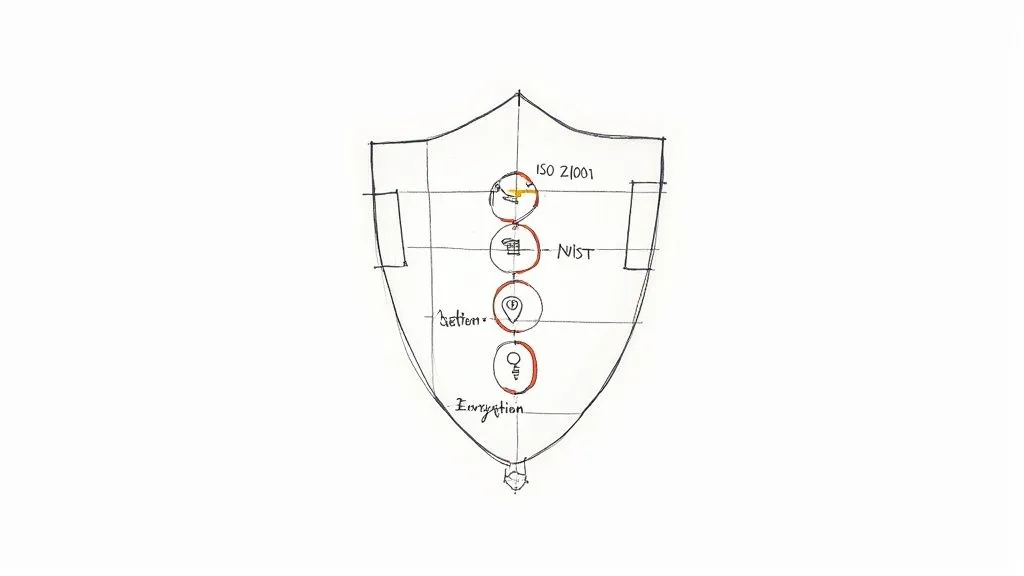
For any UK organisation wrestling with frameworks like ISO 27001 or NIST, glossing over the non-functional requirements is a massive risk. These are the nuts and bolts of your security posture—the very details that define your resilience and are so often missed by off-the-shelf templates.
A security-first approach means you’re asking tougher questions much earlier in the process. Things like:
- Data Residency: Where exactly will customer data be stored and processed to stay on the right side of UK GDPR?
- Access Controls: Who gets access to what, and what specific conditions must be met?
- Encryption Standards: What are the non-negotiable encryption levels for our data, both when it’s moving and when it’s sitting still?
- Audit Trails: Which user actions absolutely have to be logged to maintain accountability?
When you build these questions directly into your template, security stops being an afterthought and becomes a core project principle. It’s this proactive stance that saves you from costly rework down the line and proves your due diligence to auditors and clients.
A requirement collection template isn’t just a document; it’s a strategic tool. It forces critical conversations about security and compliance to happen at the beginning of the project lifecycle, not during a last-minute audit.
Establishing a Single Source of Truth
The main reason for using a comprehensive template is to create one single, undisputed source of truth. We’ve all seen it: requirements are scattered across endless email chains, random meeting notes, and a dozen different documents. It’s a recipe for confusion. This chaos leads to developers building the wrong thing and compliance teams pulling their hair out trying to map controls to project outputs.
Our security-focused template is structured to bring clarity to everyone involved, from the developers and project managers right through to your legal and compliance experts. It’s designed to ensure every single requirement is clearly defined, justified, prioritised, and tied back to a specific security control or business goal. This methodical approach turns a simple list into a powerful governance tool, making your journey to compliance far more predictable and a whole lot less painful.
A Practical Guide to Using the Template
A template is only as good as the information you put into it. To turn your requirement collection template from a simple spreadsheet into your team’s single source of truth, every field needs to be filled out with clarity and purpose. Let’s walk through the essential fields, breaking down how to move from a vague idea to a concrete, actionable requirement that everyone—from developers to auditors—can understand.
Defining the Core Requirement
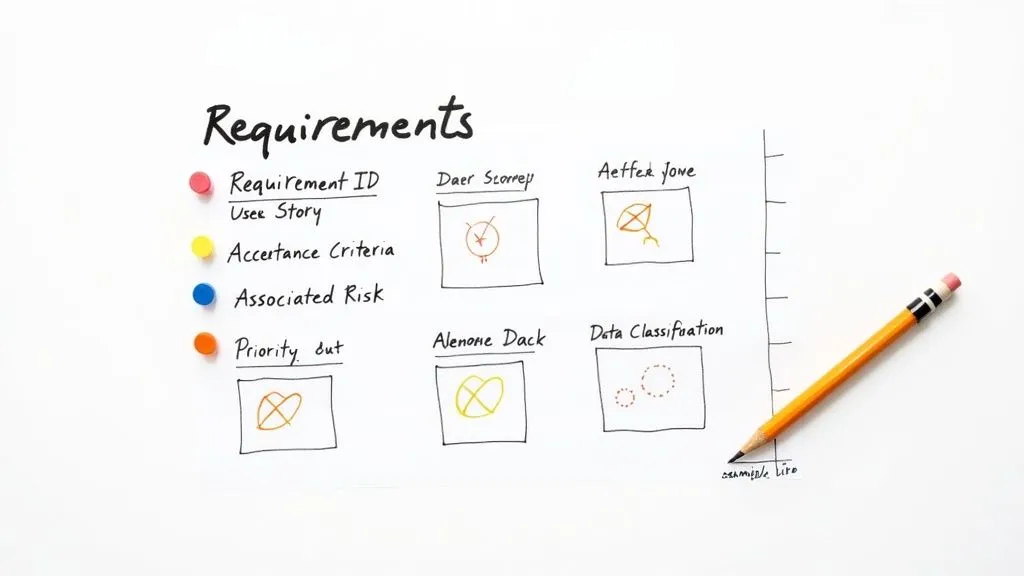
First things first, you need to capture the fundamental details of what needs to be done. This means creating a unique ID, writing a clear user story, and defining unambiguous success criteria.
Requirement ID: This isn’t just a random number; it’s a unique tracker for the requirement’s entire lifecycle. I’ve found a simple format like
[PROJECT]-[TYPE]-[###]works wonders. For example,CRM-SEC-001immediately tells you it’s for the CRM project, it’s a security requirement, and it’s the first one logged. This simple structure makes filtering and reporting a breeze later on.User Story: Try to avoid technical jargon here. The best approach is to frame the requirement from the end-user’s perspective to capture the real intent. So, instead of a blunt “Implement MFA,” you’d write: “As a remote employee, I want to use multi-factor authentication so that I can securely access company systems from outside the office.” This immediately clarifies the why behind the what.
Acceptance Criteria: These are the black-and-white conditions that prove the requirement has been successfully met. They must be testable and result in a simple pass or fail. For our MFA example, good criteria would look like this:
- Users are prompted for a second factor (e.g., authenticator app code) after entering their password.
- Successful authentication grants access to the internal dashboard.
- Three failed attempts lock the account for 15 minutes.
Essential Fields in Your Requirement Collection Template
To help you get started, here’s a breakdown of the key fields you’ll find in the template, what they’re for, and a practical example for each one.
| Field Name | Purpose | Example |
|---|---|---|
| Requirement ID | Provides a unique, traceable identifier for each requirement. | CRM-SEC-001 |
| User Story | Describes the feature from an end-user perspective, focusing on value. | ”As a remote employee, I want to use MFA to securely access company systems.” |
| Acceptance Criteria | Defines the specific, testable conditions for completion. | ”User is prompted for a second factor after password entry.” |
| Priority | Ranks the requirement based on urgency and business impact. | Priority 1 (Critical) |
| Associated Risk | Explains the potential negative outcome if the requirement isn’t met. | ”Unauthorised access to sensitive customer data.” |
| Data Classification | Identifies the sensitivity of the data involved. | Confidential (as it involves PII) |
| Compliance Mapping | Links the requirement to specific industry standards or regulations. | ISO 27001: A.9.4.2 |
| Owner | Assigns responsibility for the requirement’s implementation. | Jane Doe (IT Security) |
Filling out each of these fields consistently is what transforms a simple list into a robust system for managing security and compliance.
Adding Security and Business Context
With the core requirement defined, the next step is to layer in the crucial security and business context. These are the fields often missing from generic templates, yet they’re absolutely essential for proper compliance and risk management. For teams working in sprints, mastering Agile requirements documentation is key to weaving these details in efficiently.
Assigning Priority and Risk
Let’s be honest, not all requirements are created equal. You need a straightforward way to distinguish a critical security control from a ‘nice-to-have’ feature.
A common method I’ve used successfully is a priority score (e.g., 1-4, from Critical to Low) combined with a risk assessment. The key question to ask is: What is the business impact if this requirement is not met? For our CRM-SEC-001 example, the associated risk might be “Unauthorised access to sensitive customer data,” which would almost certainly earn it a Priority 1 rating. This simple process provides a clear, defensible justification for allocating resources.
Classifying Data and Mapping Compliance
Understanding the data is fundamental to applying the right security controls.
Data Classification: First, identify the type of data this requirement touches. Is it Public, Internal, Confidential, or Restricted? Our MFA requirement protects access to systems containing customer PII (Personally Identifiable Information), so its classification would undoubtedly be Confidential.
Compliance Mapping: This is where your template really starts to shine as a powerful audit tool. You need to link the requirement back to specific controls from relevant frameworks. For instance,
CRM-SEC-001could map directly to:- ISO 27001: A.9.4.2 (Secure log-on procedures)
- NIST CSF: PR.AC-7 (Enforce Multi-Factor Authentication)
- GDPR: Article 32 (Security of processing)
This mapping creates a clear, traceable line from a practical implementation on the ground all the way back to your legal and regulatory obligations.
By diligently completing these security-specific fields, you’re building an evidence trail. When an auditor asks how you’re complying with a specific ISO control, you can simply filter your template and show them the exact requirements, implementations, and tests that satisfy it. This level of organisation demonstrates true due diligence and saves a world of pain during an audit.
Mapping Requirements to UK Compliance Frameworks
It’s one thing to gather a list of security requirements, but the real power lies in connecting them directly to your legal and regulatory obligations. This is the step where your requirement collection template stops being just a project management tool and becomes a cornerstone of your compliance strategy. You’re creating a clear, evidence-based line from the work your teams are doing straight to the standards you’re legally required to uphold.
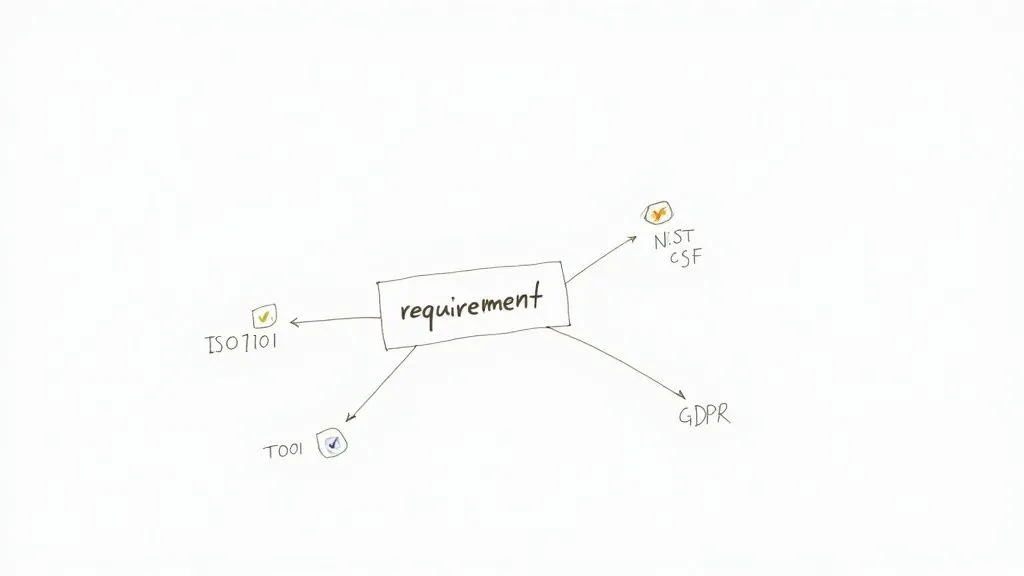
Suddenly, you have a transparent view of your organisation’s security posture that you can share with anyone from the board to external auditors. It shows you’re being deliberate and proactive about security, not just reacting to problems.
Connecting a Single Requirement to Multiple Controls
You can think of compliance frameworks as different languages describing the same core security principles. The good news is that a single, well-written requirement can often satisfy multiple controls across several different standards. That’s a huge win for efficiency.
Let’s look at a common example from the template:
- Requirement ID:
SYS-SEC-005 - User Story: “As a system administrator, I need all privileged user access to be logged and reviewed, so that we can detect and investigate unauthorised activity.”
This requirement isn’t just an isolated task. It has roots in several key UK and international compliance frameworks.
Real-World Framework Mapping Example
For our SYS-SEC-005 requirement, the mapping in your spreadsheet could look something like this:
- ISO 27001: This clearly links to control A.12.4.1 (Event logging), which requires that event logs recording user activities and security events must be produced and maintained.
- NIST CSF: It fits neatly under the DE.AE-2 (Analyse events) function, which is all about correlating and analysing security logs to spot potential threats.
- GDPR: The requirement directly supports Article 32 (Security of processing). Why? Because logging and monitoring are fundamental technical measures for ensuring personal data is secure.
By documenting these connections, you’re building a powerful, living audit trail. When an auditor asks how you’re meeting ISO control A.12.4.1, you won’t have to scramble for evidence. You can simply filter your template by that control and show them a list of specific, implemented requirements that prove you’re compliant. It’s a much more confident position to be in.
Mapping isn’t just a box-ticking exercise for auditors. It’s about creating a unified control environment where one good security practice strengthens your compliance across the board. It pulls compliance out of its silo and integrates it directly into your development workflow.
This approach ensures every security feature you build has a clear, justifiable purpose tied to the business’s regulatory duties. Of course, a solid framework is essential, and you can explore our resources for a data protection policy template for the UK to help build out your documentation.
Creating this web of connections within your template provides undeniable proof of due diligence. It demonstrates to regulators, clients, and partners that your approach to security is organised, comprehensive, and a core part of how you operate.
Bringing Your Requirements Template to Life
A filled-out requirement collection template is a great start, but if it just sits on a shared drive, it’s not doing its job. The real magic happens when you weave it into the fabric of your project workflow, turning it from a static checklist into a living, breathing tool that everyone uses. This is about creating a dynamic process for reviews, sign-offs, and keeping track of changes.
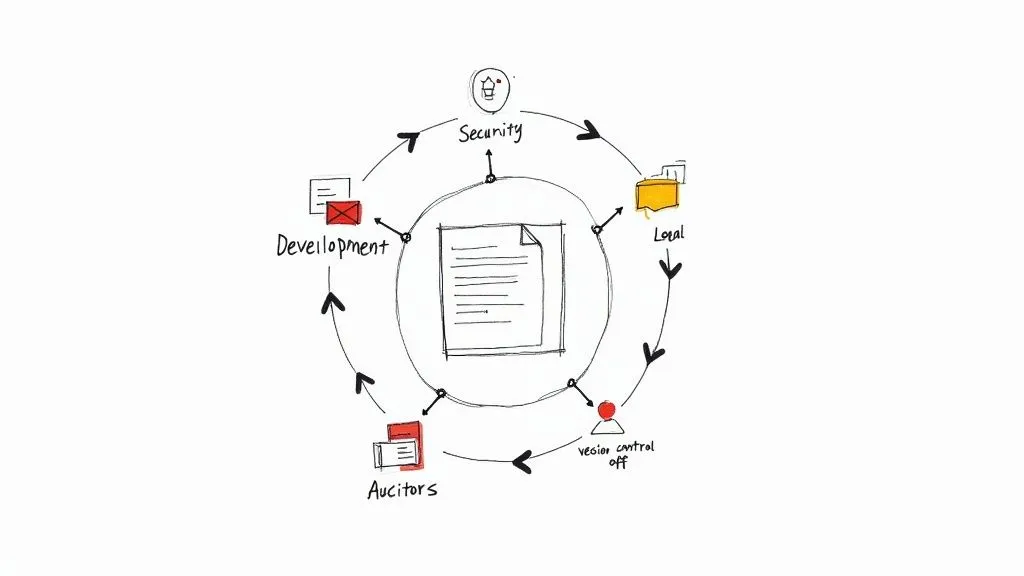
The aim is to build a clear, transparent lifecycle for every single requirement. Projects evolve, and your documentation must keep up. Without a solid process, you’re inviting the kind of ambiguity that leads to expensive mistakes and gaping security holes. A proper workflow gets the right people talking at the right time.
Setting Up a Solid Review and Sign-Off Process
One of the biggest mistakes I see is teams treating requirement gathering as a one-and-done task. It’s not; it’s an ongoing conversation. To manage this effectively, you need to establish formal review cycles that bring all the key players into the loop.
This is where you move beyond emailing spreadsheets back and forth. Instead, use a central hub where different teams can comment, ask questions, and suggest edits directly on the requirements themselves. A standard review loop usually involves:
- The Technical Team: They’ll check for feasibility and give a realistic idea of the effort involved.
- The Security Team: Their job is to validate the compliance mappings and risk assessments.
- Legal & Compliance Folks: They make sure everything lines up with regulatory duties.
- Product Owners: They give the final nod, confirming that a requirement actually serves the business goals.
Every piece of feedback from these stakeholders should be logged right alongside the template. This creates a clear audit trail of every decision, which is exactly the kind of evidence you’ll need for processes like vendor due diligence.
Handling Versions and Changes Like a Pro
Let’s be honest: requirements change. It’s a fact of life in any project. The crucial part is how you manage those changes. Without a clear version control system, you’ll have different teams working from different documents, which is a recipe for chaos.
A living document requires a living process. Your workflow must treat the template not as a final decree, but as the current, agreed-upon source of truth that can adapt under controlled conditions.
This isn’t just theory; it works in practice. Look at the University of Edinburgh’s Document Management Programme. They had to manage a staggering 737 separate requirements pulled from hundreds of different sources. By using a structured template and process, they made sure every single requirement was traceable and tied directly to user needs. It’s a fantastic model for keeping complex projects on track. You can read more about their successful requirements management process to see how they did it.
Bringing Your Requirements to Life with Automation
Let’s be honest: manually tracking security requirements in spreadsheets is a chore. It’s a huge time-drain, prone to human error, and simply doesn’t scale as projects get more complex. The fundamental problem with a static requirement collection template is that it’s a snapshot in time. It’s great for initial capture, but it struggles to keep pace with the fluid reality of project delivery and ongoing compliance.
This is where automation completely changes the game. When you graduate from a disconnected spreadsheet to an intelligent platform, your template is no longer just a document. It becomes a living, breathing compliance engine. Suddenly, your data starts working for you, not the other way around.
From Static Document to Intelligent System
Imagine uploading your carefully populated template into a tool like ResponseHub. In an instant, those requirements are no longer just passive rows in a table. They become active, trackable items inside a dynamic system. For modern teams that need to move quickly without dropping the ball on security, this shift is everything.
Once your requirements are in the system, you unlock some powerful capabilities:
- Smart Tasking: The platform can automatically create and assign tasks to the right people, pulling directly from the ‘Owner’ field you filled out.
- Live Tracking: You can link requirements directly to specific compliance controls and watch their implementation status update in real-time. No more chasing down engineers for status reports.
- Effortless Reporting: Need to show progress against ISO 27001 or the NIST CSF? You can generate on-demand reports for stakeholders with a single click.
This move drastically cuts down the administrative slog. We’ve seen teams reclaim hundreds of hours that were once swallowed by manually updating trackers and piecing together reports.
The goal of automation isn’t just to do the same tasks faster. It’s to build a continuously monitored compliance posture, giving you a real-time, evidence-backed view of your security that a spreadsheet could never provide.
The Power of an Integrated Knowledge Hub
Real automation shines when everything is connected to a central source of truth. By plugging your requirement management into a wider knowledge base, you create a powerful, self-sustaining feedback loop. For a deeper dive into this idea, check out our guides on best practices for knowledge management.
As your team completes security questionnaires or responds to audits, the answers and evidence they provide can automatically enrich your central repository. This means your documentation is always fresh and accurately reflects the latest controls you’ve put in place. For those looking to take this a step further, exploring an AI document management system can unlock even greater efficiencies.
Ultimately, this connected approach gets your most valuable people—your security and engineering experts—out of the administrative weeds. Instead of wasting their days chasing statuses and formatting reports, they can focus on what they were hired to do: solve complex security problems and build a more resilient organisation. The outcome is a far more efficient, accurate, and proactive way of managing security and compliance.
Frequently Asked Questions About Requirement Collection Templates
Even with the best guide in hand, putting a new process into practice always brings up real-world questions. A requirement collection template is a brilliant bit of kit, but making it work day-to-day is where the real magic happens. Let’s tackle some of the most common queries we see teams grapple with.
Who’s Actually in Charge of This Template?
This is a classic question. While a project manager often keeps the wheels turning, the template itself is very much a team effort.
Typically, the Product Manager or business analyst owns the content, making sure everything lines up with the bigger picture. That said, your security, legal, and technical leads need to be all over it, actively adding their expertise and signing off on the bits that fall into their court.
It’s better to think of it not as one person’s document, but as a shared space. The project manager is the guardian, making sure the process is followed, but the experts are the ones responsible for the quality of the information inside.
How Granular Do We Need to Get With Requirements?
You need to be just detailed enough to leave no room for doubt. A requirement is solid when a developer can build it and a tester can check it without having to come back and ask what you really meant. This means kicking vague terms like “user-friendly” or “secure” to the kerb.
Let’s look at an example:
- Vague: “The system must be secure.”
- Specific: “All user passwords must be hashed using Argon2id with a minimum salt length of 16 bytes.”
The aim is to eliminate guesswork, because that’s where most project failures begin.
A huge mistake is to treat the template as a one-and-done checkbox exercise. It’s a living document. As the project changes and you learn new things, it has to be updated through a proper change control process.
Are These Templates Really Suitable for Massive Projects?
Absolutely. In fact, for large, complex projects, they’re not just suitable—they’re essential.
Take the 2021 Census in England and Wales. The Office for National Statistics (ONS) relied on a highly structured requirement collection process to sift through over 100 potential topics. This methodical approach helped them balance public need against data quality, ultimately finalising the 50 questions that led to an incredible 97% response rate. It’s a perfect example of how a well-managed template ensures even the biggest projects hit their targets. You can read more about the ONS census planning process to see how they did it.