· Jane Iamias · hecvat · 21 min read
A Vendor's Guide to Mastering the HECVAT
Master the HECVAT with our expert guide. Learn to navigate the security assessment process, understand the different versions, and respond efficiently.

If you’re a vendor looking to work with universities, you’ve probably come across the acronym HECVAT. It stands for the Higher Education Community Vendor Assessment Toolkit, and it’s essentially the gatekeeper for getting your technology onto campus.
In simple terms, HECVAT is a standardised questionnaire that universities use to check out a vendor’s security and data protection practices. Think of it as a single, shared security ‘passport’ that can get you into multiple academic institutions, saving everyone a lot of time and paperwork.
Understanding The HECVAT Framework

Before the HECVAT came along, selling to universities was a bit of a nightmare. Each institution had its own bespoke security questionnaire. A vendor might have to fill out dozens of similar but slightly different forms for each new sale, a process that was slow, repetitive, and a massive drain on resources.
The higher education community knew this wasn’t working. So, led by groups like EDUCAUSE, a team of university CISOs and IT experts got together to build a better way. They created a single, comprehensive assessment toolkit to make life easier for everyone.
A Standardised Approach to Vendor Risk
At its heart, the HECVAT is all about streamlining how universities manage third-party risk. It provides a common set of questions, allowing them to assess the security posture of their partners consistently and fairly. It’s not a security framework in its own right; instead, it’s a practical tool that pulls from established standards like NIST and ISO 27001.
For any vendor in the education space, getting to grips with the HECVAT isn’t just a good idea—it’s a fundamental part of the sales cycle. A solid, well-prepared response shows you take data protection seriously and can make the procurement process move much, much faster.
The HECVAT boils down key security controls into one standard format. This simple act transforms a complex, custom-built assessment process into something predictable and efficient, building trust between institutions and their technology partners.
To give you a clearer picture, let’s break down the core elements of the HECVAT.
HECVAT at a Glance
This table summarises the main components and their roles within the framework.
| Component | Purpose |
|---|---|
| Standardised Questions | Creates a consistent baseline for evaluating all vendors, ensuring fairness and comparability. |
| Risk-Based Tiers | Offers different versions (Lite, Full) to match the assessment’s depth to the vendor’s data access level. |
| Control Mapping | Aligns questions with established security frameworks (NIST, ISO 27001), giving them weight and credibility. |
| Community-Driven | Developed and maintained by higher education professionals to address the sector’s specific challenges. |
Understanding these components helps you see why each question is being asked and how it fits into the university’s overall risk evaluation.
Key Objectives of the HECVAT
The HECVAT was designed to tackle several critical goals for universities, and understanding these will give you the context needed to craft better answers. This is a specific niche within the broader world of SaaS risk management, with its own unique priorities.
The main goals are:
- Data Protection: First and foremost, they need to know that sensitive student and institutional data is safe and handled in line with regulations like GDPR and FERPA.
- Operational Resilience: Universities need assurance that your services are reliable and that you have solid plans for business continuity and disaster recovery.
- Risk Mitigation: The questionnaire helps them spot potential security weak points in your product before it gets connected to their campus IT systems.
- Compliance Verification: It’s a formal way to confirm that your practices align with all the necessary legal, regulatory, and institutional security policies.
By rolling all this into one questionnaire, universities can make smarter, faster decisions. For vendors, the payoff is huge. A single, top-notch HECVAT response can open doors at hundreds of institutions, making the upfront effort a very wise investment for scaling your business in higher education.
Decoding the Different HECVAT Versions
When you first encounter a HECVAT request, it can feel a bit like ordering coffee. You don’t just ask for “a coffee”—you need to know if you’re getting a quick espresso or a full-on latte. The HECVAT works the same way, with different versions tailored to different levels of risk.
Getting a handle on these variations is the key to managing your workload. Knowing which one is likely coming your way means you can line up the right people and pull the necessary documents ahead of time. This turns a last-minute panic into a smooth, predictable part of your sales process.

HECVAT Full: The Comprehensive Security Deep-Dive
The HECVAT Full is the big one. Think of it as a complete security audit, reserved for vendors whose products or services will handle a university’s most sensitive data. If your solution touches student records, financial details, or protected health information, this is almost certainly the questionnaire you’ll be filling out.
With over 250 questions, it gets into the weeds on everything from your data protection policies to your incident response plans. You’ll be asked about:
- Data Protection: How you encrypt, store, and transmit sensitive data.
- Access Control: Who can access the data and how you manage those permissions.
- Incident Response: Your exact plan for what happens if a security breach occurs.
- Policy and Governance: The formal policies that underpin your entire security programme.
Tackling the HECVAT Full is a serious undertaking. It’s a team sport, pulling in experts from your security, IT, legal, and product departments. It is the gold standard for proving your security is up to scratch for a higher education institution.
HECVAT Lite: The Streamlined Path for Lower-Risk Vendors
Next up is the HECVAT Lite, a much shorter, more focused version of the questionnaire. This one is built for vendors whose products pose a much lower risk. For example, if your software doesn’t store any personally identifiable information (PII) or only works with public data, the university will probably send you the Lite version.
This trimmed-down assessment has around 70 questions and sticks to the most critical security controls. It lets universities do their homework without bogging down low-risk vendors in unnecessary paperwork. For you, the HECVAT Lite means a much faster response time and less effort, helping to speed up the procurement cycle.
The very existence of HECVAT Lite shows that the people behind it get it. They understand that not every vendor relationship carries the same weight. It’s a smart, risk-based approach that saves everyone time and focuses the real scrutiny where it’s needed most.
This tiered system is all about allocating resources sensibly. It reminds me of public health strategies around alcohol consumption in the UK. A tiny fraction of the population (about 4.4%) consumes a massive one-third of all alcohol. It makes more sense to target interventions at this high-risk group than to apply the same broad strategy to everyone. HECVAT does the same: Full for the high-risk vendors, Lite for the rest. You can see more data on UK alcohol consumption on Statista.com.
HECVAT On-Premise: Assessing In-House Solutions
Finally, there’s the HECVAT On-Premise. This version is specifically for software that gets installed and run on a university’s own servers, not hosted in the cloud by the vendor (SaaS). Because the institution’s own IT team is managing the hardware and network, the security questions shift focus.
The On-Premise questionnaire drills down into application security. It asks about your secure coding practices, patch management for the software itself, and how it behaves within the host environment. The concerns are less about your data centre and more about the security baked into your actual product.
All these versions are part of a toolkit developed and supported by the higher education community, with EDUCAUSE playing a central role. It’s a great example of a sector coming together to solve a shared problem, making security assessments more consistent and predictable for everyone involved.
Your Step-by-Step HECVAT Response Plan
Getting your first HECVAT can feel like a pop quiz you didn’t study for. It’s long, technical, and a lot is riding on it. But with the right game plan, you can turn a mountain of a task into a smooth, repeatable process that actually helps you close deals faster and tighten up your security.
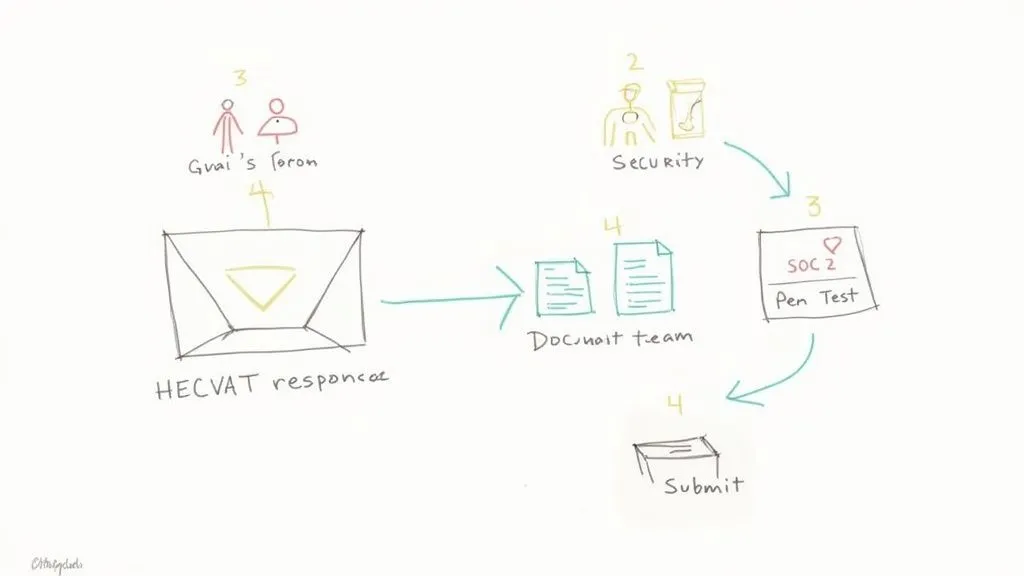
The trick is to stop seeing it as a test and start treating it like a roadmap. A solid plan breaks the whole thing down into manageable chunks, making sure nothing slips through the cracks and every answer you give is accurate and backed by solid proof. This shifts you from constantly putting out fires to having a strategic, well-oiled machine.
Step 1: Assemble Your HECVAT Response Team
Let’s be clear: answering a HECVAT is a team sport. No single person has all the answers, and trying to go it alone is a recipe for disaster. Your very first move should be to pull together a cross-functional team of experts from across the company.
Your go-to crew should include people from:
- Security and Compliance: These are your project leads. They’ll handle the technical questions about security controls, risk management, and internal policies.
- IT and Engineering: The folks who know the nuts and bolts of your infrastructure, how data is stored and encrypted, and the security of your application.
- Legal and Privacy: This team is essential for any questions touching on data privacy laws like GDPR or FERPA, your terms of service, and other contractual bits and pieces.
- Product Management: They bring the context, explaining how the product actually works and how it handles different kinds of data.
Assign a clear project lead right from the start. This simple step avoids a ton of confusion and keeps the process from stalling.
Step 2: Gather Your Essential Documentation
Before anyone types a single word, get your paperwork in order. Rounding up all your supporting documents upfront will save an incredible amount of time and make your answers far more convincing. A simple “Yes” is fine. But “Yes, as detailed in our SOC 2 Type II report” is an answer that builds confidence.
Your document library should contain:
- Security Certifications: This means your SOC 2 (Type I or II) report, ISO 27001 certificate, or any other official attestations you have.
- Penetration Test Results: Keep the executive summary of your latest third-party pen test on hand and ready to share.
- Policy Documents: Collect key policies like your Information Security Policy, Incident Response Plan, and Data Privacy Policy.
- Architectural Diagrams: A high-level diagram showing how data flows through your system can be worth a thousand words.
This preparation is a fundamental part of good vendor due diligence. Getting this stuff ready ahead of time shows you’re serious about security.
Step 3: Execute a Centralised Response Strategy
Okay, team assembled, documents ready. Now it’s time to actually answer the questions. The key to sanity here is centralisation. Don’t even think about emailing spreadsheets back and forth—it’s a one-way ticket to version-control chaos and contradictory answers.
Use a shared platform where everyone can work together. This creates a single source of truth. As you go through the HECVAT, be honest and transparent. If you don’t have a specific control in place, it’s far better to say so and explain your plan to implement it than to try and fudge an answer.
The single best thing you can do for long-term HECVAT success is build a central knowledge base. Every answer you write today should be saved, tagged, and easily searchable for the next questionnaire. This turns a one-off headache into a powerful, compounding asset.
This kind of structured, consistent approach gets results in other areas, too. Take public health campaigns in the UK, for instance. A long-term strategy has led to more mindful drinking habits. In 2022, only 48% of adults in England drank weekly, a real drop from 54% in 2011. It just goes to show that a consistent strategy pays off.
Step 4: Review and Submit a Polished Package
Before you hit ‘send’, do one last, thorough review. The project lead should get all the stakeholders to give it a final once-over, checking for consistency, accuracy, and tone. This is your last chance to catch any mistakes and make sure your submission presents you as a professional, secure partner.
When you submit, package everything together neatly—the completed HECVAT and all the supporting documents you gathered. A well-organised submission makes life easier for the university’s review team and shows them you’re an organisation that sweats the details. It’s a small thing that helps build trust right from the start.
Crafting High-Quality HECVAT Answers
Filling out a HECVAT questionnaire is far more than a box-ticking chore. Think of it as your first, best chance to prove your company’s security credentials and win the trust of a university. A lazy, one-word answer might be technically correct, but a thoughtful, detailed response backed by evidence shows you’re a mature and professional partner. Honestly, it often speeds up the whole sales process.
The secret is to move beyond simple “yes” or “no” answers. Every reply should be crystal clear, concise, and directly supported by proof. This simple shift turns a compliance hurdle into a golden opportunity to showcase your commitment to data protection.
From Weak to Strong Answers
Let’s break this down with a real-world example. A very common HECVAT question asks if you enforce multi-factor authentication (MFA) for administrative access. The difference between a weak and a strong answer here is night and day.
A weak answer is short and offers zero value.
- Weak Answer: “Yes.”
Sure, it’s truthful, but it’s completely unhelpful. It just forces the university’s security team to come back with more questions, which slows everything down for everyone.
A strong answer, on the other hand, gives context, proof, and a real sense of assurance.
- Strong Answer: “Yes, we enforce phishing-resistant MFA for all administrative access to production systems, in line with our Access Control Policy (Section 4.2). This control is audited annually as part of our SOC 2 Type II attestation, and the report is available upon request.”
See the difference? This response is powerful because it doesn’t just answer the question—it anticipates the next one. It explains the ‘what’ (MFA enforcement), the ‘why’ (it’s part of our policy), and the ‘how we prove it’ (our SOC 2 audit). This level of detail builds confidence and cuts down on the back-and-forth.
Mapping Existing Controls to HECVAT Questions
Here’s a pro tip: don’t reinvent the wheel. One of the most efficient ways to tackle a HECVAT is by using what you already have. The questionnaire isn’t some brand-new security framework; it’s designed to align with established standards like ISO 27001, SOC 2, and the NIST Cybersecurity Framework. Your existing security controls and documentation are your biggest assets.
The trick is to connect the dots between the HECVAT question and the relevant control you already have in place.
- Analyse the Question: First, figure out the security principle they’re really asking about. A question on data encryption at rest is fundamentally about your data protection policies.
- Locate Your Control: Next, dive into your security programme and find the specific policy, procedure, or technical control that addresses this.
- Reference the Evidence: Finally, cite the exact document, report, or certification that proves this control is active and working effectively.
The core of a strong HECVAT response lies in mapping. By linking each question directly to a pre-existing, audited control from a framework like ISO 27001 or a SOC 2 report, you transform your answers from simple claims into verified facts.
Let’s see how this works with another common question.
- HECVAT Question: “Do you have a formal incident response plan that is tested regularly?”
- Weak Answer: “Yes, we have a plan.”
- Strong, Mapped Answer: “Yes. Our Incident Response Plan (IRP) is fully documented and reviewed annually. We also conduct tabletop exercises quarterly to test the plan, with our most recent test completed in Q2. This entire process is detailed in Section 7 of our Information Security Policy and is a key control covered in our ISO 27001 certification.”
This mapped answer is confident and verifiable, leaving absolutely no room for doubt.
Building a Reusable Knowledge Base
Now, crafting these brilliant, detailed answers for every single HECVAT that lands on your desk can be incredibly time-consuming. This is precisely why building a central knowledge base isn’t just a good idea—it’s essential for any company serious about growing in the higher education market. Every high-quality, evidence-backed answer you create should be saved, tagged, and ready to be used again.
This approach pays off in several huge ways:
- Consistency: Every person on your team, from sales to security, uses the same approved, accurate answers.
- Speed: You’ll find you can complete future questionnaires in a fraction of the time.
- Accuracy: A single, central library is so much easier to keep up-to-date than a bunch of scattered documents.
As you get into the rhythm of refining your answers, you’ll probably notice you’re also strengthening your overall security posture. The process of documenting and referencing your controls often shines a light on areas that could be improved. You can find more great insights on this topic by exploring the 10 best practices for knowledge management in 2025 over on our blog.
Ultimately, a well-crafted HECVAT response is a direct reflection of a well-run security programme, turning a simple compliance task into a genuinely powerful sales tool.
Using Automation to Speed Up HECVAT Responses
Why would you spend weeks on something that could be done in a few hours? For too many security teams, a HECVAT questionnaire landing in their inbox triggers a frantic, manual scramble. It’s a process that bleeds resources, stalls sales cycles, and is often bogged down by digging through old spreadsheets for answers that might not even be current anymore.
Let’s be honest: the manual way of doing this is broken. It turns highly skilled security experts into administrative assistants, forcing them to hunt for information instead of focusing on genuine security threats. This isn’t just inefficient—it’s a massive drag on your ability to partner with universities and colleges.
The good news is there’s a much smarter way to handle this. Automation is completely changing the game for security questionnaires, turning a painful chore into a streamlined, strategic advantage.

The image above says it all. You can either be buried under chaotic stacks of paper or you can embrace the speed and precision of an automated workflow. It really highlights the value of using modern tools to tackle HECVAT responses.
The Power of a Central Knowledge Library
The secret to great automation is having a single source of truth. We’re talking about a central knowledge library. Think of it as your company’s collective brain for everything related to security and compliance. Instead of digging through shared drives or pestering colleagues for the tenth time, every approved answer and piece of supporting evidence lives in one organised hub.
Tools like ResponseHub are built entirely around this idea. You can feed it all your existing documentation—from security policies and previous questionnaires to technical specs—and the system intelligently sorts it all out. This library becomes the engine that drives the automation, making sure every answer you provide is consistent, accurate, and up-to-date.
How AI-Powered Automation Works
Once that knowledge library is in place, AI can do the heavy lifting. When a new HECVAT spreadsheet arrives, a good automation platform can:
- Read the Questionnaire: It automatically ingests and understands every question, no matter how the spreadsheet is formatted.
- Suggest Answers: The AI then dives into your knowledge library, finds the most relevant information, and suggests high-confidence answers for each question.
- Provide Citations: This is the crucial part. It doesn’t just give you an answer; it proves it. The platform backs up every suggestion with a direct link to the exact policy, section, or even page number where the information came from.
This process can auto-complete up to 90% of a HECVAT with verified, evidence-backed answers. Your team’s job shifts from writing everything from scratch to simply reviewing and approving the AI’s work—a much better use of their time and expertise.
Automation transforms HECVAT responses from a reactive, time-consuming chore into a proactive, evidence-based demonstration of your security posture. It frees your team to focus on strategy, not spreadsheets.
This shift reflects a broader move towards using technology for repetitive compliance work. HECVAT is fundamentally a compliance task, which is why understanding how RPA for compliance and regulatory reporting is applied in other areas is so relevant here.
The Real-World Business Benefits
Switching to an automated approach for HECVATs delivers clear, measurable results that go way beyond just saving a bit of time.
- Drastically Faster Completion: A task that used to eat up weeks of effort can now be knocked out in a matter of hours or days.
- Better Accuracy and Consistency: With one source of truth, you eliminate the risk of sending out old or contradictory answers that can erode a university’s trust in your security.
- Shorter Sales Cycles: Security reviews are often a major bottleneck in the procurement process. By responding faster, you help your sales team close deals without unnecessary delays.
- A More Strategic Security Team: Your best people are freed from administrative drudgery to focus on high-value work like threat modelling and risk management.
Taking the time to explore different tools will give you a much clearer idea of what’s possible. You can learn more about modernising your process with our guide to security questionnaire automation.
Answering Your Top HECVAT Questions
Getting a HECVAT for the first time can feel a bit like being handed a pop quiz you didn’t study for. It’s a detailed document, and as it becomes the norm in university procurement, a lot of the same questions keep coming up.
Let’s clear the air. Here are the most common queries we see from vendors, with straightforward answers to help you navigate the process without the usual headaches.
Can We Reuse a Previous HECVAT Response?
Yes, and you absolutely should. The whole idea behind a standardised questionnaire like HECVAT is to save everyone from reinventing the wheel. Once you’ve put in the hard work to complete one for a university, that document becomes your golden ticket for the next one.
But it’s not quite as simple as just hitting ‘forward’ on an old email. You need a solid process to keep it fresh.
- Set an Annual Review: Your security measures will evolve. New tools are brought in, policies get updated. Make it a team habit to review and refresh your master HECVAT response at least once a year.
- Update After Big Changes: Did you just get your SOC 2 certification? Or maybe you rolled out a major new security feature? These are ‘material changes’, and your HECVAT needs to reflect them straight away.
Think of your completed HECVAT as a living document, not a one-and-done project. Keeping it current means you’re always ready to go, turning a potential weeks-long task into a quick and simple one.
What if We Can’t Answer ‘Yes’ to a Question?
Here’s a common myth: you have to answer ‘Yes’ to every single question to pass. That’s just not true. Universities get it – security is a journey, and no one has a perfect, impenetrable fortress. What they value far more than a flawless scorecard is honesty.
If a control isn’t in place, the best way forward is with a “No, but…” answer. This is where you explain your compensating control.
A compensating control is simply the alternative way you handle a particular risk. It’s your plan B. Explaining it well shows the university you’re mature, you understand the risk, and you’ve already thought about how to manage it.
For instance, if a question asks about a specific encryption standard you don’t use, you can explain the different method you have in place and make a case for why it still keeps their data safe. The aim is to show you’re on top of it, not to tick every single box.
How Long Does It Take to Complete a HECVAT?
This really depends on how organised you are. For a company facing its first HECVAT without any security documentation ready to go, it’s a marathon. You could easily be looking at four to six weeks of chasing down answers from your security, IT, and legal teams.
On the flip side, a team that uses a response automation tool like ResponseHub and keeps its security information in one place can get it done in a couple of days. Sometimes, it’s just a matter of hours. That initial effort to get your house in order pays for itself over and over again.
Who Needs to Sign Off on the Final Document?
The final sign-off should come from a senior person who holds the ultimate responsibility for information security. In most companies, this is the Chief Information Security Officer (CISO). In smaller organisations, it might be the Chief Technology Officer (CTO) or even a VP of Engineering.
This isn’t just about putting a signature on a page. It’s a formal declaration that the answers you’ve provided are accurate and represent your company’s security posture honestly. This step is crucial for building trust with the university and shows them you’re taking the security of their data seriously. Before you hit send, make sure the right person has given it their final seal of approval.