· Jane Iamias · what are rfqs · 17 min read
What Are RFQs Your Guide to Smart Purchasing
What are RFQs? This guide explains everything you need to know about the Request for Quotation process, how it differs from an RFP, and when to use it.

A Request for Quotation, or RFQ, is a straightforward business document used to invite suppliers into a bidding process. The key thing to remember is that you use an RFQ when you need a quote for a specific product or service. Its main job is to help you compare costs from different vendors when you already know exactly what you want.
Think of it as a tool for price-focused purchasing, not for exploring creative or complex solutions.
Understanding the Request for Quotation

Let’s break this down with a simple analogy. Imagine you’re tasked with renovating your company’s kitchen. You’ve already done the research and picked out the exact make and model for the new refrigerator, microwave, and coffee machine. The decision has been made.
In this situation, you wouldn’t ask appliance suppliers for their kitchen design ideas. That part is already sorted. Instead, you’d send them an RFQ with your specific shopping list and ask one simple question: “What’s your best price?” The goal is crystal clear—find the most cost-effective supplier for a pre-determined set of goods. An RFQ works in precisely the same way.
This approach is most effective when a few conditions are met:
- The products or services are commodities or are highly standardised.
- Your requirements are detailed, clear, and not expected to change.
- Price is the number one deciding factor in choosing a supplier.
The Core Purpose of an RFQ
At its heart, an RFQ is all about creating a transparent and competitive bidding environment. By sending the exact same detailed request to multiple suppliers, a company ensures it gets back comparable, apples-to-apples quotes. This strips away any ambiguity and lets you make a decision based almost entirely on the financial details.
For instance, a construction firm needing 5,000 standard-sized bricks would use an RFQ. So would an IT department buying 50 identical laptops for new starters. The specifications are locked in; the only real variable is the price tag.
An RFQ strips away the complexity of proposals and creative solutions, focusing the procurement process on one key question: “For these exact specifications, what is your best price?”
This laser-focused approach doesn’t just help secure the best possible price; it also massively simplifies the purchasing cycle. It cuts out long, drawn-out negotiations about features or capabilities because those details have already been settled internally.
To give you a clearer picture, any good RFQ will contain a few essential building blocks. The table below summarises what you should expect to see.
Key Components of an RFQ at a Glance
| Component | Purpose |
|---|---|
| Detailed Specifications | Clearly describes the exact product or service needed, including quantity, size, and technical requirements. |
| Submission Deadline | Provides a firm date and time by which all supplier quotations must be received. |
| Pricing Structure | Instructs vendors on how to present their costs, such as per-unit price or total project cost. |
| Delivery Requirements | Outlines the expected timeline, location, and terms for delivering the goods or services. |
| Contact Information | Specifies who the supplier should contact with questions or to submit their final quote. |
Essentially, these components work together to ensure every supplier is on the same page, allowing you to make a fair and objective comparison.
When Should Your Business Use an RFQ?
Knowing exactly when to deploy a Request for Quotation is the secret to smart purchasing. An RFQ isn’t a tool for exploring new ideas or brainstorming solutions; think of it more like a scalpel, designed for one thing: getting the best price when your requirements are crystal clear and set in stone. It thrives on certainty.
An RFQ should be the final, decisive step in your purchasing journey. You only turn to it once you’ve completely nailed down the “what” and the “how many”. This is the point where the broader process of procurement narrows its focus squarely onto the bottom line.
Scenarios Built for an RFQ
Some purchasing situations are practically made for the RFQ model. These are usually cases where you’re buying standardised or commoditised goods, and the main—or only—thing separating suppliers is the price tag.
Here are a few classic examples:
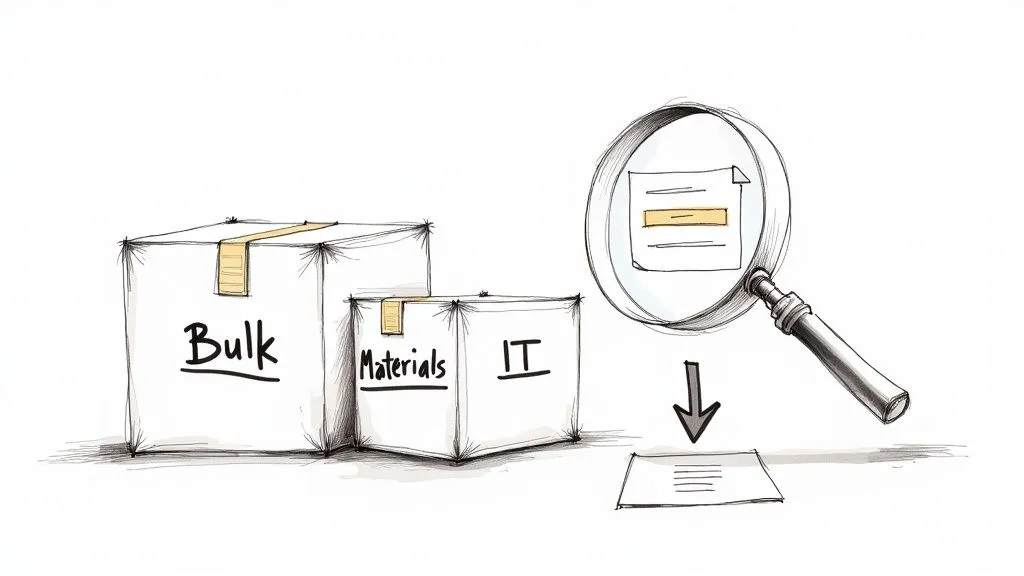
- Bulk Office Supplies: You need 200 boxes of A4 paper and 1,000 branded pens. The specs are universal, so it’s all about who offers the best deal.
- Standard IT Hardware: Your company needs 25 identical laptops, each with a specific processor, RAM, and storage size. The configuration is non-negotiable.
- Construction Materials: A building project calls for a precise quantity of standard-grade cement, timber, or steel beams with exact dimensions.
In every one of these cases, the requirements are rigid. There’s no space for creative interpretation or alternative solutions, which creates the perfect environment for an RFQ to drive competitive pricing. For instance, if you’ve decided on a white label product, understanding what a white label solution entails is the crucial first step before you can send out a specific RFQ for it.
The Role of RFQs in Public Sector Procurement
In the public sector, RFQs are more than just a tool—they’re a cornerstone of the entire purchasing philosophy. Government bodies lean heavily on this structured process to ensure fairness, transparency, and the responsible spending of taxpayer money. It’s how they acquire goods and services in a way that’s open, competitive, and proves value.
This process is also vital for bringing small and medium-sized enterprises (SMEs) into the government supply chain. The UK government, for example, has committed to placing 25% of its expenditure with SMEs. This is part of a larger push to direct about a third of all public procurement spending to smaller businesses. RFQs give these companies a straightforward path to compete for contracts, which in turn boosts economic growth.
By levelling the playing field, RFQs in the public sector ensure that contracts are awarded based on merit and cost-effectiveness, preventing favouritism and guaranteeing accountability.
At the end of the day, whether you’re in the private or public sector, an RFQ is your best friend when clarity is king. It simplifies the buying cycle, reduces risk, and makes sure you get the best possible price for your exact needs. That makes it an essential part of any solid supply chain strategy.
Comparing RFQ vs RFP vs RFI
In the world of procurement, it’s easy to get lost in the alphabet soup of RFI, RFP, and RFQ. They sound similar, but using the wrong one is a classic misstep that can lead to confused vendors, mismatched responses, and stalled projects. Getting to grips with their distinct roles is the key to picking the right tool for the job.
Let’s try a simple analogy. Imagine your company has decided it needs a new website.
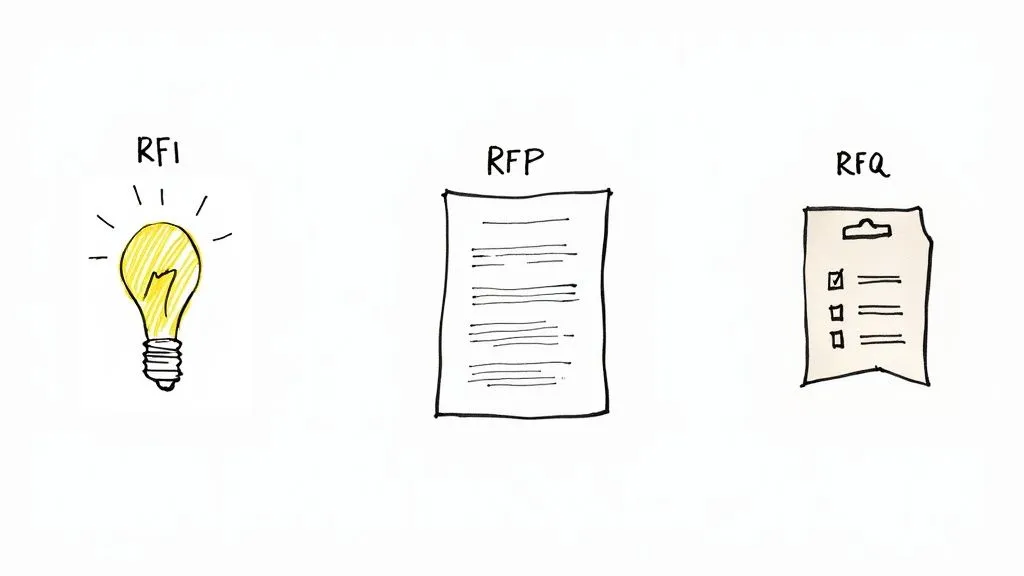
- You’d start with an RFI (Request for Information). This is your research phase. You’re asking broad questions like, “What are the latest trends in web design? Which e-commerce platforms are leading the market?” You’re just gathering intelligence.
- Next up is the RFP (Request for Proposal). Now you’re looking for a partner to solve your problem. You ask potential agencies, “Based on our business goals, propose a detailed plan to design, build, and launch our new website.” You’re evaluating their strategy and expertise.
- Finally, you’d use an RFQ (Request for Quotation) for a very specific need. You might say, “We’ve decided on the software for our new site. We need to buy 10 specific software licences. What is your best price?” Here, the decision boils down to cost.
This natural progression shows how each document fits a unique purpose at a different point in the buying journey.
Understanding the RFI
Think of the Request for Information as your fact-finding mission. It’s the widest net you can cast and is typically used right at the start of a project, often when you’re still trying to get your head around the problem or the solutions available.
You aren’t asking for pricing or detailed plans. You’re simply collecting general information about the market, what different vendors can do, and what technology is out there. An RFI helps you become a more informed buyer, setting you up to write a much sharper RFP down the line. It’s a low-commitment way to educate your team.
Decoding the RFP
A Request for Proposal is a formal call for vendors to present their unique solution to your challenge. Unlike an RFQ, an RFP recognises that the “how” is just as crucial as the “what”. It’s the go-to document for complex projects where you need to weigh up creativity, strategy, and expertise—not just the price tag.
You’d use an RFP when hiring a marketing agency or commissioning a custom software build, for instance. The responses are usually detailed, comprehensive, and help you select a long-term strategic partner. The whole process is more involved than an RFQ and shares DNA with formal bidding; you can learn more about this in our guide explaining what are tenders.
The Role of the RFQ
The Request for Quotation is the most straightforward of the three. It has one laser-focused goal: price. You should only ever use an RFQ when your needs are crystal clear, quantified, and standardised. The evaluation is simple, revolving around which qualified supplier can provide the exact goods or services for the lowest cost.
An RFQ is the final step in tactical purchasing, not a tool for strategic sourcing. It’s about execution and cost efficiency, not exploration or creative problem-solving.
This clarity is vital. Sending an RFQ when you really need the strategic depth of an RFP is a recipe for frustration. You’ll get quotes that don’t truly address your underlying business needs, wasting everyone’s time.
The table below breaks down these key differences to help you choose correctly every time.
RFQ vs RFP vs RFI: A Clear Comparison
| Attribute | Request for Information (RFI) | Request for Quotation (RFQ) | Request for Proposal (RFP) |
|---|---|---|---|
| Primary Goal | Educate and gather market intelligence. | Get the best price for specific goods or services. | Find a strategic solution to a complex problem. |
| When to Use | Early in the buying process when you’re exploring options. | When you know exactly what you need and just need to compare costs. | For complex projects where the solution is not clearly defined. |
| Focus | Vendor capabilities, technology, and market trends. | Price, payment terms, and delivery schedules. | Vendor’s expertise, strategy, approach, and value. |
| Decision Factor | Information quality and vendor landscape. | Lowest price from a qualified supplier. | Best overall value and strategic fit. |
| Document Complexity | Simple and open-ended. | Highly specific and structured (e.g., pricing tables). | Detailed, often requiring lengthy, customised responses. |
| Analogy | ”What’s out there?” (Window shopping) | “How much for this specific item?” (Price check) | “How would you solve this for us?” (Hiring a consultant) |
Understanding these distinctions isn’t just academic—it’s a practical skill that ensures your procurement process runs smoothly and delivers the results you actually need.
How to Write an Effective RFQ
Writing a Request for Quotation that actually gets you clear, competitive bids is a bit of an art form. Get it wrong, and you’re buried in vague answers, inaccurate prices, and inevitable project delays. The whole point is to give potential suppliers every single detail they need to give you a precise, no-surprises quote.
Think of it like laying out the facts of a case for a detective. The more solid evidence you provide upfront, the faster and more accurately the puzzle gets solved. Ambiguity is your worst enemy here. Precision is the best tool you have for attracting high-quality partners and making sure you receive bids you can actually compare like-for-like.
Start with Detailed Specifications
This is the absolute core of your RFQ, and frankly, it’s where most of them fall apart. Just asking for “10 laptops” is next to useless. To stop vendors from having to guess, you need to get almost painfully specific.
Your specifications section should always include:
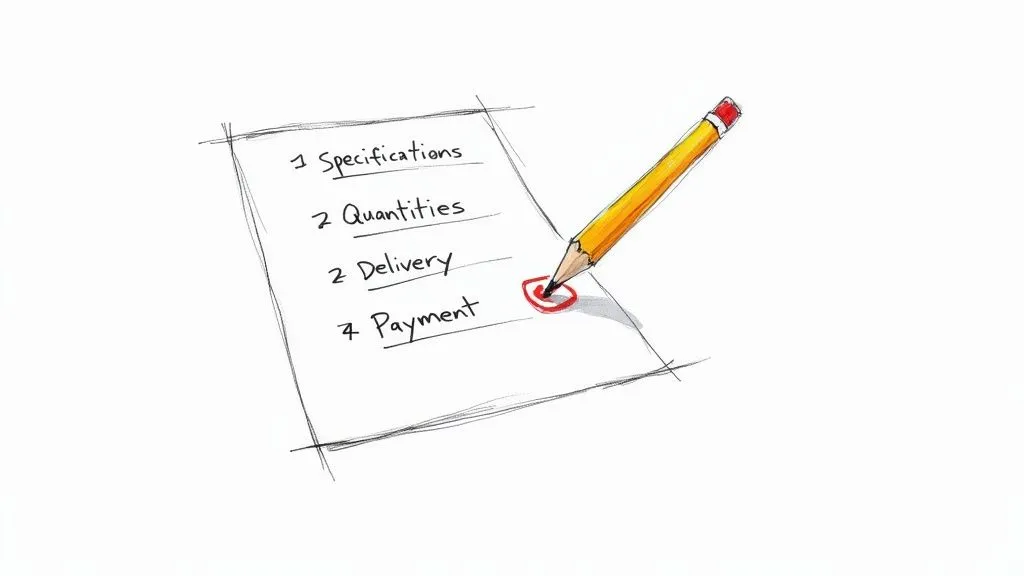
- Exact Quantities: State the precise number of units you need. No ambiguity.
- Technical Details: List out everything—model numbers, material grades, dimensions, specific colours, or any other attribute that matters.
- Quality Standards: If your items need to meet certain certifications or standards (like ISO 9001), spell it out clearly.
When you send out a vague request, you force suppliers to make assumptions. This usually leads to one of two outcomes: quotes that are inflated to cover unknown risks, or quotes that are completely misaligned with what you actually need. Getting precise from the start avoids all that hassle.
Outline Clear Logistical and Commercial Terms
Beyond the item itself, suppliers need to understand the full picture of what they’re signing up for. This means clearly defining the terms that will shape the purchase and your ongoing relationship. A strong RFQ leaves no room for doubt on these crucial points.
A huge part of this is detailing your payment and delivery expectations.
- Delivery Schedule: When do you need it, and where does it need to go? Provide the date and location.
- Payment Terms: How and when do you plan to pay? Be specific, for example, “Net 30” (meaning payment is due 30 days after the invoice date).
- Evaluation Criteria: Give them a hint about how you’ll choose the winner. Is it simply the lowest price from a qualified vendor? Let them know.
In public sector procurement, these criteria are non-negotiable. For instance, a UK government RFQ might state that price is weighted at 35% while quality accounts for the other 65%. These are formal, structured processes, often run through online portals with strict deadlines, all designed to give smaller businesses fair access to contracts.
A well-structured RFQ acts as a filter. It not only attracts serious, capable suppliers but also deters those who cannot meet your specific requirements, saving everyone valuable time.
Finally, remember that the RFQ is one of the first steps in building a new business relationship. It’s vital to run proper checks on any potential partner. For a deeper dive into this, check out our guide on practical vendor due diligence. Putting forward a professional, clear, and comprehensive document sets a positive tone from the outset and makes your organisation look good.
Best Practices for Responding to an RFQ
Alright, let’s flip the script. You’ve just received an RFQ. What now? Winning the business isn’t just about being the cheapest. It takes precision, professionalism, and a smart strategy to show you’re the right choice. Your RFQ response is more than a price list; it’s your first real handshake with a potential client. Get it right, and you build trust instantly. Get it wrong, and you’re out of the running.
The foundation of any winning bid is a deep understanding of what the buyer actually wants. Before you even touch your pricing calculator, you need to become an expert on their RFQ document. Read every line, every spec, every single requirement. It’s easy to gloss over a small detail like a delivery window or a specific quality standard, but that’s a mistake that can lead to a disqualified quote or, worse, a loss-making project down the line.
Analyse Every Requirement Meticulously
Your first move should be to turn their RFQ into a checklist. Don’t just skim it; dig in and get your hands dirty. If anything feels vague, unclear, or incomplete, don’t hesitate to ask for clarification. A thoughtful question shows you’re paying attention and are serious about getting your quote right.
This deep dive is also your chance to spot any red flags. Can you really hit that delivery date without cutting corners? Do you have the exact product they’ve specified in stock? It’s far better to ask these questions internally now than to overpromise and under-deliver later.
A winning RFQ response is a mirror of the original request. It should reflect every specification and requirement with perfect clarity, leaving no room for the buyer to second-guess your understanding or capabilities.
When you’re juggling multiple RFQ documents or trying to make your own response as sharp as possible, it helps to reduce information overload with smart summaries. This helps you stay focused on what matters, addressing every point without the fluff that just gets in the way.
Craft a Clear and Transparent Proposal
Once you’ve got a solid handle on the requirements, it’s time to build your quote. The name of the game here is total transparency. Hidden fees and surprise surcharges are the quickest way to get your bid tossed in the bin and earn a bad reputation.
Structure your pricing so it’s impossible to misunderstand:
- Itemised Pricing: Break it all down. Show the per-unit price, any taxes, and delivery charges as separate line items. Don’t lump them together.
- Total Cost: Make the final, all-in price stand out. The buyer should be able to find the bottom line in a heartbeat.
- Validity Period: Be clear about how long your quote is good for. Market prices shift, and this simple detail protects both of you from surprises.
But don’t just stop at the numbers. An RFQ is price-focused, yes, but you can still stand out. If you offer a longer warranty, better customer support, or can deliver faster than anyone else, say so! These small details can be the tie-breakers that win you the deal.
Finally, proofread everything. Then proofread it again. A polished, professional, and punctual submission sends a clear message: you’re a reliable and organised partner they can count on.
Common Questions About the RFQ Process
Once you get the hang of the basics, you’ll find that real-world situations throw up all sorts of practical questions. Let’s tackle some of the most common queries that come up when you’re in the thick of managing a Request for Quotation.
Think of this as your field guide for those specific “what if” moments.
Is an RFQ a Legally Binding Contract?
In a word, no. An RFQ document on its own is not a legally binding contract. It’s best to think of it as a formal invitation to treat—you’re asking suppliers to make you an offer.
The legal process unfolds in steps. First, you issue the RFQ. When a supplier sends you their quote, that is the official offer. A contract is only created when you, the buyer, formally accept that offer. This is usually done by issuing a Purchase Order (PO). Until that PO is sent and accepted, either party can typically walk away without any legal fuss. The RFQ just gets the ball rolling.
How Long Should Suppliers Have to Respond?
The right amount of time to give suppliers really hinges on what you’re asking for. There’s no magic number, but the golden rule is to be reasonable.
- For simple, off-the-shelf items: Giving suppliers 3-5 business days is usually plenty. It’s enough time for them to check their stock and pricing without dragging out your project timeline.
- For more complex requests: If you’re dealing with large quantities, a bit of customisation, or tricky logistics, then 1-2 weeks is a much more realistic timeframe. This gives vendors the space to put together a truly accurate quote.
The main thing is to give them enough time to prepare a quote they can stand behind. Always be crystal clear about the submission deadline—state the date, time, and time zone to avoid any last-minute mix-ups.
Can I Negotiate After Receiving Quotes?
Absolutely. Negotiation is a normal, and often expected, part of the process. Just because an RFQ is heavily focused on price doesn’t mean the conversation ends once the quotes are in.
It’s completely fine to open a dialogue with your top one or two bidders. This is especially true if their prices are neck and neck, or just a little over your budget. You can explore potential volume discounts, iron out payment terms, or haggle over secondary costs like delivery fees.
The crucial rule here is fairness. If you need to make a major change to your original request—like doubling the quantity or switching materials—you can’t just offer it to one vendor. To keep a level playing field, you’d need to issue a new or revised RFQ to everyone who originally bid.
What Is the Main Difference Between an RFQ and an Auction?
The biggest difference comes down to one thing: price visibility. They create two completely different competitive dynamics.
With a standard RFQ, suppliers submit their bids privately. This is often called a “sealed bid” process because no vendor knows what their competitors have quoted. You then evaluate these private offers on your own. This setup encourages suppliers to offer their best price right out of the gate.
A reverse auction, on the other hand, is a live and transparent event. Bidders can see the competing prices in real-time and have the chance to lower their own prices on the spot to win the deal. An RFQ is a one-shot, sealed submission; an auction is an open, dynamic competition.