· Jane Iamias · what are tenders · 18 min read
what are tenders: A clear guide to bidding and contracts
Discover what are tenders and how to win contracts with a straightforward guide on processes, types, and winning steps.
Ever heard the term ‘tender’ and felt a bit out of your depth? Let’s clear that up. A tender is simply a formal, structured invitation for businesses to bid on a specific contract. This could be anything from providing IT support to a local council to constructing a new office block.
It’s a common practice, especially in the public sector, because it’s designed to be fair, transparent, and get the best possible value for money.
Think of it as a high-stakes job application—but for your entire company.
A Simple Guide to Tenders
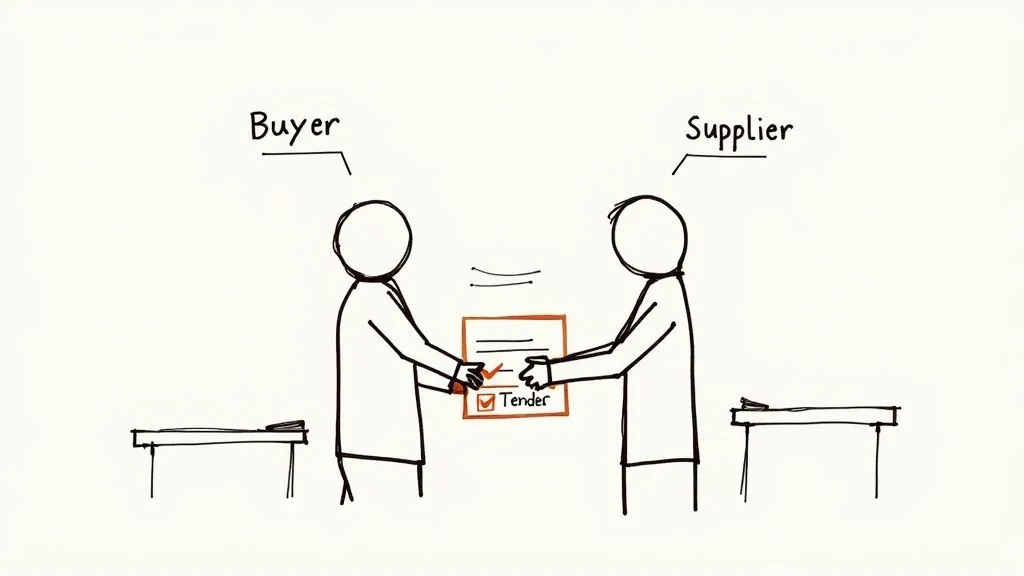
Let’s break down what this looks like in the real world. Imagine your local council needs a new company to manage its IT systems. Instead of just calling up a firm they’ve used before, they issue a formal invitation—the tender—to the open market.
This invitation asks interested businesses to submit a detailed proposal. In it, they’ll have to outline their services, prove they have the right experience, provide a clear pricing structure, and ultimately, make a compelling case for why they’re the best choice.
This competitive process is all about making sure the council gets high-quality service at the best possible price, with everything handled in an open and accountable way.
The Key Players and Their Goals
At its heart, the tendering process always involves two main parties, each with a very clear objective:
- The Buyer: This is the organisation that needs the work done—like the council in our example. Their main goal is to secure the best value, which is a careful balance of cost, quality, reliability, and expertise.
- The Supplier: This is the business bidding for the contract—like your IT company. Your goal is to put together a winning proposal that ticks all the buyer’s boxes and convinces them you’re the perfect partner for the job.
This buyer-supplier dynamic is the foundation of public procurement in the UK. In a major push for transparency back in 2010, the central government made tender documents and contracts over £10,000 publicly available. You can find these opportunities on platforms like Contracts Finder, which The National Archives explains is part of a wider government transparency agenda.
The real purpose of a tender is to create a level playing field. It shifts procurement from being about who you know to being about what you can prove, which is absolutely essential for accountability—especially when public money is involved.
To make this even clearer, let’s look at the core components and who’s involved.
The Tendering Process at a Glance
This table breaks down the main elements you’ll encounter in any typical tendering process.
| Component | Who They Are | Primary Goal |
|---|---|---|
| The Buyer | An organisation, often public sector, seeking goods or services. | To obtain the best value through a fair, competitive process. |
| The Supplier | A business or individual bidding to provide those goods or services. | To win the contract by submitting the most persuasive and compliant bid. |
| The Tender | The formal invitation document outlining all requirements. | To clearly define the project scope, criteria, and submission rules. |
Understanding these roles is the first step to navigating the process successfully and positioning your business to win.
Navigating the Different Types of Tenders
If you’ve seen one tender, you’ve seen one tender. Just like you wouldn’t approach every client with the same pitch, you’ll find that the world of tendering isn’t built on a one-size-fits-all model. Getting to grips with the different types is the first step towards spotting the right opportunities and channelling your efforts where they’ll count the most.
Broadly speaking, the landscape splits into two main arenas: public sector and private sector.
Public sector tenders come from government bodies – think local councils, NHS trusts, or central government departments. These are usually highly regulated to keep things transparent and fair. On the other hand, private sector tenders are issued by other businesses, which often means they have a bit more flexibility in how they run the process.
For a lot of businesses, winning public contracts is a major goal. The UK government, for instance, makes it easy to find these opportunities through a central portal.
Here’s a look at the UK’s Contracts Finder portal, a go-to source for public sector tender listings.
This platform lets you filter contracts by keywords, location, and value, helping you zero in on the work that’s right for your business.
Common Tendering Formats
Drilling down further, you’ll come across several common formats within both the public and private sectors. Each one has different rules about who can bid and how the process works, so it’s vital to know which is which.
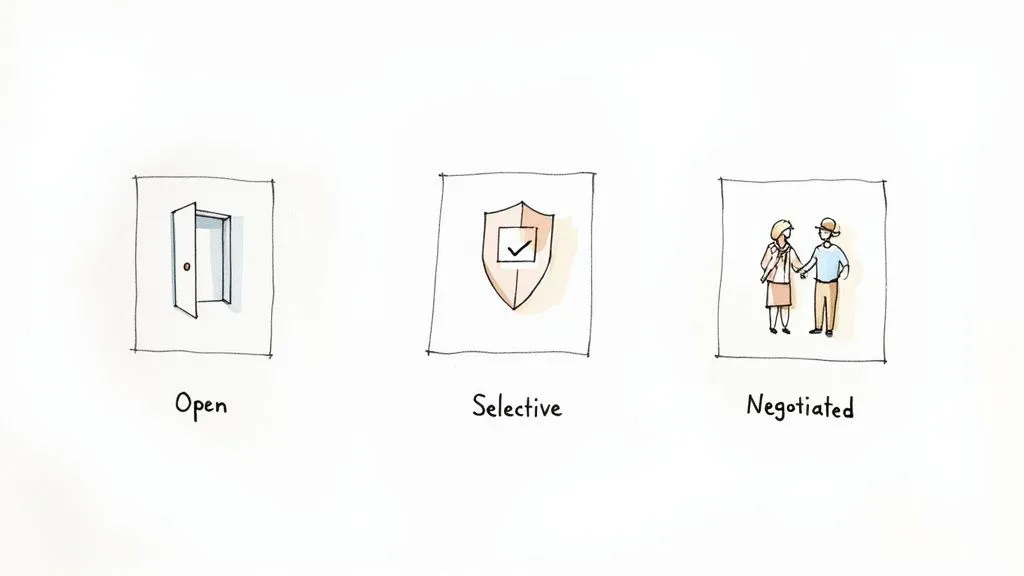
Open Tendering: This is the most straightforward and common type. Think of it as a public job advert – any supplier who’s interested can throw their hat in the ring. It’s designed to maximise competition and is perfect for standard contracts, like a year’s supply of office stationery.
Selective Tendering: Also called restricted tendering, this is a two-step dance. First, suppliers put forward an ‘Expression of Interest’. The buyer then creates a shortlist of the most suitable candidates based on their track record and capabilities. Only those chosen few are invited to submit a full tender. You’ll see this a lot for complex projects, like building a new hospital wing, where proven expertise is a must.
Negotiated Tendering: In this case, the buyer picks up the phone and directly approaches one or a handful of suppliers to negotiate a deal. It’s usually reserved for highly specialised work, emergency requirements, or when there’s really only one company for the job.
Here’s a simple analogy: an open tender is an open audition for a film. Selective tendering is the callback for a few promising actors. And negotiated tendering? That’s when the director offers the part directly to a specific A-list star.
The format a buyer chooses tells you a lot about their priorities. Even a single organisation like the Ministry of Defence uses a mix of procurement strategies. While many of their contracts are competitive, others are non-competitive agreements for very specific, niche requirements. It really underlines the importance of understanding the finer points of UK procurement.
Your Step-by-Step Tendering Process Roadmap
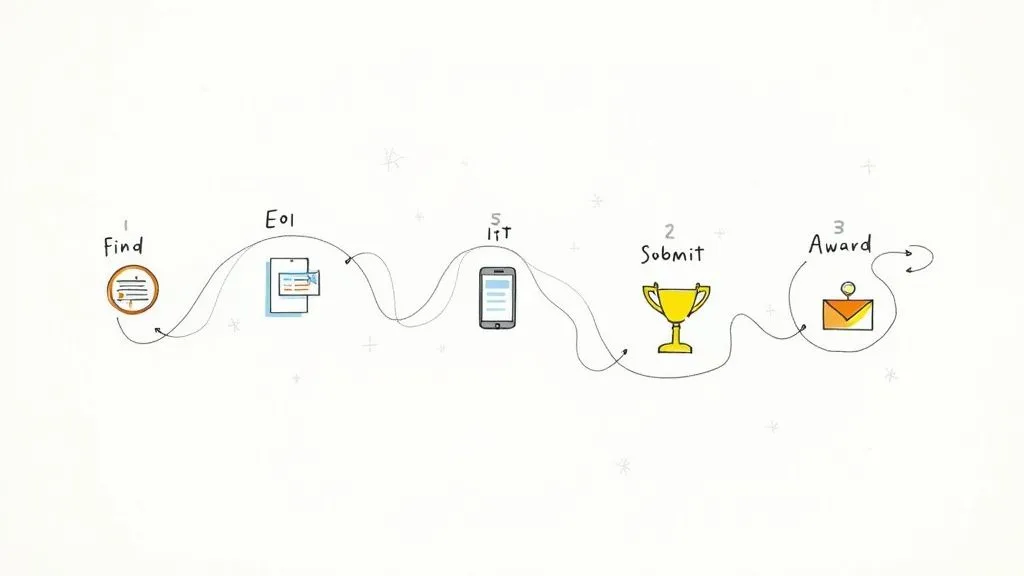
Knowing the different types of tenders is one thing; successfully navigating the process is another beast entirely. The good news is that the tendering journey isn’t random. It follows a predictable path with clear milestones. If you can see it as a structured roadmap, what feels like a monumental task breaks down into a series of logical, manageable steps.
This guide will walk you through the entire lifecycle, from the moment you spot an opportunity right through to signing on the dotted line. Get a handle on each stage, and you’ll be in a much stronger position to prepare and, ultimately, win.
Stage 1: Opportunity Discovery and Expression of Interest
It all starts with finding the right tender. Opportunities pop up in all sorts of places, from the government’s official Contracts Finder portal to niche industry websites or even paid services that pull everything together for you.
Once you’ve found a contract that looks like a good fit, your first formal move is usually to submit an Expression of Interest (EOI). Sometimes this is combined with a Pre-Qualification Questionnaire (PQQ). This is your opening gambit – a way to tell the buyer you’re keen and that you meet the basic, non-negotiable criteria. Think of it as passing the initial screening for a job; you’re not getting the offer yet, just getting your foot in the door.
Stage 2: Invitation to Tender and Document Analysis
If your EOI or PQQ hits the mark, you’ll receive the Invitation to Tender (ITT). This is the main event. It’s a bundle of documents containing everything you need to know: what the buyer needs, how they’ll score you, and the strict rules you have to follow.
Now comes the deep dive. This isn’t a quick skim-read over a coffee. You need to meticulously pick apart every single document to truly understand what makes the buyer tick. This is where you spot potential deal-breakers, flag anything that’s unclear, and start piecing together your strategy for winning.
A classic rookie error is to treat every ITT as if it’s the same. Each one tells a unique story about the buyer’s real problems and priorities. The bidders who win are the ones who can decode that story and shape their response to be the perfect answer.
Stage 3: Bid Preparation and Submission
Here’s where the hard work really kicks in. You’ll need to get your team together, decide who is doing what, and start building your proposal. Your mission is to create a response that is not only fully compliant but also compelling and persuasive. It has to answer every question directly and prove you’re the best choice for the job.
During this stage, your focus will be on:
- Creating a Compliance Checklist: Go through the ITT with a fine-tooth comb and tick off every single requirement, from file formats to specific insurance policies.
- Writing with Purpose: Don’t just list your features. Explain how your solution will solve the buyer’s problem better than anyone else can. Tell a story.
- Gathering Your Proof: Back up everything you claim. Pull together your best case studies, client testimonials, and financial documents to prove you can deliver.
Finally, with everything checked and double-checked, you submit your bid through their official portal before the deadline. And that deadline is absolute. A late submission is almost always an automatic disqualification, so always, always plan to submit early.
Stage 4: Evaluation and Contract Award
Once the deadline passes, the buyer gets to work. An evaluation panel will score every submission against the criteria they laid out in the ITT. They’ll look at everything from your price and technical skills to your social value commitments.
After all the scores are tallied, they’ll identify the winning bid. You’ll be notified whether you were successful or not. If you’ve won, you’ll move on to the contract award stage, which involves finalising the details and signing the official agreement. If you didn’t win, don’t just walk away – it’s a smart move to ask for feedback. It’s invaluable intelligence for making your next tender response even stronger.
How Buyers Evaluate Your Tender Submission
https://www.youtube.com/embed/vOJRYWIBnTc
So, you’ve poured hours into your tender submission and finally hit send. What happens next? It’s not a lottery. Behind the scenes, a highly structured evaluation process kicks off, designed to be fair, transparent, and completely defensible.
Knowing how your bid will be scrutinised is perhaps the single biggest advantage you can have.
Many people fall into the trap of thinking it’s a race to the bottom on price. That’s rarely the case. In the UK public sector, for instance, the guiding principle is to find the Most Economically Advantageous Tender (MEAT). This isn’t just a fancy acronym; it’s a framework that forces buyers to look beyond the price tag and weigh up quality, experience, and other factors to find the best overall value.
This means your proposal is scored against a set of predetermined criteria, each carrying a specific weight. Understanding this is your key to success. It allows you to stop writing generic, one-size-fits-all bids and start focusing your efforts on what the buyer actually cares about.
The Core Evaluation Criteria
While the specifics can change from one tender to the next, the criteria buyers use to judge your submission usually fall into a few key buckets. Think of it as a 360-degree review of your business and your proposal.
Here’s what they’re almost always looking at:
- Technical Merit and Proposed Solution: Does your proposal genuinely solve the client’s problem? They’ll dig into the quality, suitability, and even the innovation of what you’re offering.
- Experience and Past Performance: This is the “prove it” section. Have you done this kind of work before, and did it go well? Buyers will be looking for relevant case studies, glowing testimonials, and a track record that screams reliability.
- Financial Stability and Health: Can you be trusted to see the contract through without going bust? A financial health check is standard procedure. For a deeper dive, check out our practical guide to vendor due diligence.
- Social Value: This is a big one, especially for public contracts. What else do you bring to the table? Buyers want to see a commitment to wider community benefits, like creating local jobs, taking on apprentices, or championing sustainable practices.
- Price: Of course, price still matters. But it needs to be competitive without being suspiciously cheap. It has to be realistic and clearly represent good value for the money you’re asking for.
The key takeaway is that a winning tender submission isn’t just a sales document; it’s a piece of evidence. It must prove your capability, demonstrate your understanding of the buyer’s needs, and justify your price with tangible value.
How Weighting Shapes Your Strategy
The secret to a winning bid often lies in understanding the “weighting” of each criterion, which is usually shown as a percentage in the tender documents. This tells you exactly what the buyer’s priorities are.
For example, a tender for a highly complex IT project will naturally put a lot more weight on technical skills than a contract for supplying office stationery. Ignoring these signals is like flying blind.
Let’s look at a simple comparison to see how this plays out.
Example Tender Evaluation Weighting
Here’s how two different tenders might be weighted, showing just how much priorities can shift depending on what’s being procured.
| Evaluation Criterion | Weighting for IT Services Tender | Weighting for Office Supplies Tender |
|---|---|---|
| Quality/Technical Merit | 60% | 30% |
| Price | 30% | 60% |
| Social Value | 10% | 10% |
The difference is stark. For the IT services tender, your main job is to blow them away with your technical solution; that’s where 60% of the marks are. But for the office supplies contract, competitive pricing is king, accounting for 60% of the total score.
By carefully analysing the weighting before you even start writing, you can tailor your response to hit the high-value targets. It’s the smartest way to focus your energy and dramatically increase your chances of winning.
How to Prepare a Winning Tender Response
Understanding how buyers evaluate tenders gives you a massive strategic advantage. The next step is turning that insight into a response that doesn’t just tick the boxes but actively convinces the evaluators that you are, without a doubt, the best choice for the job. Putting together a winning bid is a methodical process; it’s certainly not something you can rush at the last minute.
It all starts with a simple but critical decision that can save you a world of pain: the ‘bid/no-bid’ assessment. Before you even think about writing, take a hard, honest look at whether the opportunity genuinely aligns with your company’s strengths and long-term goals. Chasing every single tender that comes across your desk is a fast track to burnout. The real secret to a higher win rate is focusing your energy on the right opportunities.
Once you’ve decided to go for it, your job is to dissect the tender documents with surgical precision. This isn’t just about skimming the scope of work; it’s about getting to the heart of the buyer’s problems, pressures, and priorities.
Creating Your Compliance and Content Plan
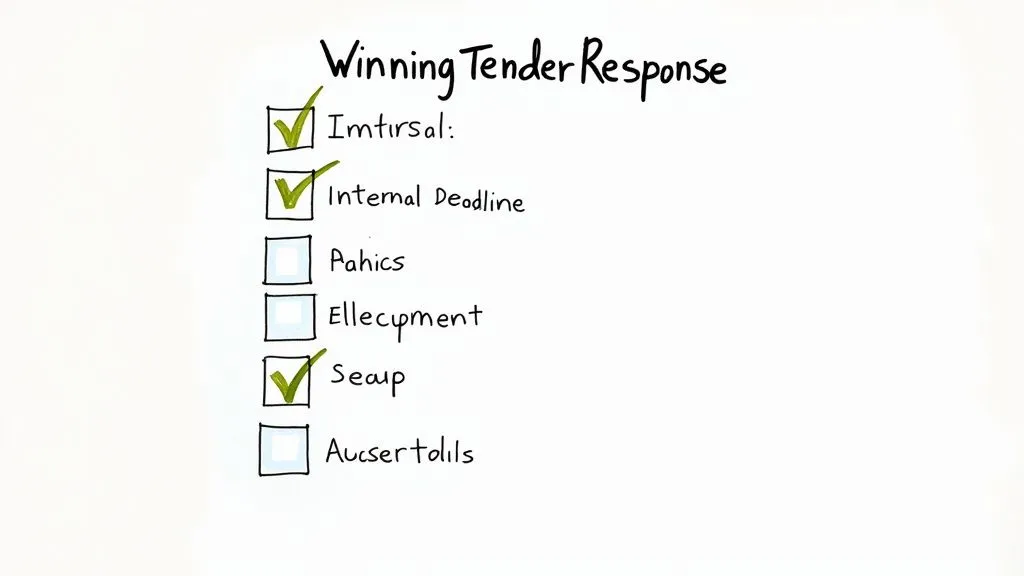
It’s a brutal truth of tendering that one simple mistake can get you disqualified instantly. To make sure that doesn’t happen, the very first thing you should do is build a comprehensive compliance checklist. This document will become the backbone of your project, ensuring every single mandatory requirement is accounted for.
Your checklist should track things like:
- Key Dates and Deadlines: Submission dates, deadlines for clarification questions, and any other critical milestones.
- Document Formatting: Pay forensic attention to file types, naming conventions, font sizes, and page limits. They matter.
- Required Policies and Certificates: Make a list of every supporting document you need to gather, from insurance certificates and accreditations to your latest financial statements.
With the compliance side locked down, you can shift your focus to writing compelling answers. This is where the magic happens—where you draw a direct line between your solution and the buyer’s needs. A big part of this comes down to the quality of your writing; it’s worth taking the time to improve your legal drafting skills so your arguments land with clarity and persuasive force.
Writing to Win
Your responses need to be more than just a dry list of facts; they need to tell a compelling story about the value you bring. Think of every question as a fresh opportunity to reinforce why your business is the perfect partner.
The most effective tender responses are client-centric. They shift the focus from “Here’s what we do” to “Here’s how we will solve your specific problem and deliver exceptional value,” demonstrating a deep understanding of the buyer’s world.
Remember the sheer scale of public sector procurement. Tenders in this arena make up a huge slice of the UK’s GDP, and a win here can be a game-changer for any business. As things become more digital, a flood of new opportunities is opening up.
Finally, managing a process this complex demands impeccable organisation. This is where modern platforms like ResponseHub really shine, helping you centralise all your documents, automate answers to common questions, and keep your team collaborating smoothly. Using the right tools ensures your final submission is polished, professional, and delivered right on time. For more practical tips, have a look at our guide on how to write a tender that wins contracts.
Common Tendering Mistakes and How to Avoid Them
You can have the best solution in the world, but a simple, avoidable mistake can get your bid thrown out before anyone even reads it. Getting to grips with what a tender is is only half the battle; knowing the common pitfalls is what separates the winning bids from the ones that land straight in the bin.
Honestly, many failed bids don’t fall down on the quality of the offering but on basic administrative errors. A submission that lands one minute past the deadline? It’s almost always disqualified, no questions asked. The same goes for using generic, copy-pasted answers that don’t speak to the buyer’s actual needs – it just screams that you haven’t done your homework.
Sidestepping the Simple Slips
The most painful losses are the ones you inflict on yourself. These are the small but critical details that can completely derail an otherwise brilliant submission.
Here are the most common blunders I see time and again, and how you can steer clear of them:
- Getting Your Numbers Wrong: Rushing the pricing is a classic mistake. You either bid too high and lose on cost, or you bid too low and win a contract that bleeds you dry. How to fix it: Build a detailed cost breakdown for every single element, and always include a sensible buffer for those inevitable surprises.
- Guessing When You’re Unsure: If a requirement in the tender document seems vague or confusing, taking a wild guess is a huge gamble. How to fix it: Always use the official clarification period to ask questions. A thoughtful question shows you’re paying close attention and are serious about getting it right.
- Ignoring the House Rules: Submitting in the wrong file format, exceeding page limits, or even using the wrong font can lead to automatic disqualification. How to fix it: The moment you get the documents, create a simple compliance checklist and tick off every formatting rule before you even think about hitting ‘submit’.
Here’s a simple trick that has saved me more times than I can count: set your own internal deadline at least 48 hours before the official one. That buffer is your safety net against last-minute tech gremlins, a dodgy internet connection, or that heart-stopping moment you realise a key document is missing.
Treating the whole process with a bit of discipline and a sharp eye for detail is what it takes. It allows you to sidestep these common stumbles and gives your proposal the fighting chance it deserves.
Tenders FAQ: Your Questions, Answered
Even with a solid grasp of the basics, you’re bound to have questions as you dive into the world of tendering. Let’s tackle some of the most common ones we hear from businesses just starting out.
What’s the Difference Between a Tender and an RFP?
It’s a common point of confusion, and while people often use the terms interchangeably, there’s a key difference in what the buyer is looking for.
Think of an RFP (Request for Proposal) as the buyer saying, “We have a problem, but we’re open to ideas on how to solve it.” They’re inviting creative, innovative solutions. A tender, on the other hand, is much more specific. The buyer knows exactly what they need and says, “Here are our detailed requirements; show us you can meet them precisely.”
Can Small Businesses Realistically Win Public Contracts?
Absolutely. In fact, public sector bodies across the UK are actively encouraged to work with Small and Medium-sized Enterprises (SMEs). Winning isn’t about being the biggest company; it’s about being the smartest.
For smaller businesses, the trick is to play to your strengths:
- Own your niche. Zero in on contracts where your specialist expertise gives you an undeniable edge.
- Team up. Consider partnering with other businesses to form a consortium, allowing you to bid for larger, more complex projects.
- Make your size an advantage. Highlight your agility, direct communication, and personalised service—things larger competitors often can’t match.
Winning a tender isn’t about having the most resources. It’s about proving you’re the best fit for the job, which levels the playing field for focused and well-prepared SMEs.
What Should I Do if My Bid Is Unsuccessful?
First off, don’t look at it as a failure. See it for what it is: invaluable market intelligence. The single most important thing you can do is request detailed feedback from the buyer.
This feedback is gold. It will show you exactly where your proposal hit the mark and where it fell short, giving you a clear roadmap to strengthen your strategy and nail your next submission.