· Jane Iamias · vendor due diligence · 20 min read
Your Guide to Vendor Due Diligence
Master vendor due diligence with this guide for sellers. Learn to streamline your process, organize documents, and build trust to close deals faster.
Vendor due diligence is, at its core, the process of a potential customer vetting you—their potential supplier. They’re kicking the tyres, looking under the bonnet, and making sure you won’t introduce unnecessary risk into their business. This deep dive covers your cybersecurity posture, financial health, and compliance with regulations.
For you, the vendor, it’s a golden opportunity to prove you’re a secure, reliable, and professional partner.
Turn Vendor Due Diligence Into a Sales Advantage

Let’s be honest. For most sales teams, the mere mention of “vendor due diligence” triggers a collective groan. It often feels like the final, infuriating hurdle that pops up just when you’re about to cross the finish line, grinding all momentum to a halt.
What follows is usually a chaotic scramble. You’re digging through old folders for documents, trying to answer the same questions for the tenth time, and chasing down approvals from colleagues in other departments. This reactive, fire-drill approach is exactly where deals go to die. It leads to inconsistent answers, stalled negotiations, and frankly, leaves a terrible impression on your potential new client.
But what if you could flip the script entirely? What if, instead of a sales blocker, vendor due diligence became your secret weapon? By getting ahead of the game, you can transform it from a last-minute panic into a well-oiled machine that builds rock-solid client trust and actually speeds up your sales cycle.
Shifting from Reactive to Proactive
A proactive strategy is all about anticipating what your client needs before they even have to ask. Imagine having all your security policies, compliance reports, and key operational procedures neatly organised and ready to share at a moment’s notice.
When a prospect kicks off their review, you’re not starting from square one. You’re handing them a polished, comprehensive package that screams professionalism and shows a serious commitment to security.
This approach is especially powerful in high-stakes deals. For example, vendor due diligence (VDD) has become a major fixture in the UK private equity market. It’s a strategic shift that puts sellers in the driver’s seat, allowing them to control the narrative of the sales process. By tackling potential red flags upfront, sellers maintain their negotiating power and reduce deal-killing risks, which in turn encourages more competitive and informed bids.
By mastering the due diligence process, you do more than just tick a box. You actively differentiate your company in a crowded market, showing potential buyers that you are an organised, transparent, and trustworthy partner.
This guide is your roadmap to building that advantage. We’ll cover everything from creating a central knowledge base for your security information to automating questionnaire responses and setting up clear workflows for your team. The goal is to give you the tools and mindset to turn every due diligence request into a reason for the customer to sign faster.
Getting this process right also sharpens other critical sales assets. For more on that, take a look at our guide on building actionable sample proposals that win deals.
Build a Single Source of Truth
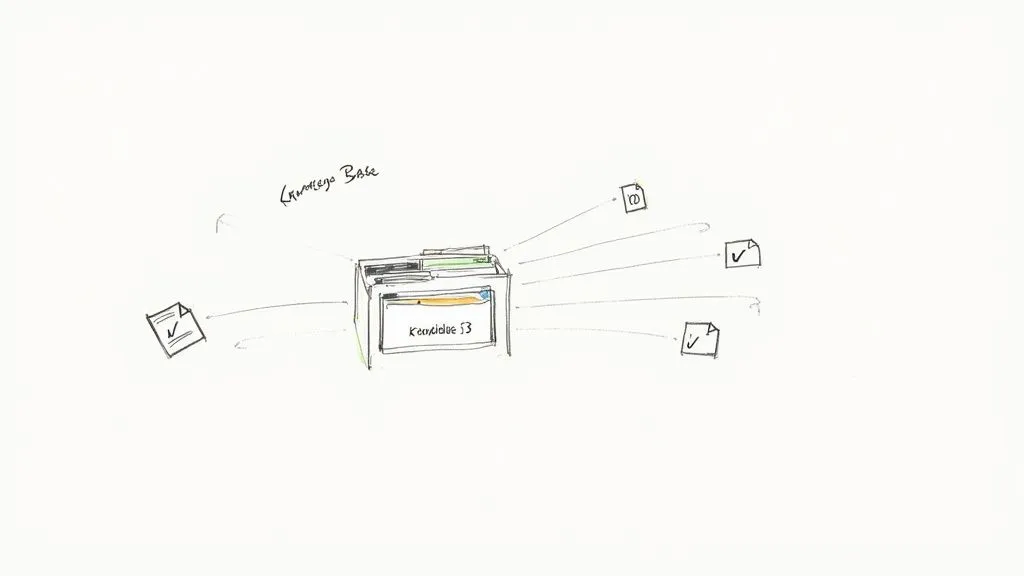
The secret to a smooth, repeatable vendor due diligence process isn’t some clever shortcut. It’s a meticulously organised knowledge base. You need to think of this as your company’s definitive library for every security, compliance, and legal question that will ever be thrown at you.
Without it, your team is stuck reinventing the wheel for every single questionnaire. They’re constantly hunting for documents, pinging engineers for the same architectural diagrams again, and trying to piece together answers from old emails. This isn’t just slow—it’s a recipe for inconsistent, and sometimes just plain wrong, answers.
Having a single source of truth cuts through that chaos. It guarantees that every response your team gives is accurate, consistent, and easy to find. This isn’t about creating a static folder of documents that just gathers digital dust; it’s about building a living, breathing repository that grows and changes with your business.
Gathering Your Essential Artefacts
First things first, you need to pull together all the documents that prospects and customers ask for time and time again. This collection becomes the bedrock of your knowledge base, giving you the hard evidence to back up all your claims.
Your initial haul should cover a mix of technical, legal, and operational documents.
- Security and Compliance Reports: Get your most recent SOC 2 Type II report, your ISO 27001 certificate, and the executive summary from your latest penetration test. These are the non-negotiable proofs of your security posture.
- Policy and Procedure Documents: Pull together key internal policies. We’re talking about your Information Security Policy, Incident Response Plan, Business Continuity and Disaster Recovery (BCDR) Plan, and your Acceptable Use Policy.
- Legal and Privacy Agreements: Make sure you have your standard Data Processing Agreement (DPA), Master Services Agreement (MSA), and a copy of your public-facing privacy policy ready to go.
- Technical Documentation: High-level network and data flow diagrams are almost always requested. They help evaluators get a clear picture of how you’re protecting their data, both in transit and at rest.
How you organise these artefacts is critical. Use a simple, logical folder structure—something like “Compliance Reports,” “Internal Policies,” and “Legal Docs”—to make everything easy to find when the pressure is on.
Making Your Knowledge Base Maintainable
A great knowledge base is never “finished.” It needs constant care and attention to stay accurate and genuinely useful. This means setting up clear rules for version control, who can access what, and a schedule for regular reviews.
For example, the moment your annual penetration test is done, the old report needs to be archived and the new one put in its place. It’s a surprisingly common mistake to leave outdated information floating around, and it can lead to providing incorrect answers during a crucial vendor due diligence review.
The increasing focus on quality over quantity in the UK M&A market really underscores this need for preparedness. Recent analysis shows buyers are spending more time on fewer, better-prepared targets that can satisfy tough due diligence demands, which in turn helps to close valuation gaps by setting realistic expectations.
A well-maintained knowledge base does more than save time. It becomes a strategic asset that reflects your company’s commitment to transparency, security, and operational excellence. It tells prospects you’re organised and ready for business.
To keep your repository in top shape, you need a system. Start by assigning clear owners for each document. The CISO might own the Information Security Policy, while the legal team is responsible for the DPA. These owners are then tasked with reviewing and updating their documents on a set schedule—usually annually or after any significant change. You can explore more strategies in our article covering the 10 best practices for knowledge management. This kind of structured approach is what keeps your single source of truth trustworthy.
Get on Top of Security Questionnaires
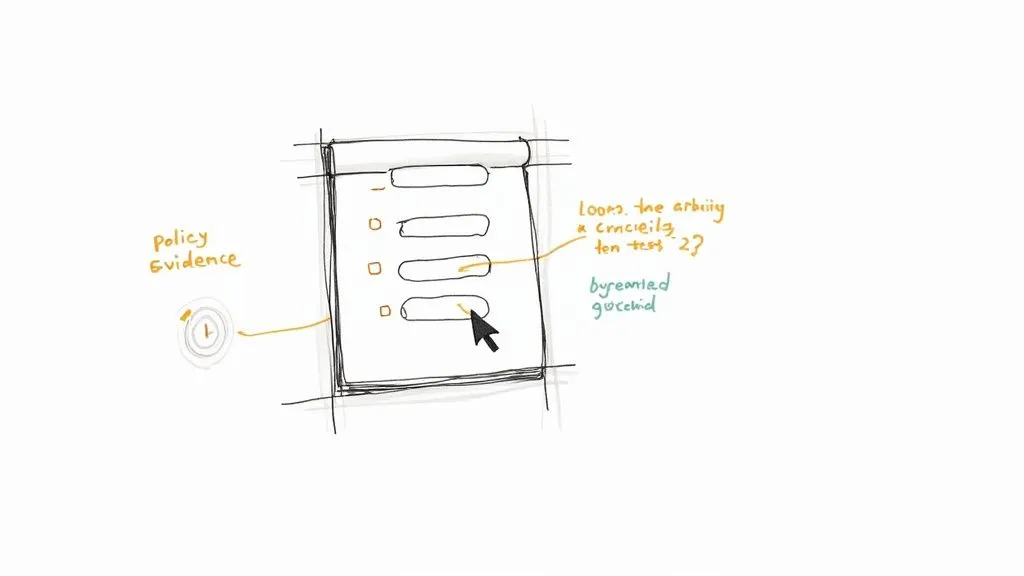
Security questionnaires are the core of vendor due diligence, but let’s be honest—they’re often a real grind. They come in every imaginable format, from massive, multi-tabbed spreadsheets to clunky client portals, each loaded with hundreds of detailed questions.
Without a smart system in place, your team is trapped in a reactive loop. They’re constantly copying and pasting, digging through old files for answers, and trying to guess what the prospect really wants to know. This isn’t just slow; it opens the door to inconsistent or inaccurate responses that can erode trust just as you’re about to close a deal.
But it doesn’t have to be this way. You can transform this bottleneck into a streamlined, efficient part of your sales motion. The key is to make the most of that single source of truth you’ve already built.
From Manual Grind to Instant Answers
Think of your knowledge base as more than just a library of documents. It’s an engine, ready to power your questionnaire responses with speed and accuracy. When a new request lands on your desk, your first instinct shouldn’t be to start typing from scratch. It should be to map their questions to the polished, pre-approved answers sitting in your repository.
This is where the right tools change the game. Modern platforms can take a questionnaire in any format and automatically generate a draft by matching questions to the best answers in your knowledge base. This simple shift can cut out up to 90% of the manual work, freeing up your security and sales teams to focus on the nuanced questions that genuinely need their expertise.
The goal isn’t just about being faster. It’s about raising the quality and trustworthiness of your answers. An automated first pass, built on approved documentation, ensures every response is consistent and correct right from the start.
Being prepared like this also means you can handle whatever format gets thrown at you. Whether it’s a convoluted Excel file or a proprietary web form, having a centralised content hub means you’re always ready to go without having to reformat answers every single time. To see how this works in practice, check out our deep dive into security questionnaire automation and how it can accelerate your sales cycle.
Crafting Responses That Build Credibility
The best security reviews don’t just rely on a simple “yes” or “no.” Prospects need context, and they want proof. Saying you have an incident response plan is fine, but providing a clear answer that links directly to the policy document itself? That’s how you build real confidence.
This is where citing your evidence makes all the difference. A best-in-class response should always include:
- A direct answer: Address the question head-on.
- Contextual detail: Briefly explain how your control or policy works.
- A link to the evidence: Point them to the specific document, policy, or report that backs up your claim.
For example, when asked about data encryption, a weak answer is just “Yes.” A much stronger one would be: “Yes, all customer data is encrypted at rest using AES-256 and in transit using TLS 1.2 or higher. This is detailed in our Information Security Policy, Section 4.2.”
This approach stops the inevitable follow-up questions before they’re even asked and shows a level of transparency that speaks volumes. It proves you aren’t just ticking boxes—you have a mature security programme with the documentation to back it up. A huge part of this is aligning with recognised standards; understanding the ISO 27001 certification process is a great way to frame your security posture. By providing clear, evidence-backed answers, you turn the questionnaire from a tedious chore into a powerful sales tool.
Map Out Your Due Diligence Workflow
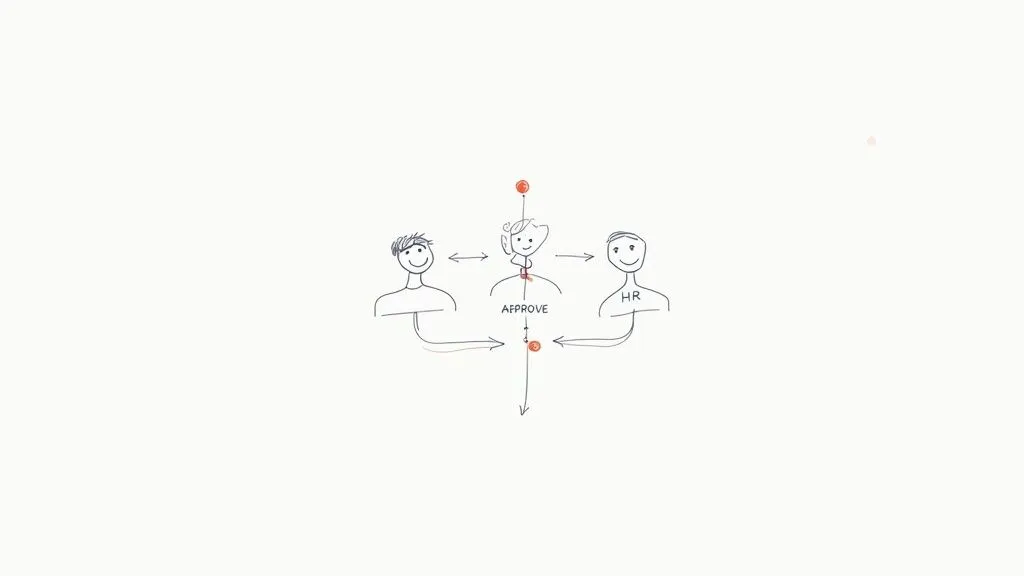
Even with the best knowledge base and slick automation, people are what make or break vendor due diligence. Without a plan, you get chaos. Questions get lobbed over the virtual fence to different departments, leading to delays, conflicting answers, and a final submission that looks like it was stitched together by a committee that never met.
To sidestep that nightmare, you need a clear, collaborative workflow. This isn’t about adding red tape; it’s about creating a simple, repeatable process. One that ensures every question lands with the right expert, gets a quality check, and is approved without a fuss.
The result? A polished, professional response that speaks with one unified voice and eliminates the bottlenecks that kill deals. Everyone knows their role, what’s expected of them, and when they need to step up.
Assigning Questions to the Right Experts
Let’s be honest: not every question in a security questionnaire is actually for the security team. They often stray into the territories of legal, HR, finance, and even physical site security. A smart workflow starts by routing these questions to the correct subject matter experts (SMEs) from the get-go.
Think about a question on employee background checks. Your security manager probably has a decent idea of the process, but the definitive, most accurate answer lives with HR. Your workflow should make it incredibly simple to ping that specific question directly to your HR lead.
Doing this pays off in two huge ways:
- Accuracy: You’re getting answers straight from the source. No second-guessing, no outdated information.
- Efficiency: Your core security team isn’t stuck chasing down answers they don’t own. This frees them up to focus on the deeply technical questions only they can answer.
Part of this process also involves knowing who your trusted external partners are for specialised services. This could mean knowing the certifications of your trusted e-waste disposal companies and being able to speak to their data protection protocols at a moment’s notice.
Implementing a Structured Review Process
Once an SME provides an answer, it shouldn’t go straight to the customer. A structured review and approval cycle is absolutely essential for maintaining quality and consistency. Think of it as your final quality gate.
A great workflow ensures that every response is vetted not just for technical accuracy, but also for tone, clarity, and consistency with your company’s messaging. This prevents siloed, contradictory answers from ever reaching the prospect.
Your review process should have at least two stages. First, a central coordinator—often a security analyst or a sales engineer—combs through all the SME responses. They’re checking that the answer actually addresses the prospect’s question and doesn’t clash with other responses. They’ll also clean up any jargon, fix typos, and make sure the tone is right.
The second stage is a final sign-off from a senior stakeholder, like the CISO or Head of Compliance. This last look confirms that the entire submission accurately reflects the company’s security posture and is truly ready for the client. This rigour is crucial in a cautious market where buyers are digging deeper than ever.
A Sample Workflow Model
You can easily adapt this simple model to fit how your team works.
- Initial Triage: The person owning the questionnaire (let’s say, a Sales Engineer) gets the request. They’ll do a first pass, using the knowledge base and any automation tools to knock out the easy, recurring questions.
- SME Delegation: Any leftover or tricky questions get assigned to designated SMEs in Legal, HR, Engineering, or wherever they belong. Clear deadlines are key here.
- SME Response: The experts jump in, provide their answers, and attach any supporting evidence needed, ideally all within one platform.
- Coordinator Review: The questionnaire owner circles back to review all the new responses. They’re checking for quality, consistency, and completeness, and might send a question back for a quick revision if needed.
- Final Approval: The finished questionnaire is sent to the final approver (e.g., the CISO) for one last look.
- Client Submission: Once it gets the green light, the polished, final package is sent off to the prospect.
Following a structure like this turns what can be a frantic, messy scramble into a predictable and efficient system.
Measure and Improve Your Process
You’ve done the hard work. You’ve built your knowledge base, you’ve smoothed out your questionnaire intake, and you’ve got a solid workflow in place. But how can you be sure any of it is actually making a difference?
Without measuring, “improvement” is just a feeling. The only way to shift from a reactive, chaotic scramble to a proactive, data-driven operation is to track what truly matters.
This isn’t about creating more admin or getting lost in spreadsheets. It’s about zeroing in on a few key performance indicators (KPIs) that give you a brutally honest look at how your vendor due diligence process is performing. These metrics are your feedback loop, shining a light on hidden friction points and helping you sharpen your strategy over time.
When you start tracking your efforts, you graduate from just completing questionnaires to optimising a critical business function—one that has a direct impact on your sales velocity and the trust you build with customers.
Key Performance Indicators for Due Diligence
To get a real sense of your efficiency and effectiveness, you need to look beyond just “time spent”. A handful of specific metrics can tell a much richer story about where your process shines and where it’s letting you down.
Start by tracking these essentials:
- Average Time to Completion: This is the big one. Measure the clock from the moment a questionnaire lands in your inbox to the moment you submit the final, approved version. If this number is consistently high, it’s a massive red flag pointing to bottlenecks in your workflow or serious gaps in your knowledge base.
- First-Pass Acceptance Rate: What percentage of your submissions get accepted by the client without any back-and-forth for clarification or more evidence? A high acceptance rate is a brilliant indicator of the quality, accuracy, and thoroughness of your initial response.
- Knowledge Base Utilisation Rate: For any given questionnaire, what percentage of answers can you pull directly from your knowledge base without having to bother an SME? Aiming for 80-90% is a great goal. It proves your repository is comprehensive and actually doing its job.
These numbers give you a baseline. From there, you can start digging deeper to understand the “why” behind them and pinpoint exactly where you need to improve.
Analysing the Data to Find Friction Points
Your KPIs are the starting point, not the finish line. When a number looks off, it’s not a failure; it’s an opportunity. Analysing these metrics helps you diagnose problems and make targeted improvements that have a real impact on your team’s workload and success rate.
For instance, a dipping knowledge base utilisation rate might tell you that prospects are asking new types of questions you haven’t prepared for. That’s a clear signal to get your repository updated with answers about new product features or emerging compliance standards.
The real power of measurement lies in transforming raw data into actionable insights. Every metric should prompt a question: “What is this number telling us about our process, and what can we do to make it better?”
Let’s say you notice your Average Time to Completion is stubbornly long. By breaking down the process, you might discover that the legal review is where everything grinds to a halt. That single insight allows you to take specific action, like pre-drafting standard responses for common contractual queries and getting them blessed by legal ahead of time.
Building a Continuous Improvement Cycle
Tracking your metrics can’t be a one-off project. To truly master vendor due diligence, you need to get into a rhythm of regular review and refinement. This creates a continuous improvement cycle that makes your process smarter and more efficient with every single deal you close.
Here’s a simple framework to put this into practice:
- Track Consistently: Use a tool like ResponseHub or even a simple shared spreadsheet to log your KPIs for every single questionnaire. Consistency is everything if you want to spot meaningful trends.
- Review Monthly: Set aside time each month with the core due diligence team. Look at the numbers, celebrate the wins, and have an honest conversation about the challenges.
- Identify One Bottleneck: Don’t try to fix everything at once. Each month, use your data to identify the single biggest friction point. Is it chasing down SMEs? Is it a specific section of your knowledge base that’s gone stale?
- Take Action and Remeasure: Implement a specific change to tackle that one bottleneck. The next month, check your KPIs to see if your change actually made a positive difference.
This iterative approach ensures your vendor due diligence process evolves right alongside your business, turning what was once a sales obstacle into a genuine source of competitive advantage.
Answering Common Vendor Due Diligence Questions
Sitting down to a vendor due diligence questionnaire can feel a bit like taking an exam. Most of the questions are straightforward enough, but some are just…tricky. They might be ambiguous, open-ended, or ask about something you simply don’t do.
How you navigate these common hurdles can be the difference between a smooth, quick approval and getting stuck in a frustrating loop of follow-up questions. Let’s walk through a few of the most frequent curveballs and how to knock them out of the park.
How Should We Answer Vague Questions?
We’ve all seen it. A question like, “Describe your security programme,” lands in your lap. It’s so broad you don’t even know where to begin. The temptation is to write a novel, but trust me, that’s not the answer. Burying the assessor in text often just obscures what they’re actually trying to find.
The trick is to be concise but comprehensive. Give them a solid framework without writing a thesis.
- Start with a recognised standard: Ground your answer in a framework the assessor will know and trust. For instance, you could start with, “Our information security programme is aligned with the NIST Cybersecurity Framework 2.0 and we hold an active ISO 27001 certification.” Right away, this gives them a familiar benchmark for your practices.
- Outline the pillars: From there, briefly touch on the core components of your programme—things like risk management, access control, incident response, and security awareness training.
- Point to the proof: Finish by directing them to the detailed evidence. Something like, “For a deeper dive, please refer to our Information Security Policy and our latest SOC 2 Type II report, which are attached,” works perfectly.
This approach gives a direct, structured answer and guides them to the nitty-gritty details they need, showing you’ve got a mature, well-organised security posture without overwhelming them upfront.
What If We Don’t Have a Specific Control?
Another classic stumbling block is a question about a control you don’t have. Maybe they ask, “Do you perform quarterly vulnerability scans?” but your cadence is actually semi-annual. It’s so easy to just tick “No,” but that’s a huge missed opportunity and can raise an unnecessary red flag.
A blunt “No” invites suspicion. The real key here is to be honest while also explaining your compensating controls.
Never just say “No.” Always follow up by explaining the alternative measures you have in place to address the underlying risk. This shows you have a thoughtful, risk-based approach to security, not just a checklist mentality.
Using the vulnerability scanning example, a far more effective answer would be: “We conduct comprehensive vulnerability scans on a semi-annual basis, which are supplemented by continuous, automated monitoring of our production environment for critical threats. This risk-based approach allows us to prioritise and remediate the most significant vulnerabilities in near real-time.”
See the difference? It’s truthful, but it frames your process positively. It shows you’re actively managing the same risk, just in a way that makes the most sense for your business.
Handling Questions About Sub-Processors and Fourth Parties
It’s no longer just about your security. Your potential clients want to know about your vendors’ a.k.a your sub-processors or fourth-parties security, too. When they assess you, they’re assessing your entire supply chain. They need assurance that you’re performing proper vendor due diligence on the companies you depend on.
When you get asked how you manage your vendors, a strong answer needs to hit three key areas:
- Onboarding Diligence: First, explain how you vet new vendors before you sign on the dotted line. Mention that you review their security posture, check for compliance certifications like SOC 2 or ISO 27001, and scrutinise their contractual obligations around data protection.
- Contractual Requirements: Next, state that your agreements legally require sub-processors to meet security and data protection standards equivalent to your own. This must include things like breach notification windows.
- Ongoing Monitoring: Finally, describe how you keep an eye on them over time. This could involve annual reviews of their security attestations or immediate reassessments if a major security incident occurs in their world.
By laying out your own rigorous vendor management programme, you show the customer that you’re not just a vendor, but a responsible partner who actively manages supply chain risk. That kind of transparency builds a massive amount of trust.