· Jane Iamias · template for proposal request · 17 min read
A Winning Template for Proposal Request Writing
Stop guessing. Use our battle-tested template for proposal request to get clear, comparable bids. This guide offers actionable steps and expert tips.
If you want to find the right vendor, a clear template for a proposal request isn’t just helpful—it’s essential. It’s the single most important tool you have for standardising submissions, making it much easier to compare different vendors fairly and setting the stage for a great partnership right from the start.
Without a solid template, you’re basically inviting chaos. You’ll get a flood of misaligned bids and set yourself up for project delays before you’ve even picked a partner.
Your Starting Point: A Clear Proposal Request Template
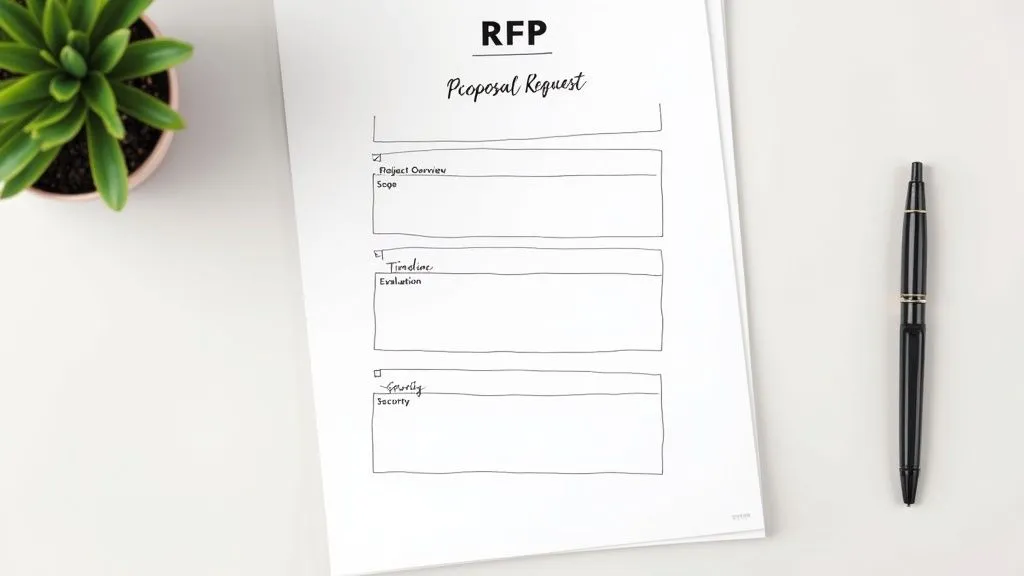
When you give every vendor the same clear structure to follow, you get back proposals that are easy to evaluate side-by-side. You’re no longer trying to compare apples with oranges; instead, you get a consistent view of how each vendor’s capabilities and proposed solutions stack up against your goals.
This structured approach does more than just help you; it forces your own team to get on the same page. The simple act of drafting a comprehensive template for a proposal request requires you and your stakeholders to agree on what success actually looks like. You have to spell out your precise goals, deliverables, and evaluation criteria, which leaves very little room for confusion later on. Honestly, this internal alignment is one of the biggest unsung benefits of the whole process and can save you from a world of pain with scope creep down the line.
To get you started, here’s a quick look at the essential sections every effective proposal request should have.
Key Components for Your Proposal Request
| Section Name | What to Include |
|---|---|
| Project Overview | A high-level summary of the project and the problem you’re trying to solve. |
| Company Background | Brief information about your organisation and its mission. |
| Scope of Work | Detailed breakdown of the specific tasks, deliverables, and services required. |
| Timeline | Key dates, including submission deadline, decision date, and project start/end dates. |
| Budget | Your allocated budget or an expected price range for the project. |
| Evaluation Criteria | How you will assess proposals (e.g., price, experience, technical solution). |
| Submission Guidelines | Instructions on how and where vendors should submit their proposals. |
| Security & Compliance | Any data security, privacy, or regulatory requirements vendors must meet. |
Having these core elements in place will ensure you get the detailed, relevant information you need to make the best decision.
Balancing Detail and Flexibility
The very best proposals come from a document that gives vendors enough detail to work with but doesn’t suffocate them. Your template should provide all the necessary information for them to put together a thoughtful, accurate response, but you don’t want to box them into a rigid, one-size-fits-all solution.
A common pitfall is creating an RFP so rigid that it stifles innovation. You want to give vendors the space to propose creative solutions you may not have considered. Think of your template as guardrails, not a straitjacket.
To get this balance right, concentrate on defining the what (your goals and what you need) and the why (the business problem you’re solving). But try to leave some room for creativity in the how. This approach encourages vendors to really show off their unique expertise and problem-solving skills.
Even government bodies are constantly working on this. The UK Cabinet Office, for example, has committed to improving its templates to provide greater clarity on its requirements, often working directly with suppliers to figure out the best way to structure their requests. You can learn more about the Civil Service’s plan to enhance data requests on GOV.UK. It’s a great example of a high-level commitment to clear communication—a principle every organisation, big or small, should adopt.
Defining Your Project Scope and Deliverables
Let’s be honest, a vague project scope is the fastest way to blow your budget and miss your deadlines. If you want proposals that are actually useful and comparable, you need to be crystal clear about what you need done and, just as importantly, why it matters.
Start by painting a picture of your current reality. What’s the problem you’re wrestling with? Maybe you’re stuck with clunky, outdated software that’s killing productivity, or your marketing just isn’t connecting with the audience you need to reach. Giving vendors this context isn’t just background noise; it helps them get inside your head and truly understand the problem you need their help to solve.
Once you’ve set the scene, you can shift to your vision for the future. This isn’t the place for a dry list of features. Instead, describe the outcome you’re aiming for. A clear vision ensures every potential partner understands what success actually looks like for your organisation.
Articulating Your Objectives Clearly
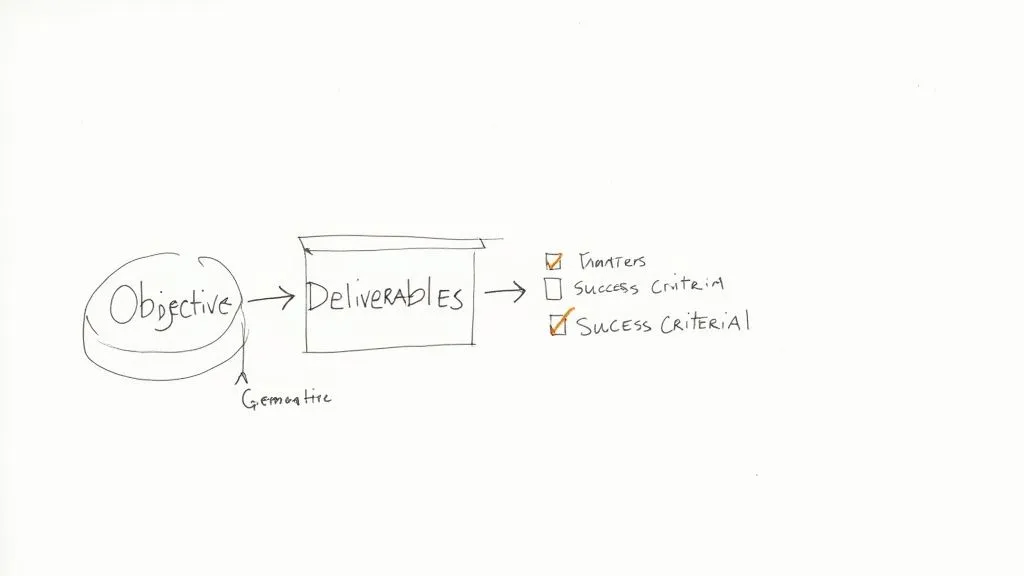
Think of your objectives as the big-picture goals—the destination on your project map. They need to be specific, measurable, achievable, relevant, and time-bound (the old SMART framework still works for a reason). Steer clear of fuzzy statements like “improve user experience.”
What does a good objective look like? Instead of the vague example above, try something like this: “Reduce customer support tickets related to website navigation by 30% within six months of the new site going live.” Now that’s a target a vendor can sink their teeth into and build a solution around.
To nail down your objectives, ask yourself a few key questions:
- Business Goals: How does this project directly support the company’s strategic priorities or bottom line?
- User Needs: Whose pain points are we solving here? Is it for your customers, your internal teams, or both?
- Success Metrics: When this is all over, how will we know if we succeeded? Define your key performance indicators (KPIs) from the very beginning.
If you want to go deeper on structuring these requirements, our guide on mastering the business requirements document offers a much more detailed framework.
Detailing Specific Deliverables
If your objectives are the destination, then deliverables are the tangible outputs you’ll receive along the way. I’ve seen it time and time again: a poorly defined list of deliverables is a guaranteed recipe for scope creep, frustration, and disappointment.
Your template for proposal request needs to be explicit here. Don’t just ask for “a new marketing campaign.” Break it down into the actual, physical (or digital) items you expect to have in your hands at the end of the project.
A classic mistake is assuming vendors just know what you mean. You have to be painstakingly clear. A deliverable isn’t a vague activity; it’s a concrete, reviewable item—a report, a chunk of code, a set of finalised designs.
Here’s a quick comparison to show you what I mean. For a software project, the difference is night and day:
| Vague Request | Specific Deliverable |
|---|---|
| User authentication system | A secure login module that includes two-factor authentication (2FA) via both SMS and an authenticator app, with full password reset functionality and a user profile management page. |
| Reporting dashboard | An analytics dashboard displaying visualisations for daily active users, engagement time, and conversion rates. The data must also be exportable to a CSV format. |
This level of detail gets rid of the guesswork. It ensures every proposal you receive is built on the same foundation, allowing you to compare them fairly. More importantly, it gives you a solid basis for holding your future partner accountable. Getting this part right is arguably the most critical step in the entire RFP process.
Setting Clear Timelines and Evaluation Criteria
So, you’ve nailed down a rock-solid scope of work. What’s next? It’s time to define exactly how and when you’ll make your decision. Any ambiguity at this stage is a huge red flag for the best vendors, and it can make your entire selection process feel disorganised and arbitrary.
Clear timelines and transparent evaluation criteria are the bedrock of a fair and efficient decision. Without them, you’re just asking for late proposals, internal arguments over what “good” actually looks like, and a final choice based on a gut feeling rather than solid data. This part of your RFP is all about setting clear expectations for everyone, both on your team and for the vendors hoping to win your business.
Mapping Out Key Project Milestones
A proper timeline isn’t just a single deadline. It should clearly map out the whole procurement journey, giving potential partners a full picture of the process from start to finish. This small detail shows you’re organised and that you respect their time and effort.
Your timeline needs specific dates for a few key events:
- RFP Issued Date: The day the race officially begins.
- Deadline for Questions: A firm cut-off for vendors to ask for clarification.
- Proposal Submission Deadline: The final, non-negotiable due date for all bids.
- Vendor Shortlisting and Interviews: When you plan to notify and meet with the top contenders.
- Final Decision Date: The day you expect to have selected your new partner.
- Project Kick-off Date: The target start date for the work itself.
Don’t just throw dates onto a page; communicate them clearly. A transparent schedule helps vendors plan their resources and shows you’re running a professional process. It’s a simple thing that builds a lot of trust right from the start.
Establishing a Fair Evaluation Framework
This is where you tell vendors exactly how you’ll be scoring their submissions. Sharing your evaluation criteria upfront is crucial if you want proposals that actually speak to your priorities. It also forces your own team to agree on what truly matters before you even lay eyes on a single bid.
Defining performance metrics is also vital to ensure the chosen vendor will meet your long-term expectations. If you need a deeper dive into this, a good guide on Mastering IT Service Level Agreements can be incredibly helpful.
A weighted scoring matrix is a great way to handle this. It works by assigning a percentage value to different parts of the proposal, making sure the most important areas carry the most weight. This simple tool shifts your decision-making process from a subjective beauty contest to an objective, data-driven analysis.
Here’s a sample breakdown you can easily adapt:
| Evaluation Criterion | Weighting | What We’re Looking For |
|---|---|---|
| Technical Solution | 40% | How well does the proposed solution meet the needs we outlined in the scope of work? |
| Cost and Value | 25% | Does the price reflect the long-term value and ROI? Is it competitive? |
| Company Experience | 20% | What’s the vendor’s track record? Do they have relevant case studies and experience? |
| Cultural Fit & Team | 15% | How strong is their team? Does their communication style align with our company values? |
By spelling this out in your proposal request, you guarantee that every submission is judged by the same standards. It not only makes your final decision easier to make, but it also gives you a clear, documented rationale to stand behind.
Weaving in Security and Data Requirements

Let’s be blunt: overlooking security and data requirements in your proposal request is a recipe for disaster. In a world where a single data breach can spiral into a financial and reputational nightmare, treating security as an afterthought just isn’t an option anymore.
Think of this section as more than a checkbox; it’s a powerful filter. It quickly weeds out vendors who don’t take data protection seriously and shows high-calibre partners that you’re a mature, responsible organisation to work with. You need to clearly state your non-negotiables for how your data will be handled, stored, and protected.
Defining Your Data and Compliance Needs
First things first, you need to map out what kind of data the vendor will be touching. Are they going to be handling sensitive customer details, personally identifiable information (PII), or confidential intellectual property? Get specific, but without ever revealing the actual data itself.
This clarity is crucial because it directly informs the level of security you need. It’s a foundational principle that even high-level government bodies rely on. The UK Statistics Authority, for instance, builds its strategic plans around robust data methodologies to ensure the information shaping national decisions is trustworthy.
You also need to lay out the regulatory gauntlet. Specify exactly which regulations the vendor must adhere to, such as:
- GDPR (General Data Protection Regulation) if you’re dealing with the data of EU residents.
- CCPA/CPRA (California Consumer Privacy Act/California Privacy Rights Act) for anyone in California.
- Industry-specific rules like HIPAA in healthcare or PCI DSS for payment card data.
If your project involves any kind of automated data processing or machine learning, it’s also smart to set out clear requirements for GDPR compliant AI integration strategies. This ensures all data handling is above board from day one.
Asking the Right Security Questions
Once you’ve outlined what you need, it’s time to make vendors prove they can deliver. A simple “yes, we’re secure” just won’t cut it. Your template for proposal request should have a dedicated security questionnaire or a section with sharp, probing questions.
A vendor’s hesitation or inability to answer detailed security questions is a massive red flag. Their response should reveal a proactive security culture, not just a reactive one.
Your questions should come at their security posture from all angles. Try including queries like these:
- Data Encryption: How is our data encrypted, both when it’s moving (in transit) and when it’s stored (at rest)?
- Access Controls: What are your policies for controlling who can access client data and when?
- Incident Response: Walk us through your process for identifying, containing, and reporting a security breach.
- Certifications: Do you hold any relevant security certifications, like ISO 27001 or SOC 2?
- Data Disposal: What is your policy for securely wiping our data at the end of the contract?
Pulling together a comprehensive list of questions can feel like a huge task. To get a head start, you can find a solid framework here: https://responsehub.ai/streamline-compliance-with-a-requirement-collection-template. It will help you systematically gather the assurances you need without reinventing the wheel, ensuring no critical security detail gets missed.
Managing Submissions and Defining Next Steps
How you handle the final stages of your proposal request says a lot about your organisation. A clear, well-organised submission process doesn’t just make life easier for vendors; it dramatically simplifies your own team’s evaluation work. Think of it as the logistical glue holding the whole effort together.
This all comes down to giving crystal-clear instructions on how vendors should respond. You need to specify the submission format, name a single point of contact for all questions, and set firm, unambiguous deadlines. Getting these small details right now will prevent major headaches later.
Centralising Questions and Answers
One of the best ways to keep the process fair and transparent is to create a central hub for all vendor questions and your answers. Instead of getting caught in a web of individual email replies, set a firm deadline for questions. Then, compile all queries and responses into a single document and share it with every potential bidder.
This levels the playing field, ensuring no single vendor gets an edge by asking a particularly clever question. It also saves your team from answering the same things over and over, freeing you up for more important tasks.
This standardised approach is a cornerstone of large-scale procurement. Just look at the UK public sector, which spent a staggering £249 billion in the last fiscal year. Managing that kind of complexity demands impeccably clear processes, which is why refined proposal request templates are so vital for efficiency.
Final Internal Review Checklist
Before you hit send and release your proposal request into the wild, a final internal check is non-negotiable. Skipping this can lead to embarrassing typos, confusing requirements, or conflicting information that undermines the entire process.
Get your key stakeholders in a room (or on a call) for one last look. A simple checklist is a great way to make sure every base is covered and everyone is aligned.
Your Pre-Launch Checklist:
- Stakeholder Sign-Off: Has every key decision-maker reviewed and approved the final document?
- Proofreading Complete: Have at least two different people proofread the entire document for grammar, spelling, and clarity?
- Consistency Check: Do the scope, timelines, and evaluation criteria all align without any contradictions?
- Contact Point Confirmed: Is the designated contact person ready to field questions and manage communications?
- Submission Details Finalised: Are the format requirements and deadline clearly and correctly stated?
A thorough final review is your last line of defence against ambiguity. It’s the five-minute check that can save you five weeks of confusion down the road. Treat it as a mandatory step, not an optional one.
This disciplined approach ensures your template for proposal request works exactly as intended, attracting high-quality, relevant bids. And for those on the other side of the fence, understanding how to structure a winning response is just as crucial. You might find our guide on how to write a tender that wins contracts useful for seeing things from their perspective.
By managing submissions meticulously and defining the next steps with precision, you set a professional tone that attracts top-tier partners and lays the groundwork for a successful project.
Common Questions About Proposal Requests
Even with the best guide in hand, putting together your first few proposal requests can feel a bit uncertain. Let’s tackle some of the most common questions that pop up during the process to clear away any confusion.
How Long Should My Proposal Request Be?
There’s no golden rule for length, but clarity and conciseness are far more important than page count. That said, a solid, effective RFP usually lands somewhere between 5-15 pages.
The goal is to provide enough detail for vendors to give you an accurate, thoughtful bid without overwhelming them. You don’t want your request to feel like homework. Keep the main document focused on the core business problem, the scope, and how you’ll be judging the responses.
For those really technical or complex projects, a smart move is to push all the granular specifications into appendices. This keeps the main body of your RFP clean and scannable, making it much easier for vendors to grasp what you truly need.
What’s the Biggest Mistake to Avoid?
Without a doubt, the single most damaging mistake you can make is writing an ambiguous project scope. It’s the root cause of almost every project headache down the line.
If you aren’t crystal clear about what you need and what a successful outcome looks like, you’ll get a stack of proposals that are all over the place, making it impossible to compare them fairly. Vendors will have to guess what you mean, and their assumptions will lead to inaccurate pricing and solutions that miss the mark.
Here’s a little trick I’ve used for years: before you send out your RFP, ask someone from a completely different department to read your scope section. If they can’t explain it back to you in simple terms, your vendors won’t understand it either. This one test can save you a world of pain.
Getting the scope right isn’t just a box-ticking exercise; it’s the best investment you can make in the entire procurement process.
Should I Include a Budget in My Proposal Request?
This is a classic debate, but from my experience, including a budget range is almost always the right call. It sets realistic expectations right from the start.
Providing a sensible financial bracket helps potential partners propose a solution that actually works for your business. It immediately filters out vendors who are way off the mark, saving everyone’s time. You won’t have to wade through proposals you could never afford.
Giving them a budget also empowers vendors to get creative. They can tailor their approach to deliver the best possible value within your means, rather than just pitching their most expensive package.
If you’re still uncomfortable putting a precise figure out there, try framing it as an investment tier. For instance, you could state you’re looking for solutions in the “£20k-£30k range”. It gives vendors the context they need without revealing your absolute bottom line.