

Alternatives to Responsive (RFPIO) for Security Questionnaires: ResponseHub Compared
If security questionnaires are your primary pain-point, ResponseHub is faster to deploy, dramatically cheaper ($124/month with unlimited usage), and purpose-built for the job. If your team runs a high-volume proposal operation spanning RFPs, RFIs, and bids alongside questionnaires, Responsive's broader feature set may justify its enterprise price tag.
Security questionnaire volume keeps climbing, and if you're evaluating alternatives to Responsive (the platform formerly known as RFPIO), you're likely wondering whether a dedicated questionnaire tool can do the job better than a full strategic response management suite. This page puts the two side by side across pricing, AI answer quality, setup speed, and day-to-day usability so you can make a confident call.
This comparison is a scalpel versus a Swiss Army knife: ResponseHub is built for surgical precision on one job — getting security questionnaires done — while Responsive is a multi-tool covering RFPs, RFIs, proposals, bids, and questionnaires under one roof.
The right pick depends on whether you need precision for one job or a multi-tool for many. Most teams drowning in security questionnaires need the scalpel.
Which one is right for you?
Choose ResponseHub if…
- Security questionnaires are your primary pain and you want a purpose-built tool, not a full proposal suite.
- You want published pricing — $124/month with unlimited usage — instead of a demo-gated quote estimated at $10,000+/year.
- You need cited, confidence-scored AI answers your team can verify fast.
- You want to be productive in under 5 minutes, fully self-serve, with a 7-day free trial.
Choose Responsive if…
- You run a dedicated proposal team managing a high volume of RFPs, RFIs, bids, and proposals alongside questionnaires.
- You need native Salesforce, Slack, and Microsoft Teams integrations tied into your response workflow.
- You're already embedded in Responsive's ecosystem with a mature, well-maintained content library.
ResponseHub
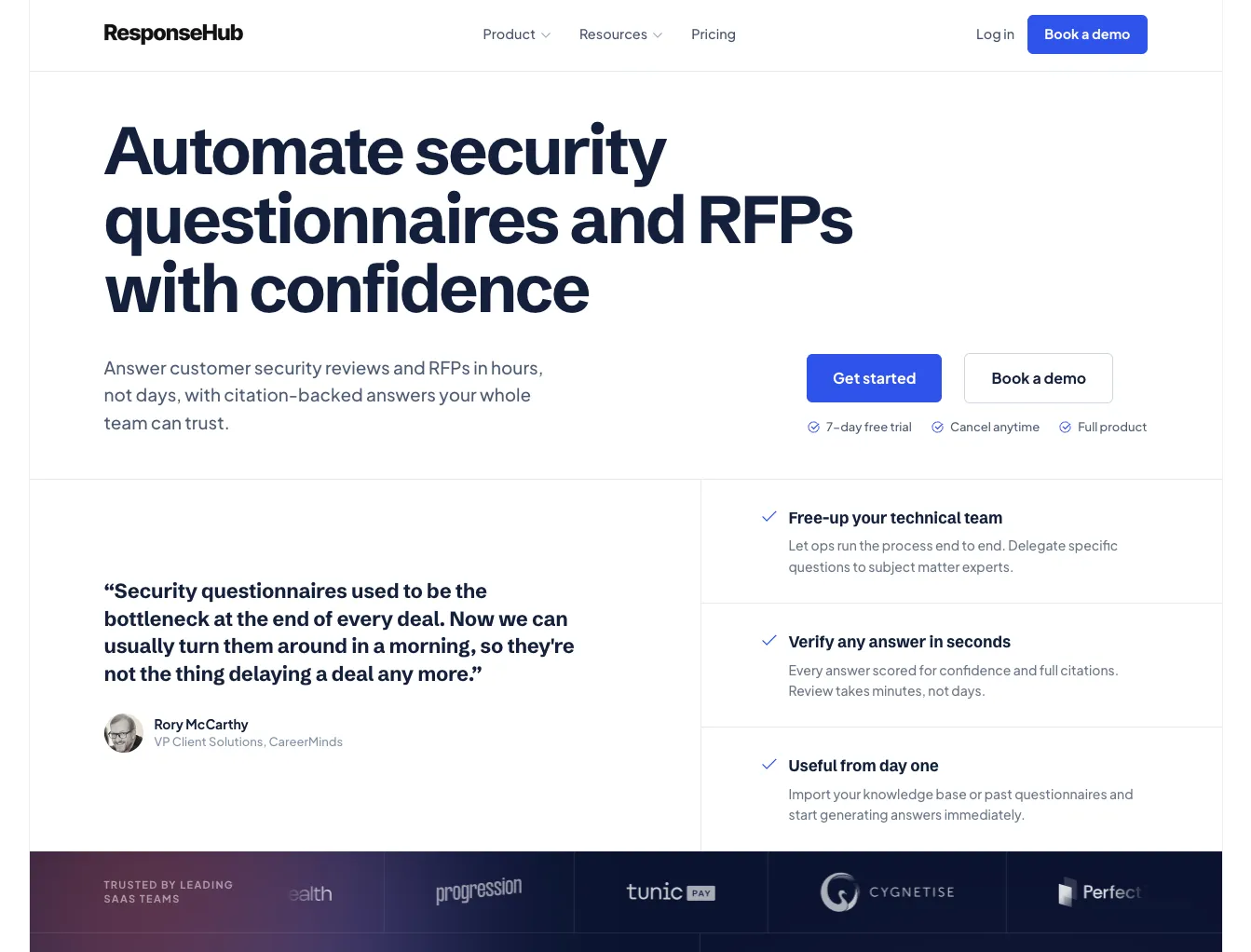
Questionnaire automationResponseHub is an AI-powered tool built specifically for security questionnaires, RFPs, and DDQs. You upload your policies as PDFs, import your existing answer library, and the AI drafts answers grounded in your actual documentation, with citations down to the exact page, section, and sentence. Every completed questionnaire feeds the knowledge base, so the system gets smarter over time.
Responsive (formerly RFPIO)
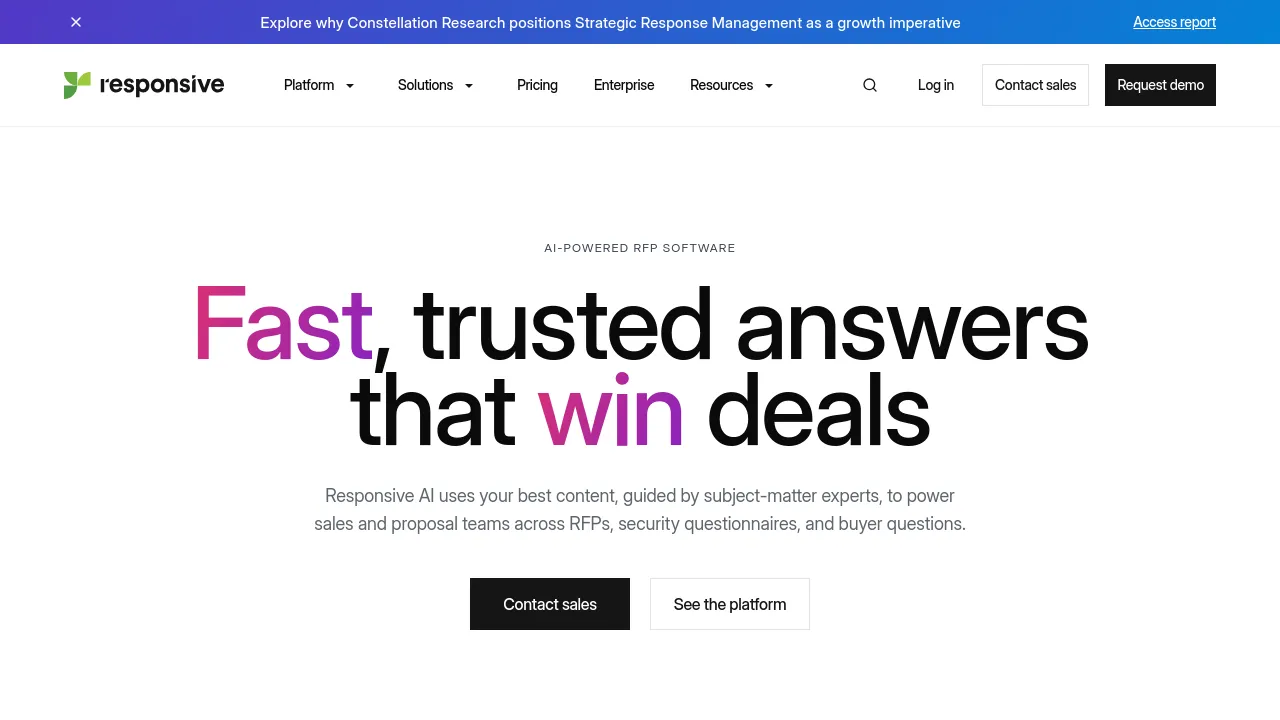
Response managementResponsive is an enterprise strategic response management platform. It covers RFPs, RFIs, proposals, bids, and security questionnaires under one roof, backed by a large content library and AI-powered answer recommendations. The platform integrates with CRMs like Salesforce and collaboration tools like Slack.
At a glance
| Comparison point | ResponseHub | Responsive |
|---|---|---|
| Published pricing | Starter $124/mo, Business $332/mo | Not published — demo required |
| Usage limits | Unlimited — no credits or fees | Not publicly documented |
| Ideal team size | 1 to 50+ | 10 to 500+ |
| AI citations | Exact source + confidence scores | AI-recommended answers from content library |
| Questionnaire formats | xlsx, docx, portals via Chrome extension | Multiple formats incl. xlsx, docx, portals |
| Round-trip export | Yes — preserves buyer formatting | Yes |
| Free trial | 7-day, fully self-serve | Not available — demo required |
| Security posture | Published security page | SOC 2 Type II certified |
Competitor details as published on their site or estimated by third-party sources, August 2026.
How they compare, dimension by dimension
Pricing & transparency
ResponseHub publishes pricing on its website. Starter is $124/month with 2 Editor seats. Business is $332/month. Every plan includes unlimited usage: no credits, no per-questionnaire fees. You pay only for Editor seats, and Viewer seats are unlimited. You can sign up for the 7-day free trial without talking to anyone.
Responsive does not publish pricing. Getting a number requires booking a demo and going through a sales process. Third-party estimates suggest entry-level starts around $10,000/year, scaling to $50,000 to $100,000+ for enterprise contracts. If your annual questionnaire spend needs to fit a specific budget, the lack of transparent pricing makes it harder to evaluate quickly.
For teams where security questionnaires are one of several response types and the budget exists, this may be acceptable. For teams that just need questionnaire automation, it's a lot of money for capabilities they won't use.
AI answer quality & citations
ResponseHub generates answers grounded in your own uploaded policies and past completed questionnaires, not generic training data. Every AI-drafted answer includes a citation to the exact policy name, page, section, and sentence it drew from, plus a per-answer confidence score. Low-confidence answers get flagged so your team can focus review time on genuine gaps instead of re-reading everything.
Responsive uses an AI recommendation engine that pulls suggested answers from your content library. The quality depends heavily on how well-maintained that library is. This is where a common complaint from G2 reviewers comes in: keeping the content library accurate and deduplicated requires significant ongoing effort. If library maintenance slips, answer quality degrades. ResponseHub's self-improving knowledge base with built-in deduplication addresses this by design, automatically incorporating every completed questionnaire and surfacing stale or duplicate entries.
Setup & time to value
ResponseHub is self-serve from start to finish. Sign up, import your existing answer library and old completed questionnaires, drag and drop your policy PDFs, and you're drafting answers. The whole process takes under 5 minutes. There is no sales call, no guided onboarding requirement, no implementation project.
Responsive requires a demo, a sales cycle, and typically a structured onboarding period. G2 and Capterra reviewers frequently mention a steep learning curve and weeks to fully configure the platform. The recent UX redesign has also drawn mixed reactions: some users report that workflows they relied on became harder to find after the interface was overhauled.
For large proposal teams with dedicated admins, this setup investment may be worth it. For a compliance manager or ops lead trying to clear a backlog this quarter, it's a significant time commitment before you see value.
Format handling & export
ResponseHub accepts questionnaires in xlsx, docx, and directly from online security portals via the Chrome extension. Its extraction engine is built for the messy reality of security questionnaires: missing column headers, multiple-choice options, not-applicable fields, and unfamiliar spreadsheet layouts. Round-trip export preserves the buyer's original formatting (xlsx or docx), so you're not reformatting answers before sending them back. Knowledge base exports to CSV.
Responsive supports a wide range of formats and has built integrations for pulling in RFPs and proposals from various sources. If your team handles a diverse mix of response documents beyond questionnaires, Responsive's format support is broader. For pure questionnaire work, ResponseHub's specialized extraction tends to handle edge cases more reliably.
Product focus
This is the core strategic difference between the two.
ResponseHub does one thing: questionnaire automation. It is not a small module inside a GRC suite or a feature bolted onto a proposal platform. The entire product, every design decision, every engineering sprint, is focused on getting questionnaires answered faster and more accurately. That focus means the tool is opinionated about questionnaire workflows in ways a general-purpose platform cannot be.
Responsive is a broad strategic response management platform. Security questionnaires are one of many document types it handles. If your team genuinely needs RFP management, proposal collaboration, RFI responses, and questionnaire automation in one place, that breadth is valuable. But if questionnaires are the drain on your team's time and you don't have a proposal team running complex bids, you're paying for (and navigating) a lot of platform you'll never touch.
What teams say about ResponseHub
The questionnaires were all similar, but different enough that we couldn't easily automate them ourselves. We looked at building something internally and it never got prioritised.

Pros and cons
ResponseHub
- Transparent pricing. Starting at $124/month with unlimited usage, you know exactly what you're paying before you sign up.
- Purpose-built for questionnaires. Every feature is designed for security questionnaires, RFPs, and DDQs. No wading through irrelevant modules.
- Cited AI answers. Every response includes the exact source policy, page, section, and sentence, plus confidence scores that focus your review time.
- 5-minute setup. Self-serve signup, import your existing library, and start drafting answers immediately.
- Self-improving knowledge base. Completed questionnaires automatically feed the next one. Built-in deduplication keeps things clean.
- Narrower scope. ResponseHub does not cover the full proposal lifecycle (RFIs, bids, proposal design). If you need all of that, you'll need another tool alongside it.
- Younger product. ResponseHub has a smaller user community compared to Responsive's established enterprise base.
- No native CRM integrations. If deep Salesforce or Slack integration is a workflow requirement, ResponseHub does not currently offer those.
Responsive (formerly RFPIO)
- Broad response management. Handles RFPs, RFIs, proposals, bids, and security questionnaires in one platform.
- Enterprise integrations. Native connections to Salesforce, Slack, Microsoft Teams, and other enterprise tools.
- Large content library. A mature system for storing and reusing response content across document types.
- Established market presence. SOC 2 Type II certified, widely adopted by large proposal teams, extensive customer base.
- Team collaboration. Built for multi-person proposal teams with role-based workflows and review cycles.
- No published pricing. You cannot evaluate cost without engaging sales. Third-party estimates put entry at $10,000/year minimum.
- Complex setup. Onboarding takes weeks, not minutes. The learning curve is steep, particularly for teams without a dedicated platform admin.
- UX redesign friction. Recent interface changes have drawn criticism from users who found the previous design more intuitive.
- Library maintenance burden. The content library requires significant ongoing curation. If it falls behind, AI answer quality drops.
- Overkill for questionnaire-focused teams. If security questionnaires are your main need, you're paying for a broad platform and using a fraction of it.
What it costs
ResponseHub publishes its pricing: Starter at $124/month (2 Editor seats) and Business at $332/month, both with unlimited usage, no credits, and unlimited Viewer seats. Responsive does not publish pricing — third-party estimates put entry-level plans at roughly $10,000/year, with enterprise contracts scaling to $50,000 to $100,000+, and you need to book a demo just to get a quote.
See full pricingSwitching from Responsive?
- Export your content library from Responsive (check their documentation for current export options) and import it into ResponseHub to seed the knowledge base.
- Import old completed questionnaires so your historical answers carry over.
- Upload your policy documents as PDFs and the AI drafts cited answers from them.
- Self-serve setup in under 5 minutes — no sales call, no implementation project.
- 7-day free trial, so you can test the migration before committing.
Which should you pick?
Our honest recommendation by situation.
Your problem is specific: enterprise buyers send questionnaires, and they're sitting in someone's inbox too long. ResponseHub is built for exactly this. Upload your policies, import past answers, and start clearing the backlog today. At $124/month with unlimited questionnaires, it pays for itself the first time it helps you close a deal faster instead of losing it to a slow security review.
If your team handles a high volume of RFPs, RFIs, bids, and proposals, and security questionnaires are just one slice of that work, Responsive's breadth is genuinely useful. The content library, CRM integrations, and multi-user collaboration features are designed for this scale. The enterprise pricing is easier to justify when the platform serves your entire response operation, not just questionnaires.
You're the person who ends up owning questionnaires because nobody else will. You don't have a dedicated team, and you're stretched between framework compliance (SOC 2, ISO 27001, NIST CSF) and answering the same questions from different buyers. ResponseHub's cited AI answers and confidence scores let you review faster and trust the output. The self-serve setup means you're not waiting on procurement or IT to get started.
If your organization has already invested in Responsive for proposal management and your team has built workflows around its content library and integrations, switching tools for the questionnaire portion alone may not be worth the disruption. The switching cost is real, especially if your library is mature and well-maintained.
ResponseHub offers a dedicated MSSP version with multiple separate client accounts under one relationship. Each client's data stays isolated, and your team manages everything centrally. This is a meaningful structural difference from platforms like Vanta or Drata, where questionnaire tooling is tied to the client's own platform subscription. Responsive does offer partner and reseller programs, but its questionnaire capability sits inside a broader proposal suite that may be more platform than your clients need. For MSSPs focused on getting questionnaires done for clients without requiring each client to adopt an enterprise platform, ResponseHub is the simpler, more cost-effective path.
For the majority of teams where security questionnaires are the bottleneck, ResponseHub is the better choice: it costs a fraction of what Responsive charges, it's ready in minutes instead of weeks, and every AI answer cites the exact source so your team can review with confidence.
Responsive earns its place when you have a dedicated proposal team running a high-volume, multi-format response operation and the budget to match. But if questionnaires are what's eating your time, there's no reason to buy a full platform to solve a focused problem. Start a 7-day free trial of ResponseHub: no sales call needed, completely self-serve, set up in under 5 minutes.
Frequently asked questions
Does Responsive (RFPIO) have a free trial?
No. Responsive requires you to book a demo and go through a sales process before you can access the platform. There is no self-serve trial. ResponseHub, by contrast, offers a 7-day free trial you can start immediately without talking to anyone.
Can I migrate from Responsive to ResponseHub?
Yes. If you can export your content library from Responsive (check their documentation for current export options), you can import it into ResponseHub to seed the knowledge base. ResponseHub also lets you import old completed questionnaires and upload policy documents as PDFs, so your historical knowledge carries over.
Is Responsive worth it for a small team?
For most small teams, Responsive is overkill. The platform is designed for large proposal operations, and the estimated pricing (starting around $10,000/year) and complex onboarding reflect that. If security questionnaires are your main need, ResponseHub starts at $124/month and takes 5 minutes to set up.
Does ResponseHub handle RFPs or just security questionnaires?
ResponseHub handles security questionnaires, RFPs, and DDQs. It does not cover the full proposal lifecycle (RFIs, bids, proposal design), but if your workload is questionnaires and RFPs, it covers both with the same AI-driven workflow.
Get Started
Get started in under 5 minutes with our self-serve trial or contact us for a demo
- 7-day free trial
- Cancel anytime
- Full product