

Alternatives to 1up: ResponseHub vs 1up for Questionnaire Automation
ResponseHub and 1up both offer AI-powered questionnaire and RFP automation with published pricing and no sales call required. That already sets them apart from most of the market. But when you compare what each tool actually delivers per dollar, the picture shifts fast: one charges $124/month for unlimited questionnaire automation, the other starts at roughly $300/month with tight volume caps. If you're evaluating alternatives to 1up for your questionnaire workload, this is the breakdown you need.
ResponseHub is the stronger pick for any team whose core job is completing security questionnaires, RFPs, or DDQs at volume. Unlimited usage at $124/month beats 1up's capped plans on pure economics. Choose 1up if your presales team wants a broader sales knowledge bot in Slack and Teams, and questionnaires are a secondary task rather than the primary workload.
This comparison really comes down to the volume ceiling: one tool puts a cap on how many questionnaires you can automate each month, turning scale into a cost problem. The other removes that ceiling entirely, letting volume grow freely while the price stays flat. The question is whether your tool grows with you — or charges you for growing.
Which one is right for you?
Choose ResponseHub if…
- You need unlimited questionnaire automation at $124/month — no credits, no caps, and the cost per questionnaire drops toward zero as volume grows.
- You want every AI answer cited to the exact policy, page, section and sentence, with a per-answer confidence score so reviewers focus only on genuine gaps.
- You need answers exported back into the buyer's original xlsx or docx with formatting preserved.
Choose 1up if…
- Your presales team wants a real-time Q&A bot in Slack and Microsoft Teams for product questions.
- Questionnaires are an occasional task, not your primary workload — 1up's caps of roughly one automation per month (Starter) or six (Plus) are enough for you.
- You want one tool covering RFPs, product Q&A, and browser-based lookups via a Chrome extension.
ResponseHub
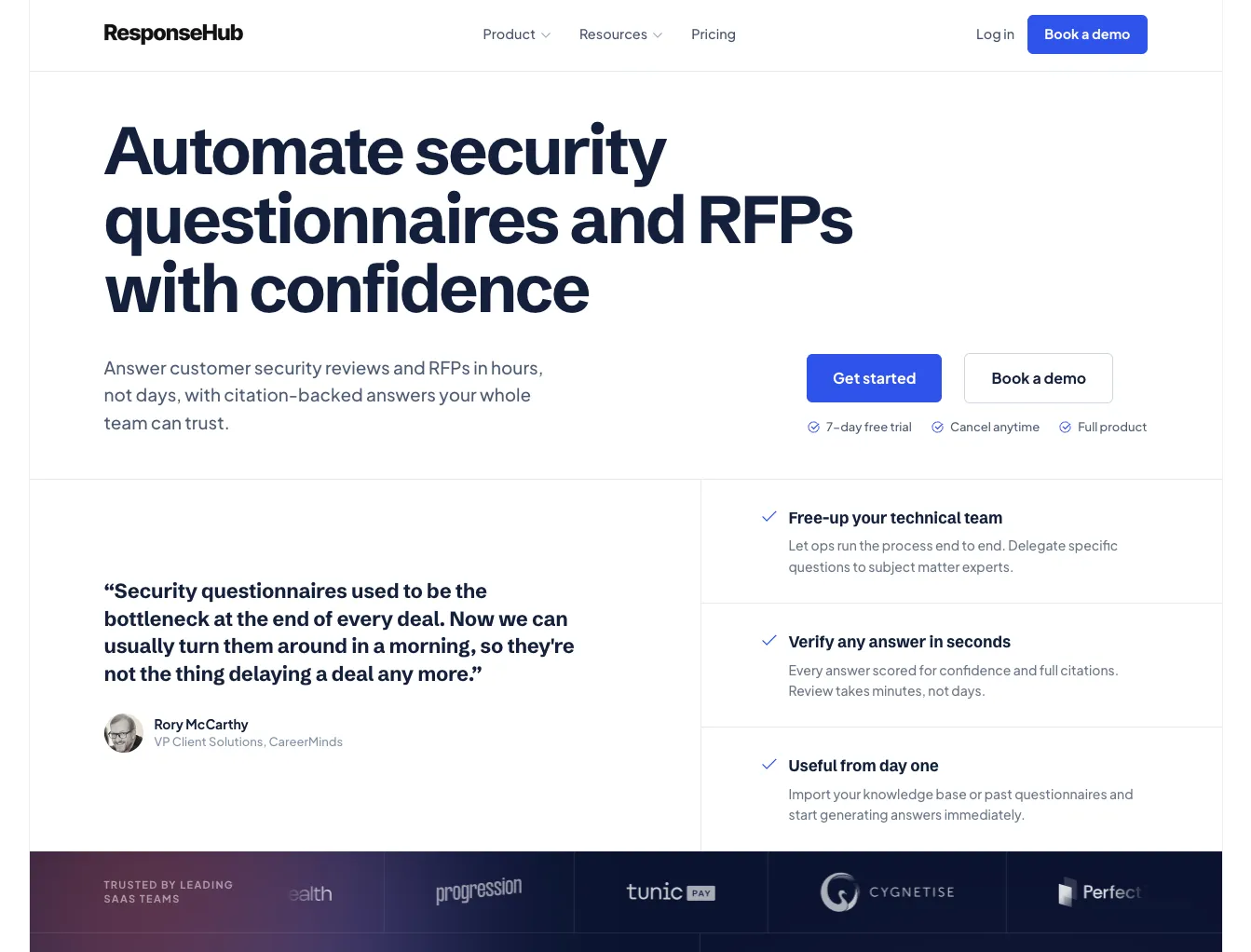
Questionnaire automationResponseHub is a dedicated questionnaire automation tool built for teams that spend too much time on security questionnaires, RFPs, and DDQs. Upload your policies as PDFs, import your existing answer library and old completed questionnaires, and the AI drafts answers grounded in your actual documents, with citations down to the exact policy name, page, section, and sentence. Each answer carries a confidence score so human reviewers focus only on genuine gaps.
1up
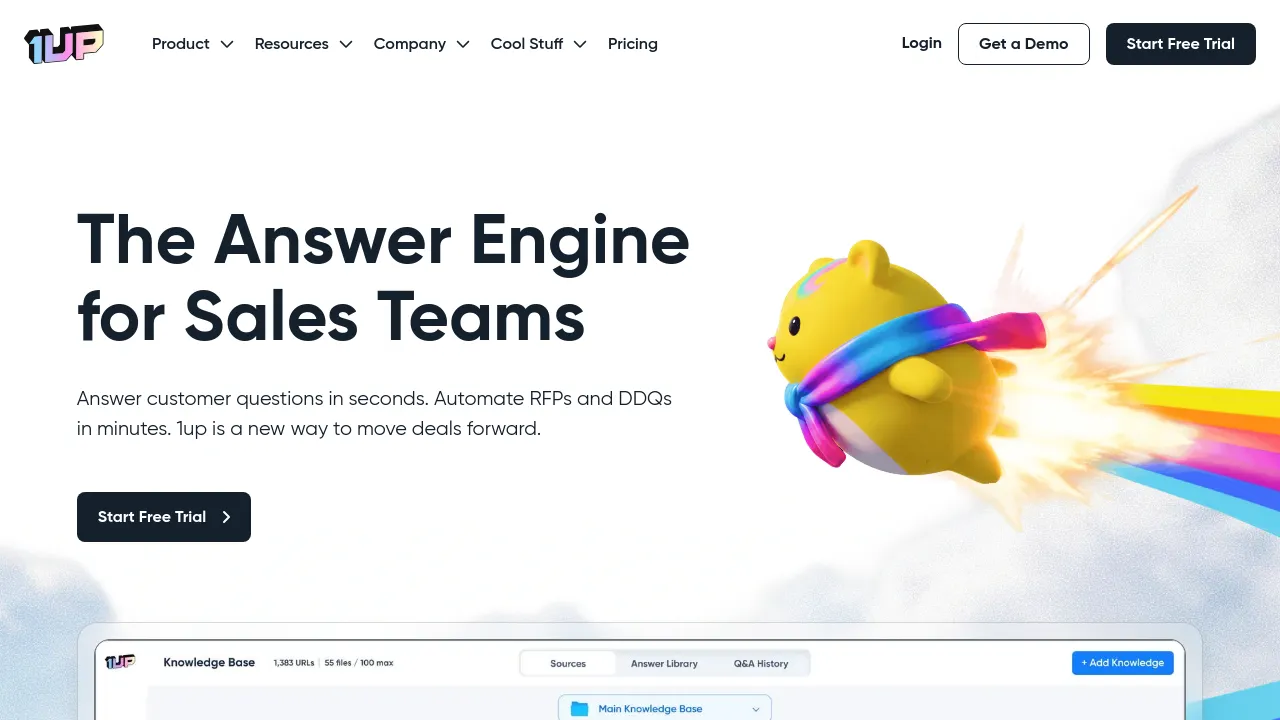
Sales enablement1up is an AI-powered sales answering engine aimed at presales and revenue teams. It goes beyond questionnaire automation: its Slack and Microsoft Teams bots let reps ask product questions in real time, and a Chrome extension enables quick lookups across web surfaces. 1up positions itself as a knowledge layer for the entire sales organization, not just the team filling out spreadsheets.
At a glance
| Comparison point | ResponseHub | 1up |
|---|---|---|
| Published pricing | Starter $124/mo, Business $332/mo | Starter ~$300/mo, Plus ~$900/mo |
| Usage limits | Unlimited — no credits or fees | Capped: ~1/mo Starter, ~6/mo Plus |
| Ideal team size | Any — solo managers to large ops teams | Presales & sales enablement teams |
| AI citations | Policy, page, section, sentence + confidence score | Document-level sourcing; less granular |
| Questionnaire formats | xlsx, docx, online portals (Chrome extension) | Common formats + Chrome extension |
| Round-trip export | Yes — back into the buyer's original xlsx/docx | Supported, but not the core focus |
| Free trial | 7-day, fully self-serve | Available (verify current terms) |
| Best fit | Questionnaires as the primary workload | Teams wanting a broader knowledge bot |
1up pricing and limits as published on their site, August 2026 — verify current terms directly with 1up before deciding.
How they compare, dimension by dimension
Pricing and volume limits
ResponseHub Starter costs $124/month with unlimited questionnaire usage. No credits, no automation caps. Your volume can triple next quarter and your bill stays the same.
1up Starter costs approximately $300/month and limits you to roughly one questionnaire automation per month. Need to handle six per month? That's the Plus tier at $900/month. If your team processes more than a handful of questionnaires monthly, the math compounds against 1up quickly. At $900/month for six automations, you're paying $150 per questionnaire. ResponseHub's unlimited model means the cost per questionnaire drops toward zero as volume grows.
Both tools deserve credit for publishing pricing at all. Most competitors in this space hide behind "contact sales."
AI answer quality and citations
ResponseHub grounds every AI-drafted answer in your uploaded policies and past questionnaires. It cites the exact policy name, page, section, and sentence, and attaches a per-answer confidence score. This means your reviewer can skip the high-confidence answers and spend their time on the gaps. For teams answering SOC 2, ISO 27001, or NIST CSF questionnaires (frameworks that require precise, verifiable responses), that specificity matters.
1up also builds its knowledge base from uploaded documents and answers questions from that content. Reviews on G2 praise its speed for common product questions. However, some reviewers note accuracy dips on complex, multi-part enterprise security questionnaires. 1up's citation model references source documents but lacks the granular page-and-sentence level detail that dedicated questionnaire tools provide.
Format handling and round-trip export
ResponseHub accepts questionnaires in Excel (xlsx), Word (docx), and online security portals via its Chrome extension. Critically, answers export back into the buyer's original file format with formatting preserved. This is the core workflow for questionnaire teams: the buyer sends a spreadsheet, you send it back filled in, looking exactly like they expect.
1up handles common document formats and offers a Chrome extension for browser-based lookups. Its export capabilities are functional, but the product's design center is broader (answering questions across Slack, Teams, and browser) rather than optimizing specifically for the format-in, format-out workflow that questionnaire-heavy teams depend on.
Product focus and integrations
ResponseHub does one thing: questionnaire automation. It is not a feature inside a larger GRC suite or a sales platform. That focus means the entire product, from extraction to export, is built around the questionnaire workflow. The downside is obvious: if you also want a Slack bot that answers product questions for your sales reps, you need a separate tool.
1up covers more ground. Its Slack and Microsoft Teams integrations let reps get instant answers to product questions without leaving their chat tool. If your team's pain is split between questionnaires and general sales knowledge gaps, 1up addresses both. The tradeoff is that questionnaire-specific features (round-trip export, confidence scoring, deduplication of stale answers) are less developed than in a specialized tool.
Data residency and security posture
According to ResponseHub's own security documentation, the platform is hosted on DigitalOcean (EU region), with AI processing via AWS Bedrock (EU regions) operating under zero data retention. Customer data is never used for AI model training. ResponseHub publishes a DPA for GDPR compliance, supports MFA and role-based permissions with audit logging, and makes its annual penetration test report available on request.
1up does not publicly document its data residency or AI data retention policies in comparable detail as of this writing. For compliance and security managers who need to justify a vendor to their own procurement teams (especially under GDPR or when handling SOC 2 evidence), ResponseHub's published posture makes the internal approval process faster.
What teams say about ResponseHub
Our tech team used to carry all of this. We talked about building something ourselves, but as a small team it never got prioritised.

Pros and cons
ResponseHub
- Unlimited usage at $124/month. No credits, no caps. Your volume can scale without your costs scaling proportionally.
- Granular citations and confidence scores. Every answer references the exact policy, page, section, and sentence, so reviewers know what to trust and what to check.
- Self-improving knowledge base. Each completed questionnaire feeds the next one. Built-in deduplication catches duplicate and stale answers before they become a problem.
- Round-trip export. Answers go back into the buyer's original xlsx or docx with formatting intact. No reformatting.
- Transparent security posture. Published data residency, zero AI data retention, GDPR with DPA, pen test report available on request.
- No Slack or Teams integration. If your sales team wants a real-time Q&A bot in their chat tool, ResponseHub doesn't cover that use case.
- Questionnaire-only focus. Broader sales enablement needs (product Q&A for reps, competitive battle cards) require a separate tool.
- Smaller brand awareness. Compared to well-funded sales enablement platforms, ResponseHub is newer and more niche. Some buyers may need to explain it internally.
1up
- Broader sales enablement. Slack and Teams bots give reps instant answers to product questions, going well beyond questionnaire automation.
- Published pricing. Rare in this category. You know what you're paying before you talk to anyone.
- Good for common product Q&A. Reviews praise speed and accuracy for standard, repeatable sales questions.
- Chrome extension for browser-based lookups. Useful for reps working across multiple web tools.
- Tight usage caps. Starter gives roughly one automation per month; Plus gives roughly six. Volume-heavy teams will hit the ceiling fast.
- Higher price floor for less volume. $300/month Starter vs ResponseHub's $124/month, with far less questionnaire throughput.
- Accuracy gaps on complex questionnaires. Reviews note that multi-part enterprise security questionnaires can produce less reliable answers.
- Less specialized for questionnaire workflows. Round-trip export, confidence scoring, and knowledge base deduplication aren't the core focus.
What it costs
ResponseHub costs $124/month (Starter, 2 Editor seats) or $332/month (Business) with unlimited usage on every plan — no credits, no per-questionnaire fees — plus a 7-day self-serve free trial. 1up starts at approximately $300/month with roughly one questionnaire automation per month, rising to approximately $900/month for roughly six; at full utilization on Plus, that works out to $150 per questionnaire.
See full pricingSwitching from 1up?
- Export your answers from 1up, then import your existing answer library into ResponseHub to seed the knowledge base.
- Import old completed questionnaires too — every past answer feeds future ones.
- Drag and drop your policy documents as PDFs.
- Fully self-serve setup — up and running in under 5 minutes, no sales call.
- 7-day free trial, so you can put a real questionnaire through it before you commit.
Which should you pick?
Our honest recommendation by situation.
At five or more questionnaires per month, 1up's Starter plan is already exhausted. You'd need their Plus tier at $900/month for six automations. ResponseHub handles unlimited questionnaires at $124/month, with citations and confidence scores built for the kind of detail SOC 2 and ISO 27001 reviewers demand.
If your primary pain is sales reps asking "how does our product handle X?" in Slack fifty times a week, and you only deal with a few RFPs or questionnaires per month, 1up's broader feature set is the better fit. The Slack and Teams integration is genuinely useful for sales enablement, and the occasional questionnaire automation is a bonus.
Enterprise buyers will send you security questionnaires that reference SOC 2, ISO 27001, or NIST CSF. You need accurate, cited answers that don't make your company look unprepared. ResponseHub's per-answer confidence scores and exact citations help a small team punch above its weight, and the $124/month price point doesn't strain an early-stage budget.
If your team handles fewer than five questionnaires a month and the bigger drain is reps struggling to find accurate product answers during calls and demos, 1up's knowledge bot addresses the broader problem. The questionnaire automation is a secondary benefit, but it covers the occasional RFP without needing a separate tool.
ResponseHub has a dedicated MSSP version that supports multiple separate client accounts under one relationship, so you can manage each client's knowledge base and questionnaires independently. 1up is built for internal sales teams, not multi-tenant service delivery. Unlike compliance platforms such as Vanta or Drata (where questionnaire tooling is tied to each client's own platform subscription), ResponseHub lets the MSSP buy and operate the tool on behalf of clients directly.
For teams whose core workload is security questionnaires, RFPs, or DDQs, ResponseHub is the clear pick. Unlimited usage at $124/month, granular AI citations, confidence scoring, and round-trip export make it purpose-built for the job. 1up earns its place for presales teams that need a broader sales knowledge bot and only deal with questionnaires occasionally. But if questionnaires are your team's defining responsibility, paying more for volume caps and less citation detail doesn't add up.
Start a free trial of ResponseHub today: no sales call needed, completely self-serve, and you can be up and running in under 5 minutes.
Frequently asked questions
Does 1up have a free trial?
1up has offered a free trial, though exact terms and duration can change. Check their current pricing page to confirm availability. ResponseHub offers a 7-day free trial that is fully self-serve with no sales call required.
Can I migrate my existing answer library from 1up to ResponseHub?
Yes. ResponseHub lets you import your existing answer library and old completed questionnaires to seed the knowledge base. Export your answers from 1up, then upload them into ResponseHub to get started. You can also drag and drop your policy documents as PDFs.
Is 1up worth it for a team that mostly does security questionnaires?
If security questionnaires are your primary workload, 1up's usage caps become expensive quickly. At roughly one automation per month on the $300/month Starter plan, volume-heavy teams will overshoot the limit. ResponseHub's unlimited model at $124/month is a better fit for questionnaire-focused teams.
Does ResponseHub integrate with Slack or Microsoft Teams?
No. ResponseHub is focused entirely on questionnaire, RFP, and DDQ automation. If you need a real-time Q&A bot in Slack or Teams for your sales reps, 1up or a separate sales enablement tool would cover that need.
Are the 1up pricing details in this comparison up to date?
The 1up pricing and feature details referenced here are based on publicly available information as of August 2026. SaaS pricing changes frequently, so verify current plans and limits directly on 1up's website before making a decision.
Get Started
Get started in under 5 minutes with our self-serve trial or contact us for a demo
- 7-day free trial
- Cancel anytime
- Full product