

ResponseHub vs AutoRFP.ai: Pricing Models Compared
If you are weighing alternatives to AutoRFP, pricing is where the two tools diverge most sharply. Both ResponseHub and AutoRFP.ai are purpose-built for questionnaire and RFP automation (neither is a side feature buried in a GRC suite), and both publish their pricing. The difference is the model itself: AutoRFP charges per project with annual caps, while ResponseHub offers unlimited usage for a flat monthly fee.
This page breaks down exactly what each model costs, what you get, and where each tool fits best.
ResponseHub gives you unlimited questionnaires at $149/month with no annual commitment ($124/month billed annually), making it the stronger pick for any team doing more than a handful of questionnaires per quarter. AutoRFP.ai is better suited to dedicated bid teams focused on complex, high-value RFP responses where 24 projects a year is plenty.
Think of it as a toll gate versus an open road: one tool meters every journey, the other lets you drive as far as you need for a flat fare.
Which one is right for you?
Choose ResponseHub if…
- You want unlimited usage from $149/month — no credits, no project caps, no 12-month lock-in.
- You need cited AI answers (exact policy, page, section, sentence) with per-answer confidence scores your reviewers can trust.
- You want to validate the tool with your own data first: 7-day self-serve free trial, set up in under 5 minutes.
- Your questionnaires arrive as messy spreadsheets or web portals — Chrome extension extraction and round-trip export are built in.
Choose AutoRFP.ai if…
- You run a dedicated bid and proposal team handling fewer than 24 high-value RFPs per year.
- Your workflow is structured proposal collaboration with multiple contributors on a single response.
- You value published pricing and are comfortable with a 12-month annual commitment from $899/month.
ResponseHub
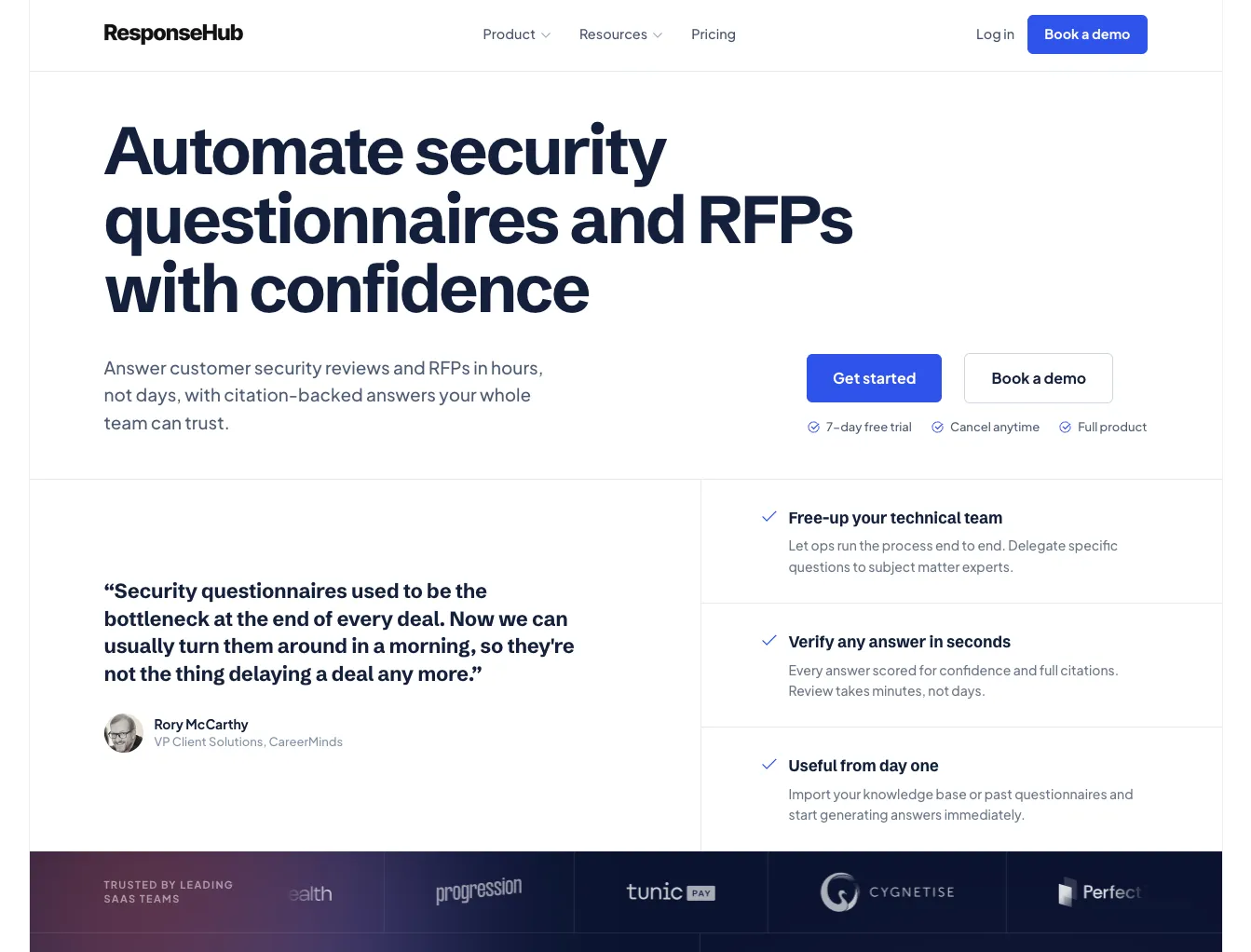
Questionnaire automationResponseHub is an AI-powered questionnaire automation tool built for security questionnaires, RFPs, and DDQs. You upload your policies as PDFs, import your existing answer library and past completed questionnaires, and the AI drafts answers grounded in your actual documentation, with citations down to the exact page, section, and sentence. It handles Excel, Word, and online portal questionnaires (via a Chrome extension), and exports answers back into the buyer's original format.
AutoRFP.ai
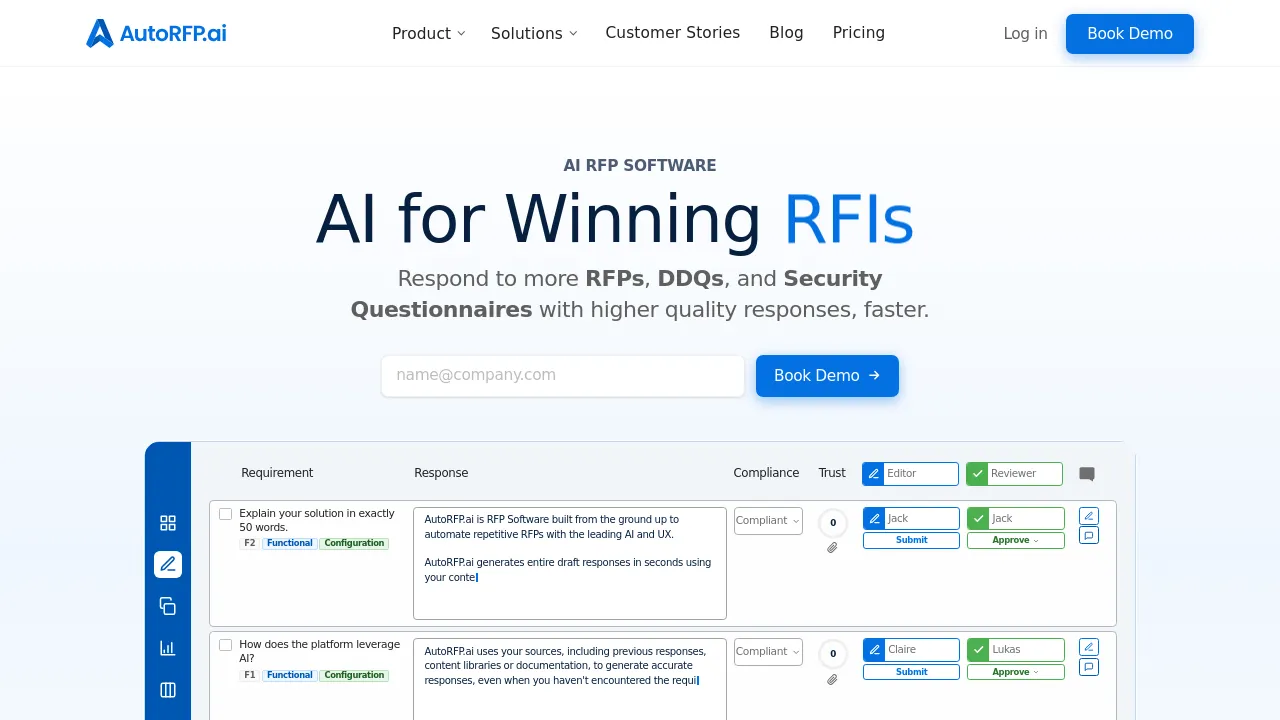
RFP automationAutoRFP.ai is a purpose-built AI tool for responding to RFPs, RFIs, and security questionnaires. It focuses on helping bid and proposal teams generate, review, and submit responses faster. AutoRFP publishes its pricing and positions itself squarely at teams managing formal proposal workflows.
At a glance
| Comparison point | ResponseHub | AutoRFP.ai |
|---|---|---|
| Published pricing | Starter $149/mo ($124/mo annual), Business $399/mo ($332/mo annual) | From $899/mo (annual billing) |
| Usage limits | Unlimited questionnaires, no credits | 24 projects/year on base plan |
| Minimum commitment | None — month-to-month | 12-month annual contract |
| Ideal team size | 1 to 50+, scales with Editor seats | Mid-size bid/proposal teams |
| AI citations | Policy, page, section, sentence + confidence scores | AI answers; citation detail not documented |
| Supported formats | xlsx, docx, online portals (Chrome extension) | Not publicly documented in detail |
| Round-trip export | Yes — original xlsx/docx, formatting preserved | Yes — exports to common formats |
| Free trial | 7-day, fully self-serve | Not publicly documented |
| Best fit | Unlimited usage at a predictable cost | Bid teams with fewer than 24 RFPs/year |
AutoRFP.ai details based on their public pricing page, last verified August 2026. Confirm directly with AutoRFP.ai for the most current information.
How they compare, dimension by dimension
Pricing transparency and cost per questionnaire
Both tools deserve credit for publishing their pricing, something many competitors still hide behind a "talk to sales" wall. The difference is in the math.
ResponseHub charges $149/mo for Starter (2 Editor seats) or $399/mo for Business — $124/mo and $332/mo respectively when billed annually. Every plan includes unlimited questionnaires. Your 1st questionnaire of the month costs the same as your 31st: nothing extra. No credits, no project tokens, no overage fees. You pay only for Editor seats; Viewer seats are unlimited and free.
AutoRFP.ai starts at $899/mo on an annual plan, which works out to $10,788/year. That gets you 24 projects. Each questionnaire or RFP consumes one project. If you do the math, that's roughly $449 per questionnaire at full utilization. If your volume grows past 24 per year, you either upgrade to a higher (and more expensive) tier or you start rationing which opportunities get a proper response.
For a team handling 3 or more questionnaires a month, ResponseHub's unlimited model is roughly 7x cheaper at the entry level, and the gap widens as volume increases.
AI answer quality and citation depth
ResponseHub grounds every AI-generated answer in your own uploaded policies and past questionnaires using a RAG pipeline (retrieval-augmented generation, meaning the AI pulls from your actual documents rather than general training data). Each answer includes a citation to the specific policy name, page, section, and sentence it drew from, plus a per-answer confidence score. Low-confidence answers get flagged so your team reviews only where it matters, not every single line.
AutoRFP.ai uses AI to draft responses and lets teams review and refine them. Its public documentation does not describe citation granularity at the same level (exact page and sentence references are not publicly documented). This does not necessarily mean the feature is absent; it may simply be undocumented.
If audit trails and traceable answers matter to your compliance or security team, this distinction is worth testing firsthand with both tools before committing.
Format support and questionnaire extraction
Security questionnaires arrive in every format imaginable: messy spreadsheets with missing headers, Word documents with inconsistent tables, and increasingly, web-based portals that you cannot download at all.
ResponseHub handles Excel (xlsx), Word (docx), and online security portals via a Chrome extension that extracts questions directly from the browser. Its extraction engine is built to deal with real-world questionnaire mess: multiple-choice options, not-applicable questions, missing column headers, and unfamiliar layouts. Answers export back into the buyer's original format, preserving their formatting.
AutoRFP.ai supports common document formats for import and export, though its public documentation does not detail how it handles edge cases like malformed spreadsheets or portal-based questionnaires. Again, absence of public documentation is not the same as absence of the feature. If your buyers regularly send questionnaires through web portals, verify this capability with AutoRFP directly before committing to a 12-month contract.
Knowledge base and self-improvement
A questionnaire tool is only as good as the knowledge behind it. If you are starting from scratch every time, you are not saving much.
ResponseHub lets you seed your knowledge base by importing your existing answer library and previously completed questionnaires. You drag and drop policy documents as PDFs. Every completed questionnaire feeds back into the knowledge base, so accuracy improves over time. Built-in deduplication flags duplicate and stale answers so your knowledge base stays clean. The entire knowledge base exports to CSV if you ever need it outside the tool.
AutoRFP.ai also maintains a content library for reuse across proposals. Reviews from users suggest that the library works well at moderate volumes but that larger teams eventually feel constrained by project caps, because each new questionnaire that could improve the library still consumes a project slot.
Setup, trial, and time to value
ResponseHub offers a 7-day free trial that is completely self-serve. No sales call, no demo booking, no procurement paperwork. You sign up, upload your policies, import your answer library, and start answering questionnaires. The whole setup takes under 5 minutes.
AutoRFP.ai does not publicly document a free trial on its website. Its base plan requires a 12-month annual commitment at $899/mo. That means your first real test of the product comes after you have already committed nearly $11,000. For teams that want to try before they buy, this is a meaningful gap.
What teams say about ResponseHub
So much easier than trawling through folders of old questionnaires, hunting for one with similar questions. Now everything is in one place, backed by the exact source.
Pros and cons
ResponseHub
- Unlimited usage at a flat rate. No credits, no project caps. You never have to ration which deals get a proper questionnaire response.
- Transparent, low entry price. $149/mo for Starter with no minimum contract and month-to-month flexibility, or $124/mo billed annually.
- Deep citation and confidence scoring. Every answer traces back to the exact policy, page, section, and sentence, so reviewers know exactly what the AI relied on.
- Self-improving knowledge base. Each completed questionnaire makes the next one faster. Deduplication keeps things tidy.
- Self-serve free trial. Try it for 7 days with zero commitment.
- MSSP version available. Supports multiple separate client accounts under one relationship.
- Narrower product scope. ResponseHub focuses entirely on questionnaire automation. If you need broader proposal management features (like bid/no-bid workflows or proposal design tools), you will need to pair it with another tool.
- Smaller brand presence. AutoRFP.ai may be more recognized in dedicated RFP/bid circles, so your procurement team might need a quick intro to ResponseHub.
- No PDF questionnaire import. Policy documents go in as PDFs, but questionnaires must be xlsx, docx, or web portals.
AutoRFP.ai
- Purpose-built for RFP workflows. If your team's primary job is responding to complex, multi-section RFPs (not just security questionnaires), AutoRFP is designed around that workflow.
- Published pricing. Unlike many competitors, you can see what you will pay before talking to anyone.
- Structured proposal collaboration. Built for bid teams that need to coordinate multiple contributors on a single response.
- Project caps create pressure. 24 projects per year on the base plan means roughly 2 per month. Teams with growing volume quickly feel the squeeze.
- High entry price. $899/mo is over 7x ResponseHub's Starter price, with a 12-month lock-in.
- No documented free trial. You commit to an annual contract before you can meaningfully test the product with your own data.
- Limited public detail on citations. Key details like per-answer source citations are not clearly documented on the website, making it harder to evaluate answer trustworthiness before buying.
What it costs
ResponseHub costs $149/mo (Starter) or $399/mo (Business) month-to-month — $124/mo and $332/mo billed annually — with unlimited usage on every plan and no minimum contract — plus a 7-day self-serve free trial. AutoRFP.ai starts at $899/mo on a 12-month annual commitment ($10,788/year) with 24 projects included, which works out to roughly $449 per questionnaire at full utilization.
See full pricingSwitching from AutoRFP.ai?
- Import your existing answer library and previously completed questionnaires to seed your knowledge base — you are not starting from scratch.
- Drag and drop your policy documents as PDFs.
- Initial setup takes under 5 minutes; total migration time depends on the size of the answer library you are importing.
- 7-day free trial, fully self-serve, no contract required.
Which should you pick?
Our honest recommendation by situation.
At 20+ questionnaires a year, AutoRFP's 24-project cap is already tight, and any growth pushes you into a higher tier. ResponseHub's unlimited usage from $124/mo (billed annually) means you never have to think about rationing. The self-improving knowledge base gets more accurate with every questionnaire you complete, so the time savings compound as your volume grows.
If your team's core function is assembling multi-section RFP responses (not just security questionnaires) and you handle fewer than 24 per year, AutoRFP's workflow is built around that process. It is designed for structured proposal collaboration with multiple contributors, which fits formal bid team operations.
It depends on your workload. If you receive fewer than 10 formal RFPs a year and your bottleneck is proposal assembly rather than security questionnaire volume, AutoRFP covers that use case within its project cap. If the majority of your inbound requests are security questionnaires, DDQs, or vendor assessments tied to deals, ResponseHub's lower price and unlimited usage are a better fit.
At scale, every questionnaire that sits unanswered is delayed revenue. ResponseHub's per-answer citations (exact policy, page, section, sentence) and confidence scores give compliance and security reviewers an audit trail they can trust, which speeds up internal approval. Unlimited usage means growing questionnaire volume does not trigger surprise cost increases.
ResponseHub offers a dedicated MSSP version with multiple separate client accounts under one relationship, so you can manage questionnaire workload across your entire client portfolio without mixing data. AutoRFP.ai does not publicly document a partner or multi-client offering. ResponseHub's model lets you own the workflow and protect your margins as your client count grows, with the same team.
For most teams evaluating alternatives to AutoRFP, ResponseHub is the stronger choice. The unlimited usage model from $124/mo eliminates the cost-per-questionnaire math entirely, the citation depth gives reviewers genuine confidence in AI-drafted answers, and the self-serve free trial means you can validate the tool with your own data before spending a dollar.
AutoRFP.ai earns its place for dedicated bid teams running fewer than 24 high-value RFPs a year, but the moment volume grows, its project caps and 7x higher entry price start working against you. If you want to see the difference for yourself, start a free trial at ResponseHub: no sales call, fully self-serve, set up in under 5 minutes.
Frequently asked questions
Does AutoRFP.ai have a free trial?
AutoRFP.ai does not publicly document a free trial on its website as of August 2026. Its base plan requires a 12-month annual commitment at $899/mo. ResponseHub, by contrast, offers a 7-day free trial that is fully self-serve with no contract required.
Can I migrate from AutoRFP to ResponseHub?
Yes. ResponseHub lets you import your existing answer library and previously completed questionnaires to seed your knowledge base, so you are not starting from scratch. You can also drag and drop your policy documents as PDFs. Initial setup takes under 5 minutes; total migration time depends on the size of the answer library you are importing.
What happens if I exceed AutoRFP's 24-project cap?
You would need to upgrade to a higher-tier plan, which increases the annual cost. Each questionnaire or RFP consumes one project, so teams with growing volume can hit the cap faster than expected. With ResponseHub, there are no project caps on any plan.
Is ResponseHub only for security questionnaires?
No. ResponseHub handles RFPs and DDQs in addition to security questionnaires. That said, it is purpose-built for questionnaire-style workflows rather than full proposal design. If you need a tool specifically for assembling complex, multi-section proposals, AutoRFP.ai may be a better fit for that workflow.
How current is the AutoRFP.ai pricing and feature information on this page?
We gathered AutoRFP.ai details from their public pricing page and website, last verified in August 2026. Pricing, features, and contract terms can change, so we recommend confirming directly with AutoRFP.ai for the most up-to-date information.
Get Started
Get started in under 5 minutes with our self-serve trial or contact us for a demo
- 7-day free trial
- Cancel anytime
- Full product