

ResponseHub vs HyperComply: Alternatives to HyperComply Compared
If you are evaluating alternatives to HyperComply, the ground has shifted under you. SecurityScorecard acquired HyperComply in September 2025 and is folding it into a broader supply-chain-risk platform, which means the standalone product you may have evaluated six months ago is on an uncertain path. This page compares HyperComply (now part of SecurityScorecard) with ResponseHub, an independent, purpose-built questionnaire automation tool, across pricing, AI quality, format support, and long-term viability.
TL;DR: If you want a self-serve tool with published pricing, unlimited usage, and a clear product roadmap focused entirely on questionnaire automation, ResponseHub is the stronger pick. If your organization already uses SecurityScorecard for vendor risk and wants questionnaire tooling bundled into that ecosystem, HyperComply's integration into that platform may still make sense.
When the tool you relied on gets absorbed into a larger platform, you need a compass in shifting ground — something independent and clearly pointed in one direction. The SecurityScorecard acquisition is a rational move for SecurityScorecard, but it leaves HyperComply's standalone identity, roadmap, and pricing on an uncertain path.
ResponseHub is independently operated, transparently priced, and pointed at exactly one problem: questionnaire automation. The rest of this page shows where that difference matters.
Which one is right for you?
Choose ResponseHub if…
- You want published pricing and a self-serve start: Starter at $124/month, 7-day free trial, no sales call.
- You want unlimited usage with every AI answer cited to the exact policy, page, section and sentence.
- You want a vendor whose entire roadmap is questionnaire automation — not a product being absorbed into a TPRM platform.
Choose HyperComply if…
- Your organization already uses SecurityScorecard for vendor risk ratings and wants questionnaire tooling in the same ecosystem.
- You need supply-chain risk management bundled with questionnaire automation under one contract.
- Procurement at your company prefers an established enterprise vendor with deep sales presence.
ResponseHub
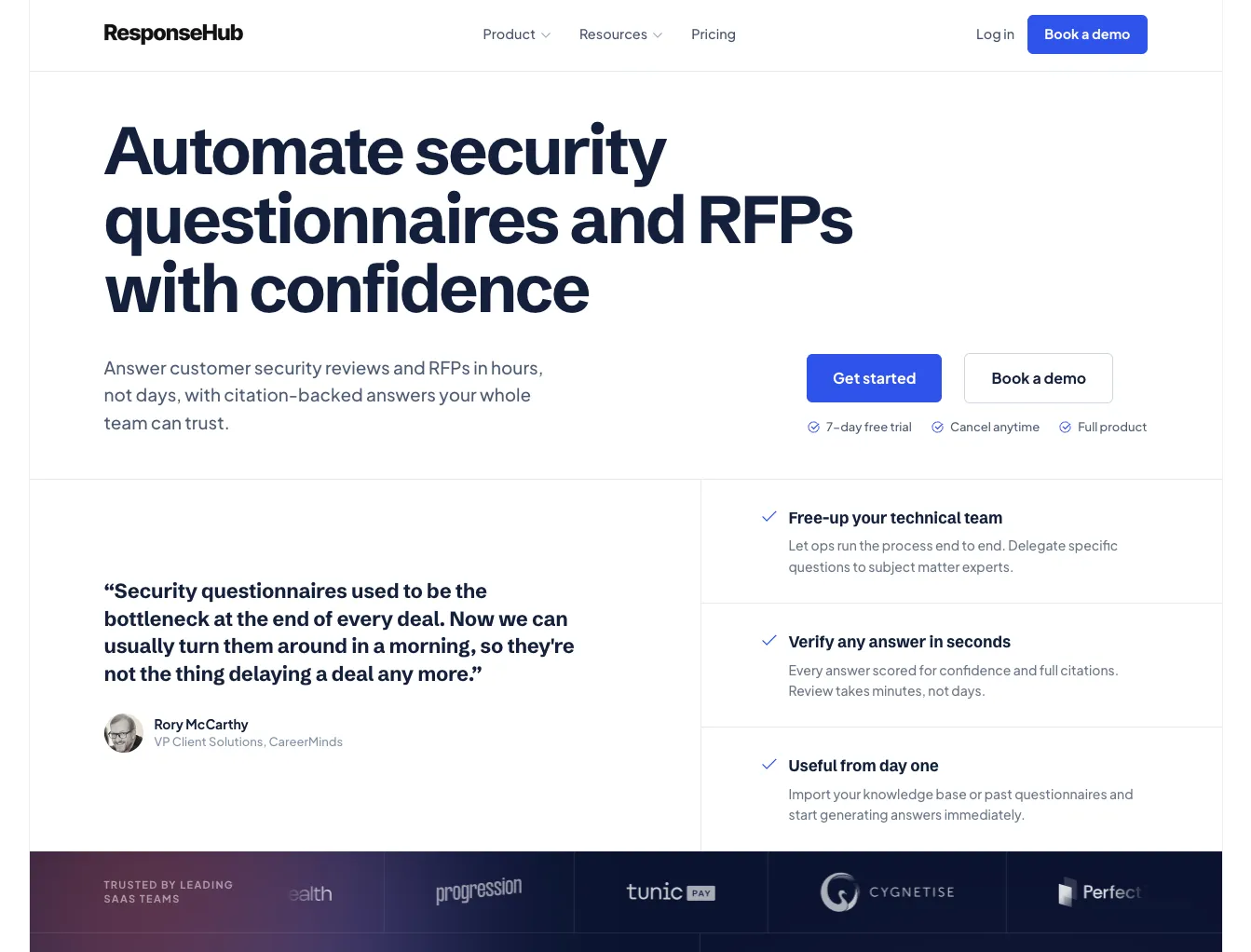
Questionnaire automationResponseHub is a standalone AI tool built exclusively for security questionnaires, RFPs, and DDQs. You upload your policies as PDFs, import your existing answer library and old completed questionnaires, and the AI drafts answers grounded in your actual documentation, citing the exact policy, page, section, and sentence. Every answer comes with a confidence score so your team knows exactly where to focus review time.
HyperComply (SecurityScorecard)
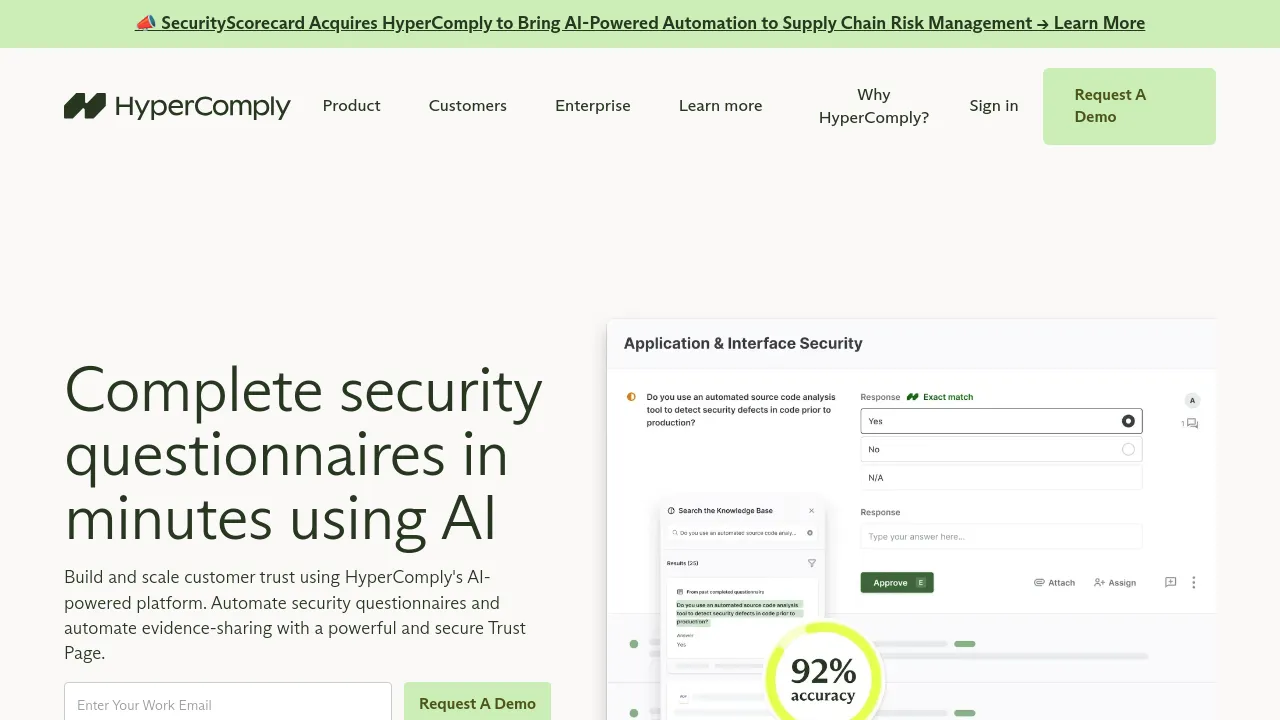
Questionnaire automation / TPRMHyperComply was one of the few purpose-built security questionnaire tools on the market, offering AI-assisted answers, a knowledge base, and integrations with sales workflows. In September 2025, SecurityScorecard acquired HyperComply and began integrating it into its supply-chain-risk and third-party risk management (TPRM) platform.
At a glance
| Comparison point | ResponseHub | HyperComply |
|---|---|---|
| Published pricing | Starter $124/mo, Business $332/mo | No — sales-led, not publicly listed |
| Usage limits | Unlimited, no credits or per-questionnaire fees | Not publicly documented |
| Ideal team size | Any: startups through large enterprises | Mid-market to enterprise |
| AI citations | Exact policy, page, section, sentence + confidence scores | AI-assisted answers; citation granularity not documented post-acquisition |
| Supported formats | Excel, Word, online portals via Chrome extension | Excel, Word; portal support not documented |
| Round-trip export | Yes — preserves buyer formatting | Supported pre-acquisition; current status unclear |
| Free trial | 7 days, fully self-serve | No public free trial |
| Data residency / AI training | EU-hosted, zero AI data retention, GDPR compliant | Not publicly documented post-acquisition |
Competitor details as publicly documented, last verified August 2026.
How they compare, dimension by dimension
Pricing and buying experience
ResponseHub publishes its pricing on its website. Starter is $124/month with 2 Editor seats, Business is $332/month, and every plan includes unlimited usage with no credits or per-questionnaire fees. You pay for Editor seats; Viewer seats are unlimited. The 7-day free trial is fully self-serve: no demo, no sales call, set up in under 5 minutes.
HyperComply never published pricing, even before the acquisition. You had to book a call to get a quote. Third-party data estimated $12,000 to $25,000 per year, but that figure may have shifted now that the product sits inside SecurityScorecard's commercial model. If you are the kind of buyer who wants to evaluate a tool on your own terms before talking to sales, this is a real friction point.
AI answer quality and citations
ResponseHub's AI is grounded in your uploaded policies and past completed questionnaires. Every answer cites the exact policy name, page, section, and sentence it drew from, and a per-answer confidence score tells your reviewer whether the AI is confident or flagging a gap. This is not a generic chatbot pulling from training data; it is a RAG pipeline (retrieval-augmented generation) anchored to your documents.
HyperComply offered AI-assisted answers with a knowledge base, and pre-acquisition reviews on G2 noted solid first-draft quality for straightforward questionnaires. However, recurring G2 feedback flagged issues with complex, multi-department questionnaires and weak search within the knowledge base, making it harder to find the right answer when your library grew large. Post-acquisition, the AI roadmap is tied to SecurityScorecard's priorities, and it is unclear how much standalone investment the answer engine is receiving.
Product direction and roadmap certainty
This is the elephant in the room.
ResponseHub is an independent product where questionnaire automation is the entire focus. There is no parent company pulling the roadmap toward a different market. Every sprint goes toward making questionnaires faster and the knowledge base smarter, including built-in deduplication, a self-improving knowledge base that learns from every completed questionnaire, and robust extraction that handles messy real-world formats (missing headers, multiple-choice columns, not-applicable questions).
HyperComply was acquired by SecurityScorecard to strengthen its supply-chain-risk platform. That is a rational strategic move for SecurityScorecard, but it means HyperComply's standalone identity is being absorbed. Features may be reprioritized to serve SecurityScorecard's broader TPRM vision rather than pure questionnaire automation. If you are choosing a tool you want to rely on for the next two to three years, that uncertainty matters.
Knowledge base and search
ResponseHub's knowledge base is designed to grow with you. You seed it by importing your existing answer library and old completed questionnaires, then every new questionnaire you complete feeds back into it. Built-in deduplication catches duplicate and stale answers so your library stays clean. The knowledge base exports to CSV if you ever need to move data out.
HyperComply offered a knowledge base as well, and for smaller libraries it worked fine. But G2 reviewers repeatedly called out search quality as a pain point: as the library scaled, finding the right answer became harder. For teams managing hundreds of questions across SOC 2, ISO 27001, NIST CSF, and HECVAT frameworks, that search friction compounds fast.
Format support and export
ResponseHub accepts questionnaires in Excel (xlsx), Word (docx), and directly from online security portals via its Chrome extension. Answers export back into the buyer's original file format, preserving their formatting. That round-trip export matters: your buyer expects their spreadsheet back looking exactly like they sent it, not a reformatted mess.
HyperComply supported Excel and Word. Portal-level extraction and the current state of export formatting post-acquisition are not publicly documented, so it is hard to evaluate where the product stands today on this front.
What teams say about ResponseHub
We don't worry when a new questionnaire arrives any more. The knowledge base is ready and most of the work goes quickly.

Pros and cons
ResponseHub
- Transparent, published pricing. You know what you will pay before you sign up. No surprise invoices, no lengthy negotiation.
- Unlimited usage. No credits, no per-questionnaire fees. Your 50th questionnaire this month costs the same as your first: nothing extra.
- Cited, grounded AI. Every answer traces back to a specific policy, page, section, and sentence, with confidence scores that direct your review time.
- Self-improving knowledge base. Every completed questionnaire makes the next one faster. Deduplication keeps your library clean.
- Self-serve onboarding. 7-day free trial, set up in under 5 minutes, no sales call required.
- Independent product focus. Questionnaire automation is the entire product, not a feature inside a larger platform.
- No broader GRC or TPRM platform. If you need vendor risk scoring, continuous monitoring, or compliance certification management alongside questionnaire automation, you will need a separate tool.
- Smaller brand presence. ResponseHub is a focused product, not a household name in enterprise security yet. If executive buy-in requires a marquee logo, that may take an extra conversation.
- No PDF questionnaire import. You can upload policies as PDFs, but questionnaires must come in as xlsx, docx, or via the Chrome extension.
HyperComply (SecurityScorecard)
- SecurityScorecard ecosystem. If your organization already uses SecurityScorecard for vendor risk ratings, bundling questionnaire automation into the same platform reduces tool sprawl.
- Enterprise relationships. SecurityScorecard has deep enterprise sales presence; procurement teams at large organizations may find the combined offering easier to approve.
- Pre-acquisition reputation. HyperComply had a solid reputation for first-draft quality on standard questionnaires before the acquisition.
- No published pricing. You cannot evaluate cost without engaging sales, and post-acquisition pricing structure is unclear.
- Uncertain standalone roadmap. The product is being absorbed into a TPRM platform. Features you rely on today may be reprioritized.
- Search and complex questionnaire handling. G2 reviewers flagged weak search in the knowledge base and difficulty with multi-department questionnaires.
- No public free trial. You cannot try before you buy without a sales conversation.
- Data residency and AI policies unclear. Post-acquisition documentation does not clearly state data residency options or whether customer data is used for model training.
What it costs
ResponseHub starts at $124/month (Starter, 2 Editor seats) with Business at $332/month, unlimited usage and unlimited Viewer seats on every plan, and a self-serve 7-day free trial. HyperComply does not publish pricing: third-party sources estimated $12,000 to $25,000 per year before the SecurityScorecard acquisition, and post-acquisition pricing may be bundled differently.
See full pricingSwitching from HyperComply?
- Export your answers and past questionnaires from HyperComply and import them into ResponseHub to seed the knowledge base — start building on top of your existing library immediately.
- Upload your policy documents as PDFs and the AI starts citing them right away.
- Setup is fully self-serve and takes under 5 minutes.
- 7-day free trial with no sales call, so you can test it on a real questionnaire before committing.
Which should you pick?
Our honest recommendation by situation.
At $124/month for the Starter plan with unlimited usage, you get a tool that scales with your volume without scaling your costs. You can be live in minutes, and the self-improving knowledge base means each questionnaire gets faster than the last. No sales call, no contract negotiation.
If your organization already runs SecurityScorecard for vendor risk ratings and TPRM workflows, adding questionnaire automation inside that same platform reduces context switching and may simplify procurement. The integration with your existing risk scoring data could provide value that a standalone tool cannot match.
ResponseHub has a dedicated MSSP version that supports multiple separate client accounts under one relationship, so you can manage questionnaire workloads across your client base without tangling their data. This is a structural advantage over platforms like Vanta or Drata, where questionnaire tooling is tied to the client's own subscription. HyperComply did not publicly offer a multi-tenant MSSP model before the acquisition, and SecurityScorecard's partner offerings are oriented toward risk rating resale rather than questionnaire operations.
If your primary need is a unified platform that combines vendor risk scoring, continuous monitoring, and questionnaire automation in one contract, SecurityScorecard's bundled offering is worth evaluating. The trade-off is that the questionnaire tooling may not be as focused or as rapidly improving as a standalone product, but the platform consolidation benefit is real for large procurement-heavy organizations.
When a deal is stalled because the buyer sent a 200-question security questionnaire and your team is already stretched, you need a tool you can spin up immediately. ResponseHub's 7-day free trial and self-serve setup mean your rev ops team can start drafting answers today, not after a two-week procurement cycle. Confidence scores let non-security staff review AI answers and know exactly where to loop in a subject matter expert.
For most teams searching for alternatives to HyperComply, ResponseHub is the better path forward. It is purpose-built for questionnaire automation, independently operated with a clear roadmap, priced transparently, and designed so your team can start today without waiting on a sales cycle.
HyperComply still makes sense if you are already embedded in SecurityScorecard's ecosystem and want everything under one vendor, but for everyone else, the combination of uncertain product direction, gated pricing, and documented search limitations makes it a harder bet.
Start a free trial of ResponseHub right now: no sales call needed, completely self-serve, set up in under 5 minutes.
Frequently asked questions
Is HyperComply still available as a standalone product?
As of August 2026, HyperComply is being integrated into SecurityScorecard's supply-chain-risk platform following the September 2025 acquisition. You can still access HyperComply's capabilities, but the standalone product identity is being absorbed. New buyers will likely engage through SecurityScorecard's sales process.
Can I migrate my knowledge base from HyperComply to ResponseHub?
Yes. ResponseHub lets you import your existing answer library and old completed questionnaires to seed the knowledge base. If you can export your HyperComply data (answers, past questionnaires), you can bring it into ResponseHub and start building on top of it immediately.
Does HyperComply have a free trial?
HyperComply has not offered a public free trial. Access requires a sales conversation. ResponseHub, by contrast, offers a 7-day free trial that is fully self-serve with no sales call required.
How much does HyperComply cost compared to ResponseHub?
HyperComply does not publish pricing; third-party sources estimated $12,000 to $25,000 per year before the acquisition, though post-acquisition pricing may differ. ResponseHub starts at $124/month (Starter, 2 Editor seats) with unlimited usage on all plans. The pricing difference is significant, especially for smaller teams.
Get Started
Get started in under 5 minutes with our self-serve trial or contact us for a demo
- 7-day free trial
- Cancel anytime
- Full product