

Alternatives to Skypher: How ResponseHub Compares for Questionnaire Automation
ResponseHub is the stronger pick for most teams searching for alternatives to Skypher: it publishes pricing ($124/mo Starter, $332/mo Business), offers a 7-day self-serve trial with no sales call, and gives you unlimited usage. Skypher requires a sales conversation before you even see a number — which makes it harder to evaluate quickly, especially if you're trying to unblock a deal stuck in security review.
Both tools are built for the same job — automating security questionnaires — which makes this a tighter comparison than most. This page breaks down the real differences in pricing, AI citation quality, format support, and buying experience so you can make a decision without sitting through multiple demos first.
Think of this comparison as the glass door: when you're choosing a tool your team will rely on every week, you should be able to see what's inside — pricing, features, data handling — before you walk through it. ResponseHub opens the door; Skypher asks you to knock and wait for a sales call.
The sections below compare both tools across pricing, AI answer quality, format support, knowledge base mechanics, and security transparency so you can make the call quickly.
Which one is right for you?
Choose ResponseHub if…
- You want published pricing and a self-serve 7-day trial instead of a sales call just to see a number.
- You need verifiable citations — exact policy, page, section and sentence — plus per-answer confidence scores, rather than an aggregate accuracy claim.
- You want unlimited usage so costs don't spike when a big quarter hits.
- You're an MSSP or vCISO who needs separate client accounts under one relationship.
Choose Skypher if…
- Most of your questionnaire volume arrives through web-based security portals and you want an autonomous agent working inside them.
- You want a public-facing trust portal bundled with your questionnaire tool.
- You're a mid-market or enterprise team doing 20+ questionnaires a year and comfortable with a sales-led buying process.
ResponseHub
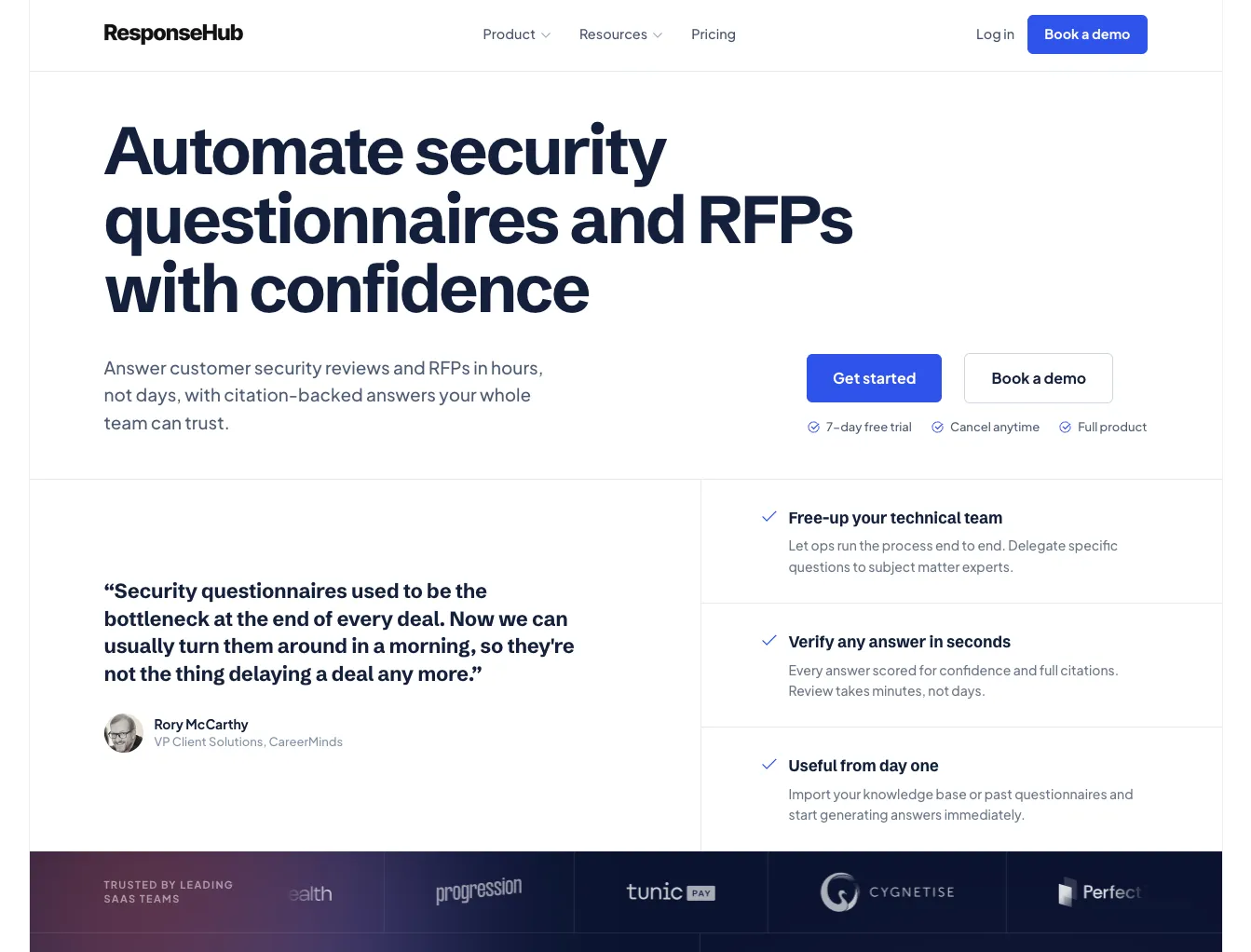
Questionnaire automationResponseHub automates security questionnaires, RFPs, and DDQs (due diligence questionnaires) using AI that's grounded in your own uploaded policies and past answers. Every AI-drafted response cites the exact policy, page, section, and sentence it drew from, with a per-answer confidence score so your team knows where to focus review time.
Import your existing answer library and policy PDFs, and the knowledge base gets smarter with every completed questionnaire.
Skypher
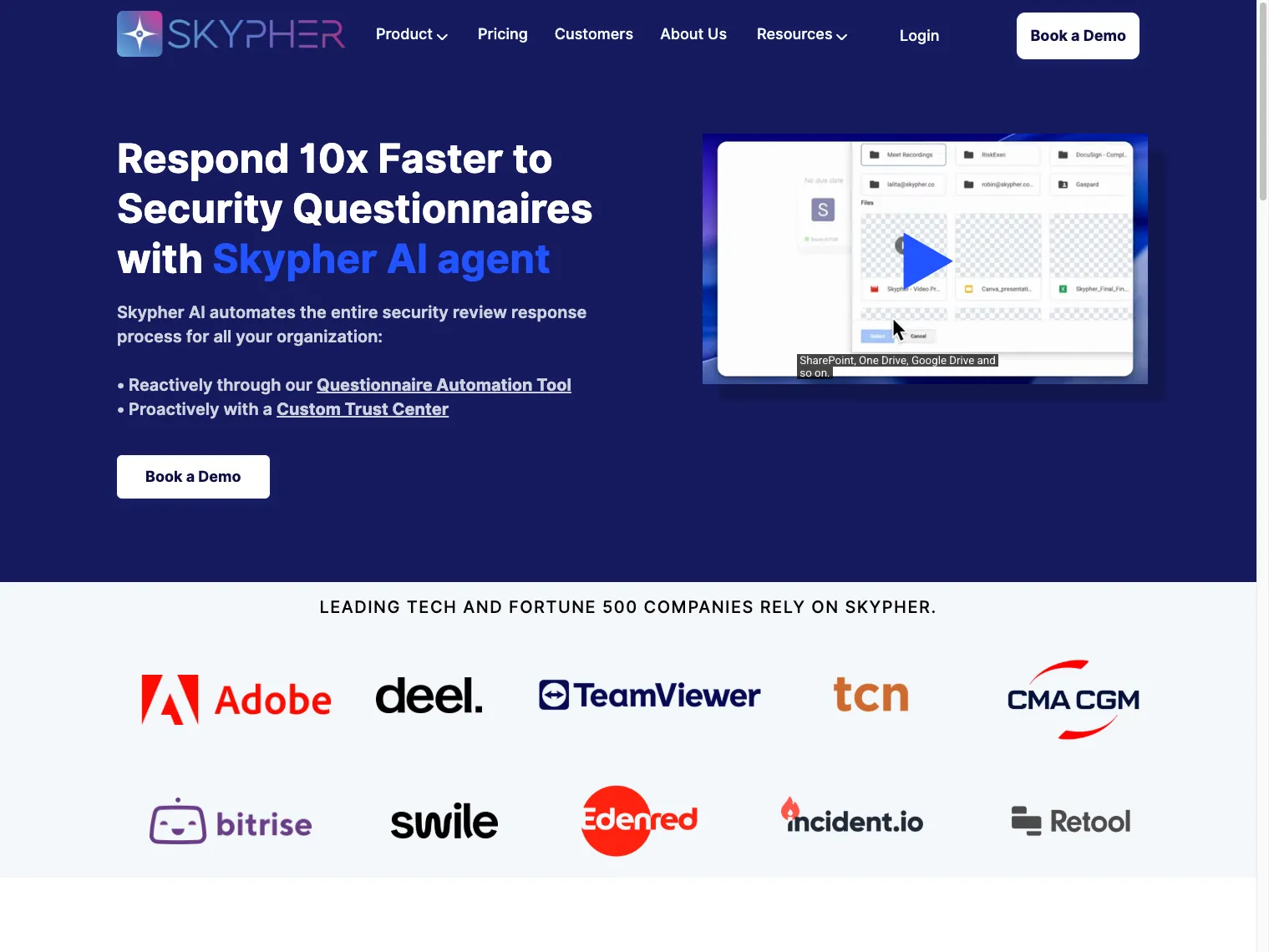
Agentic questionnaire automationSkypher positions itself as an "agentic AI" platform for security questionnaire automation (based on Skypher's website as of August 2026). It claims 96% answer accuracy and emphasizes autonomous portal automation, meaning its AI agent can work directly inside web-based security portals to fill out responses. Skypher also offers a trust portal, a public-facing page where prospects can self-serve common security documentation before sending a questionnaire at all.
At a glance
| Comparison point | ResponseHub | Skypher |
|---|---|---|
| Published pricing | Starter $124/mo, Business $332/mo | Not published — sales call required |
| Usage limits | Unlimited — no credits or fees | Not publicly documented |
| Ideal team size | Any — startups through enterprise | Teams doing 20+ questionnaires/year |
| AI citations | Exact source + confidence score | Claims 96% accuracy; depth not documented |
| Supported formats | xlsx, docx, portals via Chrome extension | Portal automation; other formats not detailed |
| Round-trip export | Yes — preserves buyer formatting | Not publicly documented |
| Free trial | 7-day, fully self-serve | Not publicly available |
| Trust portal | — | Yes, public-facing |
Skypher details sourced from Skypher's website and last verified August 2026. Details may have changed since.
How they compare, dimension by dimension
Pricing & buying experience
This is the sharpest divide between the two.
ResponseHub publishes its pricing on its website: $124/month for Starter (2 Editor seats), $332/month for Business. Every plan includes unlimited usage, unlimited Viewer seats, and no per-questionnaire fees. You can start a 7-day free trial right now, no sales call, no credit card gauntlet, set up in under 5 minutes.
Skypher does not publish pricing at all. To learn what it costs, you book a demo and go through a sales process. For teams trying to evaluate tools quickly (especially when a deal is stalled in security review), that friction is real. Gated pricing isn't inherently bad, but it does signal enterprise-level contracts, which often means longer procurement cycles and annual commitments. If your team needs to move this week, that's a problem.
AI answer quality & citations
ResponseHub takes a different approach: every AI-drafted answer cites the exact policy, page, section, and sentence it used, with a per-answer confidence score. Low-confidence answers get flagged automatically so a human reviewer can focus there instead of re-reading every response. The knowledge base is grounded in your actual policies and past completed questionnaires, not generic training data. That distinction matters when a prospect's security team asks "where did this answer come from?"
Skypher markets a 96% accuracy rate for its AI answers and uses the term "agentic AI" to describe its approach (per its website as of August 2026). What's less clear from public documentation is how that accuracy is measured, and whether answers include granular source citations (policy name, page, section, sentence) that a compliance or security reviewer can verify without going back to the source document.
Format support & portal handling
ResponseHub handles Excel spreadsheets (xlsx), Word documents (docx), and online portals via its Chrome extension. Its extraction engine is built to handle the mess of real-world questionnaires: multiple choice options, not-applicable questions, missing column headers, and unfamiliar layouts. Round-trip export preserves the buyer's original formatting, so you're not copy-pasting answers back into a spreadsheet.
Skypher's core pitch is its agentic portal automation. The AI works directly inside web-based security portals, filling in responses autonomously. If most of your questionnaire volume comes through portals (rather than spreadsheets or Word docs), that's a genuine strength. Skypher's document format support beyond portals is not publicly detailed.
Knowledge base & self-improvement
ResponseHub has a self-improving knowledge base at its core. You seed it by importing your existing answer library, old completed questionnaires, and policy documents (dragged and dropped as PDFs). Every questionnaire you complete feeds the next one. Built-in deduplication finds duplicate and stale answers so your library stays clean over time. The knowledge base exports to CSV if you ever need to move it.
Skypher references a knowledge base in its marketing, but the specifics of how it handles deduplication, answer versioning, and knowledge base seeding are not publicly documented. Its trust portal feature (where prospects can self-serve security documentation) is a related but distinct capability that ResponseHub does not offer.
Security & data handling transparency
ResponseHub publishes details about its security posture, including GDPR compliance and a DPA available on request. Customer data is not used for AI model training, and the product supports role-based permissions. For the full picture on data residency and infrastructure specifics, ResponseHub's security documentation is available directly within the product and on request.
Skypher's data residency, AI data handling, and security certifications are not publicly documented on its website. For compliance and security managers evaluating tools (especially those bound by GDPR, SOC 2 (a widely used audit standard for service organizations), or ISO 27001 (the international standard for information security management) requirements), the ability to verify these details before a sales call matters.
What teams say about ResponseHub
What surprised me was how quickly we could start testing it and seeing results. And the more questionnaires we do, the better it'll get.

Pros and cons
ResponseHub
- Transparent, published pricing. You know exactly what you'll pay before you sign up. No surprise quotes after a demo.
- Unlimited usage. No credits, no per-questionnaire fees. Volume spikes don't cost extra.
- Self-serve trial. 7-day free trial, set up in under 5 minutes. Test it on a real questionnaire before committing.
- Granular citations. Every answer cites the exact source down to the sentence, with confidence scores. Reviewers can trust the output.
- Self-improving knowledge base. Deduplication and continuous learning from completed questionnaires keep answers fresh.
- No trust portal. ResponseHub doesn't offer a public-facing trust center for proactive security documentation sharing. If that's a priority, you'll need a separate tool or Skypher.
- No fully autonomous portal agent. The Chrome extension handles portals, but it's not a hands-free agent working independently inside a portal.
- Smaller brand presence. ResponseHub is a focused, newer product. If your procurement team wants a vendor with a large G2 review base, it's still building that.
Skypher
- Agentic portal automation. For teams whose questionnaire volume is mostly portal-based, Skypher's autonomous agent approach can reduce manual effort significantly.
- Trust portal. A public-facing trust center lets prospects self-serve security docs, potentially reducing inbound questionnaire volume before it even starts.
- High stated accuracy. The 96% accuracy claim (per Skypher's website), if it holds up in practice, suggests strong AI answer quality.
- Pricing is completely gated. No published pricing, no self-serve trial. You can't evaluate cost or test the product without booking a sales call.
- Thin review base. Very few public customer reviews on G2 or Capterra, making it harder to validate claims independently.
- Limited public documentation. Key details (data residency, citation granularity, supported document formats, knowledge base mechanics) aren't available on the website.
- Positioned for higher volume. Teams doing fewer than 20 questionnaires per year may find it harder to justify the (unknown) cost.
What it costs
ResponseHub publishes its pricing: $124/month for Starter (2 Editor seats) and $332/month for Business, both with unlimited usage, no credits, and no per-questionnaire fees. Skypher does not publish pricing at all — you must book a sales call to get a quote, and there is no published free trial at the time of writing.
See full pricingSwitching from Skypher?
- Import your existing answer library and old completed questionnaires to seed the knowledge base — you don't start from scratch.
- Drag and drop your policy documents as PDFs and the AI drafts cited answers from them.
- Self-serve setup in under 5 minutes — no sales call required.
- 7-day free trial gives you time to test the migration before committing.
Which should you pick?
Our honest recommendation by situation.
You need to move fast, your team is stretched, and you don't have time for a multi-week procurement cycle just to see a price. ResponseHub's self-serve trial and published pricing let you test the tool on a real questionnaire today. Unlimited usage means your costs don't spike when a big quarter hits.
When your job is to review and approve AI-drafted answers, you need to see exactly where each answer came from. ResponseHub cites the policy, page, section, and sentence for every response, with confidence scores that tell you where to focus. That audit trail matters for SOC 2, ISO 27001, or any framework review.
If the majority of your questionnaire volume comes through web-based security portals (not spreadsheets), and your team has the budget and patience for a sales-led buying process, Skypher's agentic portal automation is a genuine differentiator. The trust portal feature can also reduce inbound volume by letting prospects self-serve common security documents.
ResponseHub does not offer a public-facing trust portal. If proactive security documentation sharing is a priority and you want it from the same vendor as your questionnaire tool, Skypher bundles both. Just know you'll need to go through a sales process to get started.
ResponseHub has a dedicated MSSP version with multiple separate client accounts under one relationship. That means you can manage questionnaires across your client base without each client needing their own subscription. Skypher's multi-client capabilities are not publicly documented.
For most teams evaluating alternatives to Skypher, ResponseHub is the stronger choice. It gives you published pricing, unlimited usage, granular AI citations grounded in your own policies, and a self-serve trial you can start right now.
Skypher earns its spot for portal-heavy enterprise teams that want agentic automation and a bundled trust portal, but its gated pricing and thin public documentation make it harder to evaluate without committing to a sales cycle. If you want to see what ResponseHub can do with your actual questionnaires, start a 7-day free trial today. No sales call needed, completely self-serve, set up in under 5 minutes.
Frequently asked questions
Does Skypher have a free trial?
As of August 2026, Skypher does not offer a publicly available free trial. You need to book a sales call to access the product. ResponseHub offers a 7-day self-serve free trial with no sales call required.
Is Skypher worth it for a small team doing under 20 questionnaires a year?
Skypher positions itself for teams handling 20 or more questionnaires per year, and its pricing is not published. For smaller teams or lower volumes, the sales process and likely enterprise-level pricing may be hard to justify. ResponseHub starts at $124/month with unlimited usage, which is easier to scale into.
Can I migrate from Skypher to ResponseHub?
Yes. ResponseHub lets you import your existing answer library and old completed questionnaires to seed the knowledge base, so you don't start from scratch. You can also drag and drop your policy documents as PDFs. The 7-day free trial gives you time to test the migration before committing.
How does Skypher's 96% accuracy claim compare to ResponseHub's approach?
Skypher markets a 96% accuracy rate (per its website), but the methodology behind that number isn't publicly documented. ResponseHub takes a different approach: every AI answer includes a per-answer confidence score and cites the exact source (policy, page, section, sentence), letting your reviewer verify each answer independently rather than relying on an aggregate accuracy claim.
Where do Skypher's product claims in this comparison come from?
All Skypher-specific details (pricing approach, accuracy claims, feature descriptions, positioning) are sourced from Skypher's public website and were last verified in August 2026. We are not affiliated with Skypher and cannot guarantee these details remain current. We recommend checking their site directly for the latest information.
Get Started
Get started in under 5 minutes with our self-serve trial or contact us for a demo
- 7-day free trial
- Cancel anytime
- Full product