

Alternatives to Vendict: ResponseHub vs Vendict for Security Questionnaires
For most ops, compliance, and security teams that want to start today with transparent pricing ($124/month) and no sales process, ResponseHub is the stronger pick. Choose Vendict if you need multilingual questionnaire support or you're specifically looking for a vendor moving toward managed third-party risk.
Security questionnaire tools that actually cite their sources are still rare. Vendict and ResponseHub both do it, which makes them a natural head-to-head if you're searching for alternatives to Vendict. Vendict is an AI-native platform with strong multilingual support, but its pricing is gated behind a sales conversation and the product is shifting toward broader managed TPRM. ResponseHub publishes its pricing, offers a self-serve free trial, and stays focused entirely on questionnaire automation. This page compares the two on pricing, AI quality, format handling, and product focus — without sitting through two separate sales pitches (though only one of these tools would ask you to).
This one is a locked gate versus an open road: Vendict keeps its pricing behind a sales conversation, while ResponseHub publishes its prices and lets you put the product to work on a real questionnaire today.
Both tools ground AI answers in your documentation and cite their sources — still rare in this category. The real differences are transparency, time to value, multilingual support, and where each product is headed.
Which one is right for you?
Choose ResponseHub if…
- You want published pricing (Starter at $124/month) and a self-serve 7-day trial you can start today.
- You want unlimited usage plus per-answer confidence scores that tell reviewers exactly where to focus.
- You want round-trip export back into the buyer's original Excel or Word file, and online portal support via the Chrome extension.
Choose Vendict if…
- You regularly handle questionnaires in languages other than English — Vendict advertises multilingual support.
- You're an enterprise team that wants questionnaire automation from a vendor moving toward managed TPRM.
- You're comfortable with a sales-led evaluation and procurement process to get pricing.
ResponseHub
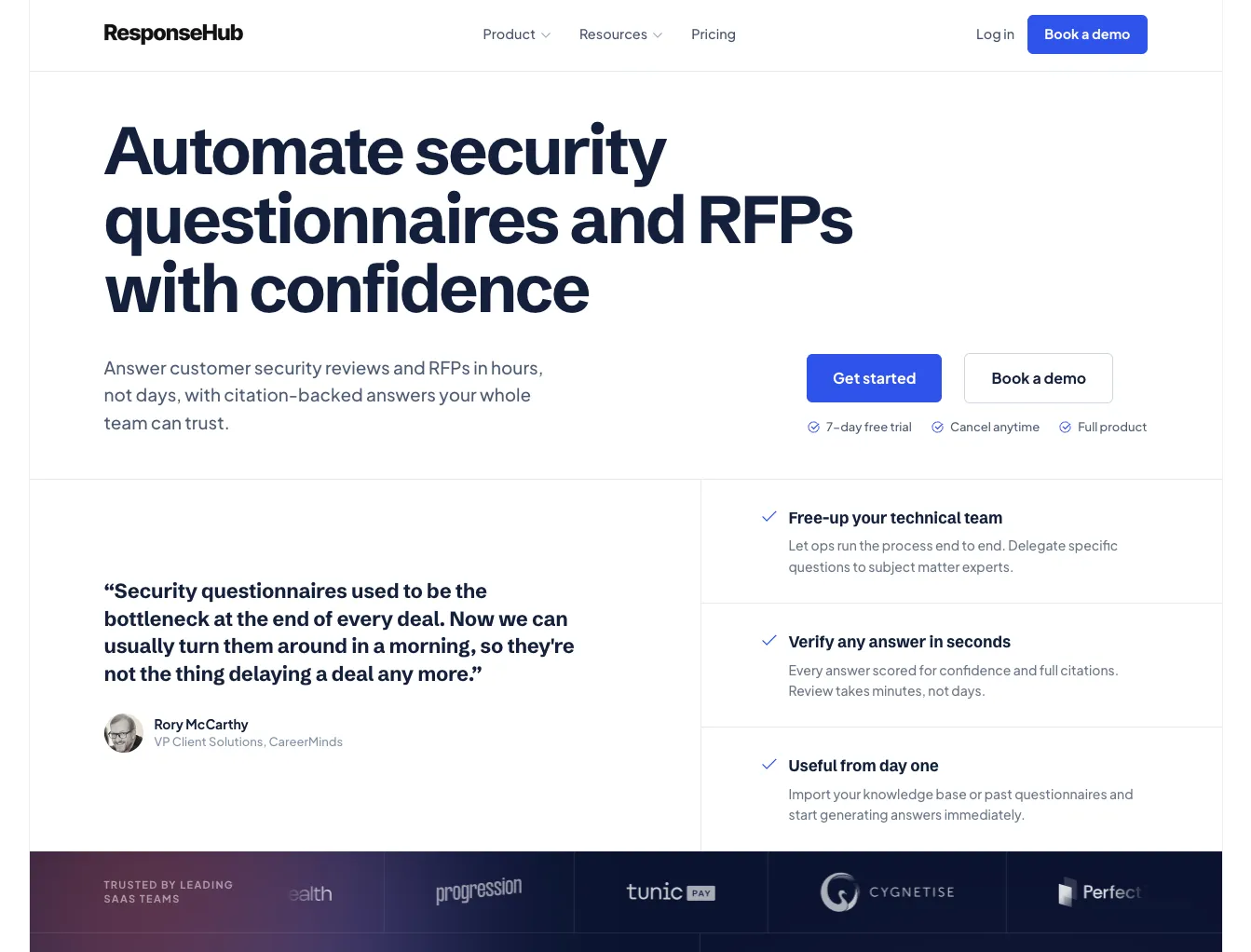
Questionnaire automationResponseHub is a focused AI tool for automating security questionnaires, RFPs, and DDQs. You upload your policies as PDFs, import your existing answer library and old completed questionnaires, and the AI drafts answers grounded in your actual documentation, with citations down to the exact page, section, and sentence. Every completed questionnaire feeds back into a self-improving knowledge base.
Vendict
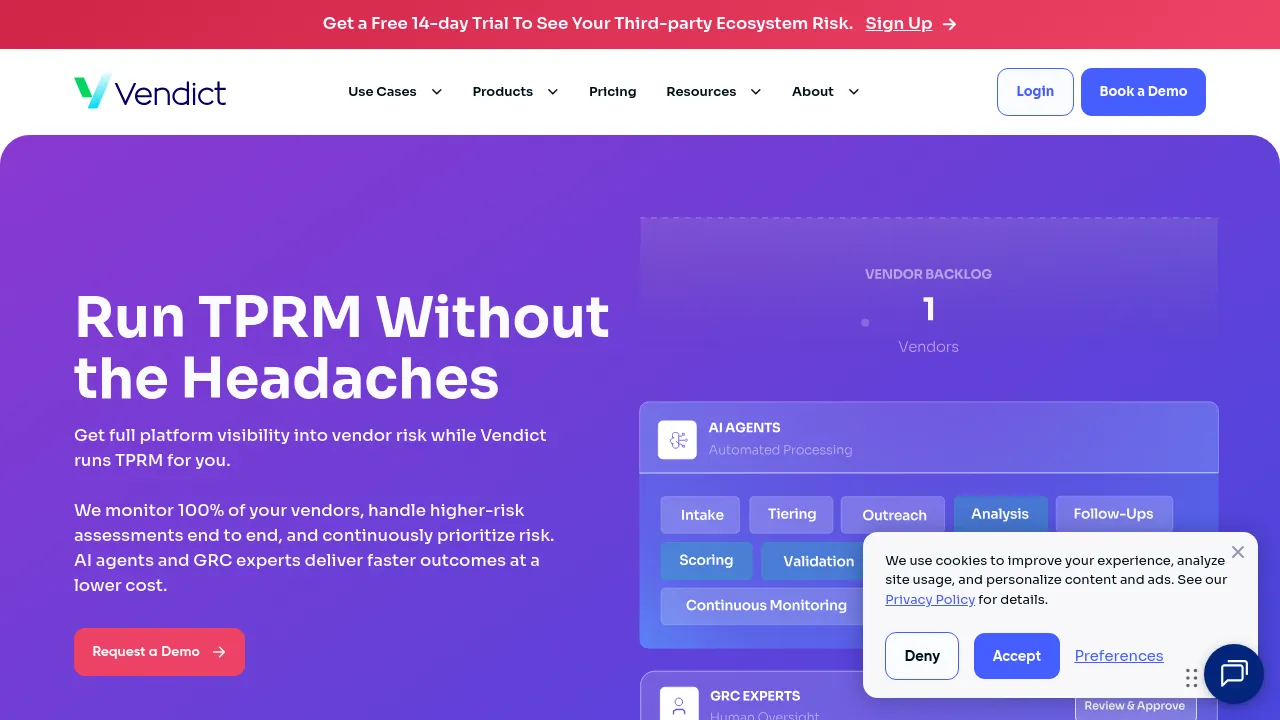
AI questionnaires / TPRMVendict is an AI-native platform for security questionnaires and RFPs that also offers per-answer citations. The product has been expanding its scope toward managed TPRM (third-party risk management), positioning itself for enterprise buyers who want questionnaire automation bundled with broader vendor risk workflows. Vendict also supports multilingual questionnaire handling, which is a genuine differentiator for teams dealing with non-English buyers or global compliance reviews.
At a glance
| Comparison point | ResponseHub | Vendict |
|---|---|---|
| Published pricing | Starter $124/mo, Business $332/mo | Not publicly listed (sales-gated) |
| Usage limits | Unlimited, no credits or per-questionnaire fees | Not publicly documented |
| Ideal team size | Any size: startups through enterprise | Appears enterprise-focused |
| AI citations | Exact policy, page, section, sentence + confidence scores | Yes — per-answer citations |
| Supported formats | Excel, Word, online portals via Chrome extension | Not publicly documented in detail |
| Round-trip export | Yes — preserves buyer formatting | Not publicly documented |
| Free trial | 7 days, self-serve, no sales call | Not publicly documented |
| Data residency / AI training | EU-hosted, zero AI data retention, no training on customer data | Not publicly documented |
Competitor details as published on their site, last verified August 2026.
How they compare, dimension by dimension
Pricing and transparency
This is the sharpest difference between the two.
ResponseHub publishes exact prices on its website: $124/month for Starter (2 Editor seats) and $332/month for Business. All plans include unlimited usage, unlimited Viewer seats, and you only pay for Editor seats. There are no credits, no per-questionnaire fees, and no surprises on your invoice.
Vendict lists tier names on its pricing page but leaves the numbers blank. Getting a price means booking a call with their sales team. That's common in enterprise software, but it means you can't evaluate cost until you've invested time in a sales conversation. For teams that want to compare options quickly and move on, that friction matters.
If your budget is modest or you need fast internal approval, a published price you can drop into a Slack message to your manager is worth a lot.
AI answer quality and citations
Both tools ground AI answers in your own uploaded documentation and provide per-answer citations.
ResponseHub cites the exact policy name, page, section, and sentence, and attaches a confidence score to each answer so your reviewer knows exactly where to focus. The knowledge base is self-improving: every completed questionnaire feeds back in, and built-in deduplication flags duplicate or stale answers.
Vendict also offers cited AI answers, which puts it ahead of many competitors that rely on generic training data. However, with only around 3 reviews on G2 as of mid-2026, it's difficult to independently verify the consistency and accuracy of Vendict's AI output at scale.
ResponseHub's confidence scoring gives reviewers a concrete signal for where human judgment is needed, which is a practical advantage when you're reviewing hundreds of answers.
Format handling and export
ResponseHub imports questionnaires in Excel (xlsx), Word (docx), and directly from online security portals via its Chrome extension. Its extraction engine handles messy real-world questionnaires: multiple choice options, not-applicable questions, missing column headers, and unfamiliar layouts. Answers export back into the buyer's original spreadsheet or document format, preserving their formatting. The knowledge base also exports to CSV.
Vendict's supported import and export formats are not documented in detail on its website. If format coverage matters to you (and it should, because buyers send questionnaires in every conceivable shape), ask Vendict's sales team to confirm which formats they handle before committing.
Multilingual support
ResponseHub does not advertise dedicated multilingual questionnaire handling. For primarily English-language questionnaire workflows, this won't matter. For teams dealing with French, German, Japanese, or other non-English questionnaires on a regular basis, Vendict's multilingual capability is a genuine differentiator worth investigating.
If your team regularly handles questionnaires in languages other than English, Vendict has a real edge here. It advertises multilingual questionnaire support, which is valuable for companies selling into markets across Europe, Asia, or Latin America where buyers may issue questionnaires in their local language.
Setup, trial, and time to value
You can sign up for ResponseHub's 7-day free trial, upload your policies, import your existing answer library, and start completing a real questionnaire in under 5 minutes. No sales call, no procurement process, no waiting for an account to be provisioned.
Vendict does not clearly offer a self-serve free trial. Getting started means contacting their team, which introduces calendar delays. For a compliance manager who needs to respond to a questionnaire this week (not next month), that gap in time to value is significant.
The ability to try the product on a real questionnaire before you buy is the fastest way to know if it actually works for your documents and your workflow.
Product focus and direction
ResponseHub does one thing: security questionnaire, RFP, and DDQ automation. It is not a feature inside a larger GRC suite, and it is not pivoting toward a different market. That focus means product development is entirely directed at making questionnaire automation better.
Vendict is expanding into managed TPRM (third-party risk management), which means the product roadmap is splitting attention between questionnaire automation and broader vendor risk capabilities. If you want a tool that might eventually cover both questionnaires and third-party risk assessment, that trajectory could be appealing. If you want a tool laser-focused on getting questionnaires done, a broader product scope can mean slower iteration on the features you care about most.
What teams say about ResponseHub
Questionnaires used to interrupt sales, product and engineering all at once. Now ownership is clearer and the work moves forward without constant chasing.

Pros and cons
ResponseHub
- Transparent, published pricing. You know the cost before you talk to anyone: $124/month or $332/month, unlimited usage, pay only for Editor seats.
- Self-serve free trial. Sign up, upload policies, and test on a real questionnaire in under 5 minutes. No sales call required.
- Cited AI answers with confidence scores. Every answer references the exact policy, page, section, and sentence. Confidence scores tell reviewers where to focus.
- Self-improving knowledge base. Every completed questionnaire feeds back in. Built-in deduplication catches stale or duplicate answers.
- Round-trip export. Answers export back into the buyer's original xlsx or docx, preserving formatting.
- Focused product. Questionnaire automation is the entire product, not a side feature.
- No multilingual support advertised. Teams handling non-English questionnaires regularly may find this limiting.
- Smaller brand presence. ResponseHub doesn't have the enterprise brand recognition of larger GRC platforms, which can matter in internal procurement discussions.
- No broader GRC or TPRM capabilities. If you need vendor risk management alongside questionnaires, you'll need a separate tool.
Vendict
- Per-answer citations. Like ResponseHub, Vendict grounds answers in your documentation and cites sources, which is better than tools relying on generic AI.
- Multilingual questionnaire support. A genuine advantage for teams working across languages and geographies.
- TPRM direction. If you want questionnaire automation and broader third-party risk management from one vendor eventually, Vendict's roadmap may align with that.
- Pricing is not published. You cannot evaluate cost without engaging their sales team, which slows down comparison and internal approval.
- Very thin review coverage. With roughly 3 G2 reviews as of mid-2026, it's hard to independently assess real-world reliability and user satisfaction.
- No clear self-serve trial. Getting started requires a sales conversation, which introduces delay.
- Splitting focus. Expanding into managed TPRM means product attention is divided between questionnaire automation and a broader risk platform.
What it costs
ResponseHub publishes its pricing: Starter at $124/month (2 Editor seats) and Business at $332/month, with unlimited usage and unlimited Viewer seats on every plan, plus a self-serve 7-day free trial. Vendict lists tier names on its website but does not publish pricing figures — you'll need to contact their sales team for a quote.
See full pricingSwitching from Vendict?
- Import your existing answer library and old completed questionnaires to seed your ResponseHub knowledge base.
- Upload your policy documents as PDFs — the AI grounds and cites answers from them immediately.
- Most teams are up and running within minutes of signing up.
- 7-day free trial, fully self-serve, no sales call required.
Which should you pick?
Our honest recommendation by situation.
You need a tool you can adopt this week without a procurement cycle. ResponseHub's published pricing, self-serve trial, and unlimited usage model mean you can test it on real questionnaires immediately. The round-trip export back into the buyer's original format saves your team from reformatting work that eats into deal timelines.
If your buyers regularly send questionnaires in French, German, Japanese, or other non-English languages, Vendict's multilingual support addresses a real gap. The gated pricing is less of an obstacle for enterprise procurement teams accustomed to vendor evaluations, and the broader TPRM direction may align with your compliance roadmap.
If your organization is actively building out a third-party risk management program and you want a vendor whose product roadmap is headed in that direction, Vendict's pivot toward managed TPRM could be a strategic fit. Just confirm their current TPRM capabilities match your timeline, since the product is still evolving.
At $124/month for Starter with 2 Editor seats and unlimited usage, ResponseHub is the most cost-predictable option. You can start your 7-day free trial, import your existing answer library, and begin completing questionnaires the same day. No sales calls, no waiting for a quote.
ResponseHub offers a dedicated MSSP version with multiple separate client accounts under one relationship. This matters because many compliance platforms (like Vanta or Drata) tie their questionnaire features to the client's own platform subscription, meaning an MSSP can't simply buy and operate it on a client's behalf unless that client already pays for the platform. Vendict does not publicly document a comparable multi-client or partner offering. If you're a managed security provider handling questionnaires across a portfolio of clients, ResponseHub's MSSP structure lets you scale that work with the same team without requiring each client to hold their own license.
For most teams looking for alternatives to Vendict, ResponseHub is the stronger choice. It gives you transparent pricing, a self-serve 7-day trial, cited AI answers with confidence scores, and a product entirely focused on getting questionnaires done.
Vendict earns its spot for enterprise teams that need multilingual support or want a vendor heading toward broader TPRM, but its gated pricing, thin review coverage, and shifting product focus make it harder to evaluate and commit to.
If you want to see how ResponseHub handles your actual questionnaires, start a free trial right now: no sales call needed, completely self-serve, set up in under 5 minutes.
Frequently asked questions
Does Vendict have a free trial?
Vendict does not clearly advertise a self-serve free trial on its website as of August 2026. Getting started appears to require contacting their sales team for a demo and quote. ResponseHub, by contrast, offers a 7-day free trial you can start immediately without a sales call.
Can I migrate from Vendict to ResponseHub?
Yes. ResponseHub lets you import your existing answer library and old completed questionnaires to seed your knowledge base. You can also upload your policy documents as PDFs. Most teams are up and running within minutes of signing up.
Is Vendict worth it for a small team?
It's hard to say without knowing the price. Vendict does not publish pricing, so a small team would need to invest time in a sales conversation before knowing whether it fits their budget. ResponseHub starts at $124/month with 2 Editor seats and unlimited usage, which gives small teams a clear, predictable cost from day one.
Does ResponseHub support non-English questionnaires?
ResponseHub does not advertise dedicated multilingual questionnaire support. If you regularly handle questionnaires in languages other than English, Vendict's multilingual capability may be a better fit. For English-language workflows, ResponseHub covers the full range of formats: Excel, Word, and online portals via its Chrome extension.
Get Started
Get started in under 5 minutes with our self-serve trial or contact us for a demo
- 7-day free trial
- Cancel anytime
- Full product