

ResponseHub vs Claude: General AI or Purpose-Built Questionnaire Tool?
Keep Claude if questionnaires are rare and you enjoy owning the checking and copy-paste. Choose ResponseHub when volume is real: cited answers drawn from your own policies, confidence scores, portal extraction, and export back into the buyer's file, at $124/month with unlimited usage and a 7-day self-serve trial.
Claude might be the best writing model you can point at a security questionnaire, and if you are already pasting questions into it, this page is for you. The comparison is not about intelligence, it is about everything wrapped around it: ResponseHub is a system built only for questionnaires, RFPs, and DDQs.
This choice is a brilliant generalist and a specialist walking into the same job interview: one can talk about anything, the other has done this exact job ten thousand times.
This page compares both across citations, exports, workflow, and real cost, so you can decide whether a top-tier general assistant is still the right tool for the questionnaires arriving in your inbox.
See also: ResponseHub vs ChatGPT · How ResponseHub compares to purpose-built rivals
Which one is right for you?
Choose ResponseHub if…
- Questionnaires are a recurring part of your revenue motion: unlimited usage at $124/month keeps the fee flat whether the quarter brings five questionnaires or fifty.
- You need enforced grounding: answers drawn only from your own policies and past questionnaires, cited to the exact policy, page, section, and sentence, with confidence scores.
- You want the whole pipeline covered: portal extraction in, round-trip export back into the buyer's original file, formatting intact.
- You're an MSSP or vCISO serving multiple clients and need separate client accounts, each with its own isolated knowledge base.
Choose Claude if…
- Questionnaires are rare (a couple a year) and you can own the hand-verification and copy-paste yourself.
- You want a top-tier general assistant for policy drafting, research, and everything beyond questionnaires.
- You value long-context strength: Claude can hold a 100-page security policy and a full questionnaire in view at once.
ResponseHub
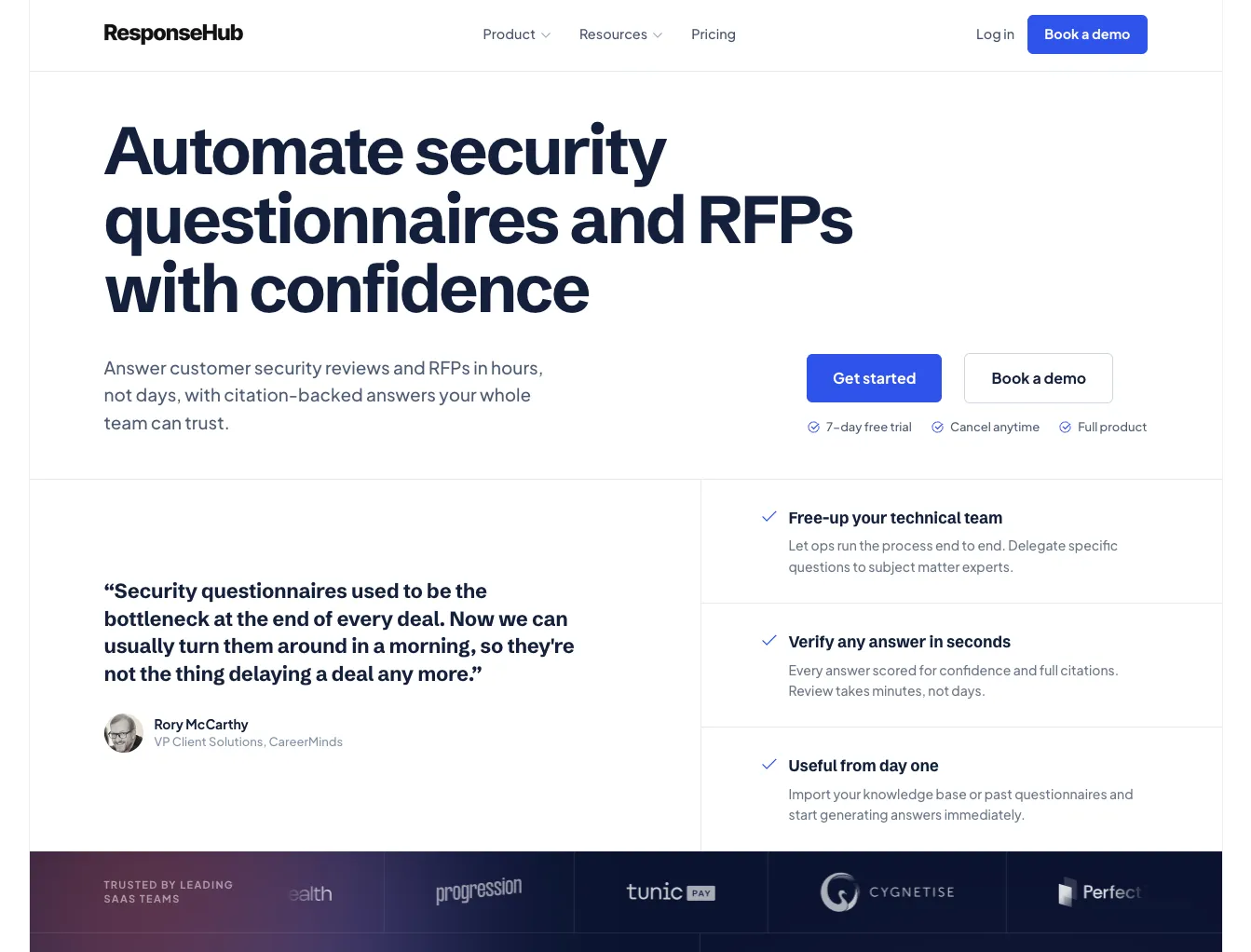
Questionnaire automationResponseHub is a purpose-built security questionnaire tool. It ingests questionnaires as Excel, Word, or web portals (via Chrome extension), drafts answers grounded exclusively in your uploaded policy PDFs and imported past questionnaires, cites the exact policy, page, section, and sentence per answer, and attaches a confidence score so reviewers focus where it counts. Finished answers export back into the buyer's original file with formatting intact, and every completed questionnaire strengthens the knowledge base.
Claude
General AI chatbotClaude is Anthropic's AI assistant, notable for strong long-document handling and careful writing, both genuinely relevant to questionnaire work. Claude Projects store reference documents, and file uploads let it read a questionnaire and your policies side by side. It remains a general assistant: no citation guarantee tied to your policy text, no questionnaire extraction, no export pipeline, no review workflow.
At a glance
| Comparison point | ResponseHub | Claude |
|---|---|---|
| Published pricing | Starter $124/mo, Business $332/mo | Free; Pro $20/mo; Max from $100/mo; Team from $25/seat/mo |
| Usage limits | Unlimited questionnaires, no credits | Usage limits by tier |
| Built for | Security questionnaires, RFPs, DDQs | General assistance |
| AI citations | Exact policy, page, section, sentence, with confidence scores | Can quote uploaded documents when asked; no guarantee or confidence signal |
| Questionnaire formats | Excel (xlsx), Word (docx), online portals via Chrome extension | Reads uploaded files; no portal access |
| Round-trip export | Yes, buyer's original file, formatting preserved | No; manual transfer |
| Knowledge base | Self-improving answer library with deduplication | Projects hold documents; no answer library |
| Data training policy | Never trains on customer data; EU hosting, zero AI retention | Consumer plans may train unless opted out (since Sept 2025); commercial plans excluded |
| Free trial | 7-day, self-serve | Free tier |
| Best fit | Recurring questionnaire volume | Occasional, low-stakes use |
Competitor details last verified: August 2026.
How they compare, dimension by dimension
Where Claude Genuinely Shines
The honest caveat: none of that is a system. Quality drafting is one step of a pipeline that also includes extraction, verification, formatting, and institutional memory, and those steps are where the hours go.
Credit where due. Claude's long-context handling means it can hold a 100-page security policy and a full questionnaire in view at once, and its drafting quality on nuanced questions (data flow explanations, subprocessor descriptions, framework mapping) is arguably the best of any general assistant. For a founder facing their second questionnaire ever, Claude plus a Project full of policies is a legitimate setup.
Citations You Can Defend
When a customer's security team asks why you answered yes to question 141, "our AI wrote it" is not an answer.
ResponseHub attaches the receipt to every draft: the policy name, page, section, and sentence it drew from, plus a confidence score that tells reviewers which answers deserve scrutiny. Low-confidence answers surface themselves.
Claude will quote your documents when asked, and does it well, but the grounding is best-effort per prompt, not enforced by the product. Across 300 answers you cannot tell which were quoted, which were paraphrased, and which were improvised, so a careful team verifies all of them. That verification pass is the hidden cost of every chatbot workflow.
From Inbox Back to Buyer
The questionnaire lifecycle starts in a portal or a spreadsheet and must end in exactly the same place.
ResponseHub covers both ends: robust extraction handles multiple-choice grids, not-applicable questions, and missing headers; the Chrome extension lifts questions out of web-based security portals; and round-trip export drops approved answers back into the buyer's original xlsx or docx, formatting untouched.
Claude handles the middle beautifully and neither end at all. It cannot see a portal, and moving its answers into the buyer's template is manual work that scales linearly with volume. Fifty questions is an evening. Three hundred is a lost week.
Memory, Workflow, and Data Handling
ResponseHub's knowledge base records approved answers, deduplicates near-identical questions, flags stale answers after policy changes, and can be seeded by importing your existing answer library and old questionnaires. Editor and Viewer roles plus audit logging cover the who-approved-what question that chatbots cannot answer.
ResponseHub never trains on customer data, hosts in the EU, and runs AI via AWS Bedrock EU regions with zero retention, with a DPA available.
A Claude Project stores documents; it does not remember decisions.
On data: since September 2025, Claude's consumer plans (Free, Pro, Max) may use chats for model training unless you opt out, with retention extending to five years for opted-in users; Team, Enterprise, and API usage are excluded. If your team uses personal Claude accounts for policy work, that is worth fixing regardless of tooling.
The Price of the Pipeline
ResponseHub's unlimited usage means the fee is flat whether the quarter brings five questionnaires or fifty, which is precisely when a $20 subscription becomes the expensive option.
Claude Pro at $20/month is cheaper than ResponseHub at $124/month, and for rare questionnaires that is the end of the analysis. The equation flips with volume: a chatbot workflow costs roughly a half day of skilled time per questionnaire in extraction, verification, and formatting. At four questionnaires a month, that is two days of monthly labor to save $104.
What teams say about ResponseHub
Security questionnaires used to be the bottleneck at the end of every deal. Now we can usually turn them around in a morning, so they're not the thing delaying a deal any more.

Pros and cons
ResponseHub
- Enforced grounding. Answers come only from your policies and past questionnaires, cited to the sentence.
- Confidence scores. Review effort lands on genuinely uncertain answers instead of all of them.
- Full pipeline coverage. Portal extraction in, round-trip export out, formatting preserved.
- Institutional memory. Deduplicated, self-improving answer library with audit logging.
- Defensible data posture. No training on customer data, EU residency, zero AI retention, DPA available.
- Does one thing. No general assistance, no long-form writing help outside questionnaires, RFPs, and DDQs.
- Higher subscription cost. $124/month against Claude Pro's $20/month; the gap only closes with volume.
Claude
- Excellent drafting quality. Arguably the strongest general model for nuanced security-question prose.
- Long-context strength. Holds large policies and full questionnaires in view simultaneously.
- Projects for reference docs. A workable lightweight setup for occasional questionnaires.
- Low entry price. Free tier and $20/month Pro.
- No enforced citations or confidence signal. Verification of every answer stays a human job.
- No extraction, portal access, or export. Both ends of the pipeline are manual.
- No answer library or review workflow. Nothing carries over; no approval audit trail.
- Consumer plans may train on chats unless opted out. Policy documents belong on commercial plans at minimum, with 5-year retention for opted-in consumer accounts.
What it costs
ResponseHub is $124/month (Starter, 2 Editor seats) or $332/month (Business), with unlimited usage on both plans. Claude's published pricing runs from a free tier through Pro at $20/month, Max from $100/month, and Team from $25 per seat/month, with Enterprise custom. Claude Pro is cheaper on subscription price, but a chatbot workflow costs roughly a half day of skilled time per questionnaire in extraction, verification, and formatting, and the math flips at roughly monthly questionnaire volume.
See full pricingMoving beyond copy-paste with Claude?
- Import your existing answer library and past questionnaires to seed the knowledge base on day one.
- Upload your policy PDFs and the AI drafts answers grounded exclusively in your own documentation, cited to the sentence.
- Setup is completely self-serve and takes under 5 minutes, no sales call.
- 7-day free trial: run a real questionnaire through it, export back to the buyer's template, and decide with evidence.
- Keep Claude for policy drafting, research, and general work; the tools complement rather than compete.
Which should you pick?
Our honest recommendation by situation.
A couple of questionnaires a year does not justify dedicated tooling. Set up a Project with your policies, ask Claude to quote sources for every answer, and verify by hand. It is slow, but at this volume slow is fine. Opt out of training in settings first.
Recurring volume is where the pipeline gaps compound: extraction time, verification time, export time, and no memory between questionnaires. ResponseHub removes all four, and unlimited usage keeps cost flat as volume grows. Seed the knowledge base with your answer library and past questionnaires on day one.
Use both, with a clean split. Your commercial Claude plan is excluded from training and stays excellent for policy drafting, research, and general work. Route the questionnaire pipeline through ResponseHub, where citations, round-trip export, and the audit trail live. The tools complement rather than compete.
Running multiple clients through one chatbot account mixes confidential policy sets with no isolation and no audit trail, which fails the standards you advise clients on. ResponseHub's dedicated MSSP version provides separate client accounts under one relationship, each with its own isolated knowledge base.
A single 400-question enterprise review is exactly what the 7-day self-serve trial is for: upload policies, run the questionnaire through it, export back to the buyer's template, and decide with evidence. If it saves the week it usually saves, keep it; if not, you spent nothing.
Claude is a superb writer and a fair choice for the occasional questionnaire, handled carefully on a commercial plan. But writing was never the bottleneck: extraction, verification, export, and institutional memory are, and those are product problems no prompt solves.
If questionnaires are a recurring part of your revenue motion, run them through a system that cites its sources and hands the buyer back their own spreadsheet. ResponseHub's trial is free for 7 days, no sales call, completely self-serve, set up in under 5 minutes.
Frequently asked questions
Can Claude answer security questionnaires?
Yes, and its drafting quality on individual answers is excellent, especially with your policies uploaded to a Project. What it lacks is the pipeline: no enforced citations, no confidence scores, no portal extraction, no export back into the buyer's file, and no answer library. For occasional use that is acceptable; at volume it is the bottleneck.
Does Claude train on my data?
On consumer plans (Free, Pro, Max), chats may be used for model training unless you opt out, a policy in effect since September 2025, with data retention extending to five years for opted-in users. Team, Enterprise, and API usage are excluded. ResponseHub never trains on customer data and runs AI in EU regions with zero retention.
Is ResponseHub just a wrapper around models like Claude?
ResponseHub runs AI via AWS Bedrock in EU regions, but the model is a small part of the product. The value is the system around it: questionnaire extraction, enforced grounding in your policies with sentence-level citations, confidence scoring, round-trip export, and a deduplicated answer library that improves with every questionnaire.
Which is cheaper for security questionnaires, Claude or ResponseHub?
Claude Pro is cheaper on subscription price: $20/month against ResponseHub's $124/month. Factor in the manual work a chatbot leaves behind (verification of every answer, copy-paste into the buyer's template) and the math flips at roughly monthly questionnaire volume. ResponseHub's usage is unlimited, so heavy quarters cost the same.
Get Started
Get started in under 5 minutes with our self-serve trial or contact us for a demo
- 7-day free trial
- Cancel anytime
- Full product